





 For all latest news, follow the Daily Sun's Google News channel.


There is a definitive maxim in global energy circles: “The cheapest megawatt is the one you never have to generate.”
As Bangladesh grapples with a volatile global fuel market, this hidden “fuel source”, efficiency, remains the only one that does not require a billion-dollar loan or a decade-long wait for a deep-sea discovery.
Yet, a walk through the industrial belts of Gazipur or the aging state-owned power stations of Ashuganj reveals a nation bleeding energy at a rate that is structurally unsustainable.
While the country has made significant strides – improving energy efficiency by 13.64% over the last decade and avoiding approximately $3.3 billion in import bills in the 2023-24 fiscal year alone – progress is stalling exactly when it is needed most.
From legacy boilers in the textile sector to a national grid designed for a bygone era, the staggering inefficiency of the energy system has become a “silent tax” on every citizen and business.
The captive power conundrum
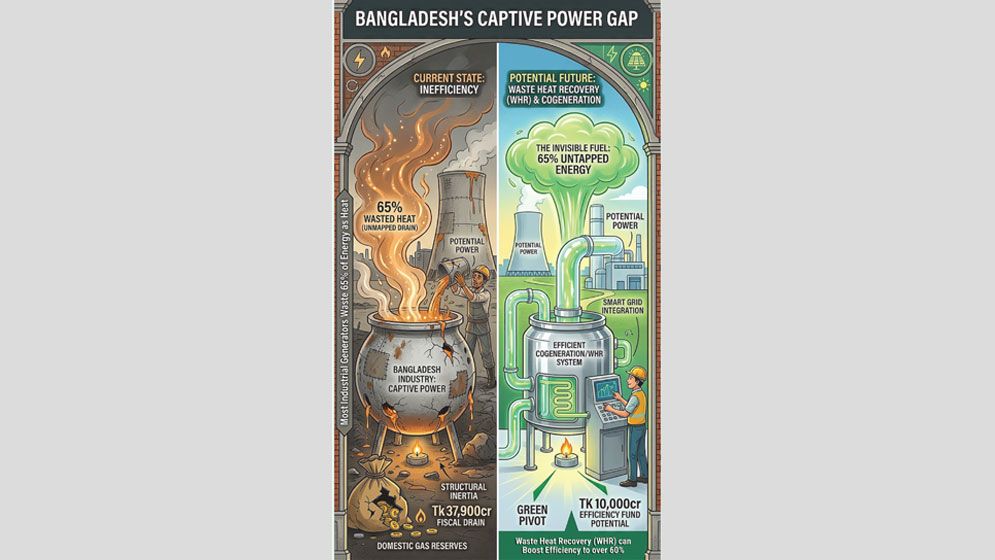
For decades, the backbone of Bangladesh’s industrial success was “captive power” – gas-fired generators sitting inside factory compounds, acting as a buffer against an unreliable national grid. Today, as domestic gas reserves dwindle – with Petrobangla reporting that recoverable reserves of 8.5 trillion cubic feet may last only eight to eleven more years—these generators have become a fiscal liability.
The Institute for Energy Economics and Financial Analysis (IEEFA) notes that industry and households consume two-thirds of the country’s energy, yet much of this is squandered.
Many captive units operate at thermal efficiencies as low as 30% to 35%. The remaining energy is literally vanished into thin air as waste heat.
“Our economy is virtually stagnant due to the gas shortage,” noted researchers at a recent energy discourse.
If the 4,000-plus garment factories were incentivised to adopt Waste Heat Recovery (WHR) and Cogeneration systems, the resulting gas savings could potentially power several small towns without burning a single extra cubic foot of fuel.
However, the transition is stalled by a regulatory “duty wall”.
Mohammed Sohel, director of the BGMEA and managing director of Bangla Poshak Ltd, told the Daily Sun that the current framework is stifling progress.
“Our energy policies remain utility-centric when they must become industry-centric,” Sohel noted, adding, “Without wheeling policies and a robust energy credit system, we are effectively disincentivising the very efficiencies that could save our industrial base.”
According to World Bank data, implementing such demand-side efficiency measures could save up to 14.3% of the total primary energy requirement by 2030.
However, the Bangladesh Power Development Board (BPDB) maintains a different fiscal perspective. A senior director at the state utility argued that Waste Heat Recovery technology is often “economically unviable” in the local context.
Speaking to the Daily Sun on condition of anonymity, the official noted that when production costs significantly exceed the domestic selling price, the resulting financial gap places a direct strain on a subsidised economy—an argument that effectively sidesteps the multi-billion-taka cost of the primary fuel currently being wasted.
The ‘gas-guzzlers’: Legacy of the old and cold
Perhaps the most glaring inefficiency lies in our aging state-owned power plants. Many units have long passed their retirement age, consuming vast amounts of gas to produce a fraction of the electricity a modern combined-cycle plant would generate.
The BPDB, however, describes the continued use of these plants as a “derated capacity” necessity.
The director clarified that while modernisation is a continuous process, there is no “magic switch” to replace the old guard.
“Specific projects for every site don’t exist; instead, we rely on a sequence of upgrades,” the official said, defending the utility’s incremental approach.
Shahid Shamsu, an oil and gas professional with over 20 years of experience, argues that ensuring energy security requires a “hybrid approach,” which includes extending the production plateau of existing fields and addressing power needs through efficiency.
A world-standard policy would demand a “Repowering” mandate – decommissioning the “gas-guzzlers” and upgrading existing sites with modern turbines. Instead, the state continues to pump expensive, imported LNG into inefficient plants because the political and administrative cost of decommissioning remains high.
A grid built for yesterday
While the government has expanded the reach of the grid, the quality of that infrastructure remains a critical bottleneck. Independent observers estimate system loss (theft/unauthorised connections) in the energy sector at around 12%-13%, even as official figures from Petrobangla cite lower numbers.
By any measure, the loss is staggering; Petrobangla’s own figures show that 2,036 million cubic metres of gas were lost during distribution, costing the national exchequer approximately Tk37,900 crore.
When asked about the slow pace of infrastructure reform, the BPDB director told the Daily Sun that expectations must be tempered.
“System loss cannot be reduced overnight — it is not a ‘switch’ you can simply press,” the official noted, adding that the utility relies on gradual maintenance rather than a dedicated “magic” budget for loss reduction.
Shahriar Ahmed Chowdhury, founding director of the Centre for Energy Research at UIU, points out that the nature of the future grid must change.
“A modern grid must handle decentralised generation, bidirectional flows, and real-time balancing,” he says.
This requires a fundamental redesign – moving from a one-way flow to a “Smart Grid” equipped with advanced forecasting and automated controls.
Currently, the lack of such an intelligent system means that even when industries produce surplus solar energy, it cannot be effectively fed back into the grid during peak times or grid instability.
The human and fiscal cost
The price of this inefficiency is not just measured in megawatts. A recent roundtable revealed that 86% of electricity consumption in Bangladesh currently depends on fossil fuels.
This reliance contributes significantly to air pollution, which reduces average life expectancy by 6-7 years and causes the deaths of more than one lakh people every year.
Economically, the “inefficiency tax” is compounded by currency volatility. In 2019, the exchange rate stood at Tk84 per dollar.
By 2025, it has reached approximately Tk123. This means a $1 billion fuel bill that once required Tk8,400 crore now costsroughly Tk12,300 crore – solely because of exchange rate movements. When this expensive fuel is burned in plants with 30% efficiency, the economic waste is doubled.
This “efficiency leak” extends far beyond the factory floor and into the nation’s fields.
BGMEA Director Sohel pointed out that the continued reliance on 1.3 million diesel-powered irrigation pumps represents a massive fiscal haemorrhage.
“Converting diesel irrigation to solar isn’t just a green project; it is a fiscal recovery plan,” he argued.
“We are allowing a Tk25,600 crore leak every year — money that is literally going up in smoke while our foreign exchange reserves struggle.”
M Zakir Hossain Khan, CEO of Change Initiative, warns that as subsidies are eventually withdrawn, industries could face electricity costs as high as Tk20 per kWh.
“Renewable energy and efficiency are the only viable paths for industrial competitiveness,” Zakir said.
He proposed that a carbon tax could generate Tk10,000 crore annually, which could be specifically earmarked to fund industrial efficiency upgrades and “Smart Grid” infrastructure.
The BPDB director confirmed that while hydro-imports from Nepal are a priority to offset these costs, the technical path is hostage to regional diplomacy.
“We are ready to import, but the tripartite grid connection requires Indian approval, which is yet to be secured,” the official noted, highlighting how the nation’s efficiency remains tethered to external transit hurdles.
A choice for the FY27 budget
As the government prepares for the 2026-2027 fiscal year (FY27), the path to energy sovereignty is clear.
We cannot simply build our way out of the crisis with more “gas-guzzling” plants and expensive imports, observe experts, adding we must efficiency-proof our way out.
The “Invisible Fuel” is sitting in our factory chimneys and our leaking transmission lines. It is the cheapest, cleanest, and fastest energy source available to Dhaka.
Unlocking it, however, requires more than just turbines; it requires a KPI-driven bureaucracy.
As BGMEA’s Sohel concluded in his discourse with this newspaper, “Regional peers like Vietnam and India scaled up because they eliminated bureaucratic inertia. If we don’t modernise our grid and our mindset, we will continue to bleed foreign exchange through the very same holes we refuse to patch. The only question is: will the upcoming budget continue to ignore the massive savings sitting right under its nose?”
The only question is: will the upcoming budget continue to ignore the massive savings sitting right under its nose?
(This is the third of a four-part investigative series by the Daily Sun exploring the structural fissures in Bangladesh’s power and energy sector.)