




 For all latest news, follow the Daily Sun's Google News channel.


The future of Sammilito Islami Bank, formed by merging five weak Shariah-based banks to restore depositor confidence and stability in the banking sector, remains uncertain even three months after its launch. Recommended Stories
Former Bangladesh Bank governor Ahsan H Mansur initiated the merger of five Islamic banks -- Social Islami Bank, First Security Islami Bank, Union Bank, Global Islami Bank, and EXIM Bank -- after identifying them as financially weak.
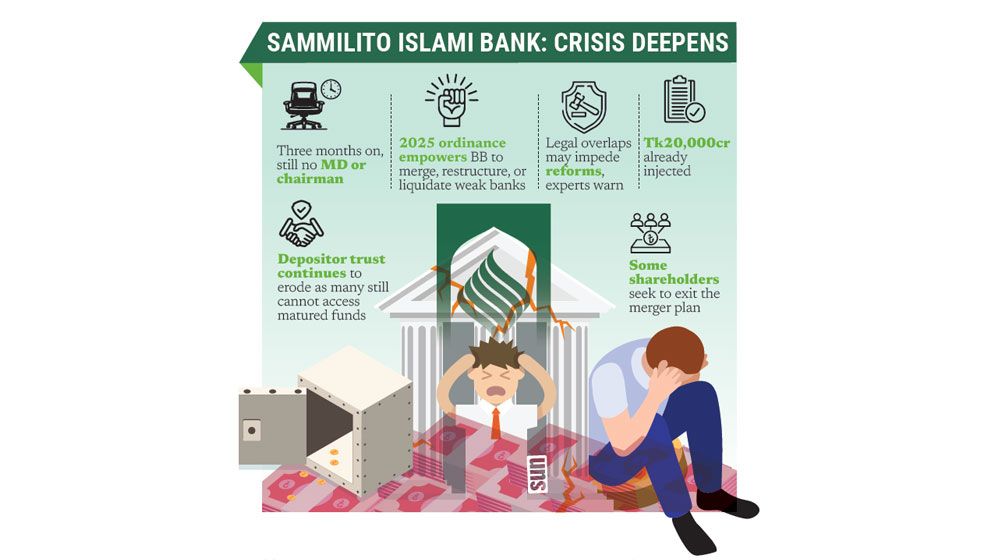
However, despite the passage of three months, the government has yet to appoint a managing director (MD).
The bank’s founding chairman, former secretary Dr Mohammad Ayub Mia, recently resigned citing personal reasons, leaving the institution without both a chairman and an MD.
At present, the bank is being run by administrators appointed across the five merged entities. While routine operations continue, there has been little progress in customer-focused or business-friendly initiatives, resulting in an overall state of stagnation.
Former World Bank lead economist Dr Zahid Hossain said, “Core reforms in the banking sector have begun under the Bank Resolution Ordinance 2025 and the Deposit Protection Ordinance. According to the amended Bank Resolution Ordinance 2025 passed in Parliament, Bangladesh Bank has been given full authority to restructure, merge, or, if necessary, declare troubled banks bankrupt.”
“Now the key question is whether the ordinances have been passed in their original form or whether there have been changes in language. If new laws are introduced alongside these, they could potentially hinder the reform process by creating conflicts with existing measures,” he added.
Zahid Hossain noted that the government has already provided Tk20,000 crore to Sammilito Islami Bank. “Depositor confidence must be restored. If the bank remains weak, it will be difficult to tackle the broader crisis. Therefore, a managing director and chairman should be appointed urgently, and the board restructured if necessary to make the bank functional,” he said.
He warned that failure to resolve the bank’s fragile condition would make it more vulnerable to external pressures and economic shocks.
“Appointing competent leadership quickly and ensuring a strong legal foundation are the main solutions to the current crisis,” he added.
Nurul Amin, former chairman of Global Islami Bank, said the government passed the Bank Resolution Ordinance 2025 to restructure five banks through consolidation.
“Major reforms are expected to be carried out under this law. The formation of Sammilito Islami Bank and other key initiatives are likely to gain full momentum once the ordinance is fully implemented,” he said.
Confidence crisis remains the biggest challenge
Despite being formed to restore depositor confidence, the bank is now facing a severe trust deficit, with repercussions across the wider banking sector.
The biggest concern stems from the controversial “haircut” decision, reducing profits for 2024 and 2025, followed by a revised announcement of a 4% return. This has triggered widespread dissatisfaction among an estimated 75 to 76 lakh depositors.
Many depositors are still unable to withdraw their funds even after maturity. Even the promised Tk2 lakh deposit protection limit has not been effectively delivered to all customers.
Recently, Bangladesh Bank announced that customers of Sammilito Islami Bank would be allowed to withdraw up to Tk10 lakh for medical treatment in special cases.
Administrators appointed by the central bank have repeatedly urged regulators to withdraw the haircut decision, arguing that restoring full profit rates is essential to rebuild depositor confidence and revive the bank.
Alif Reza, member secretary of the Bangladesh Bank Victims’ Depositors Association, said they had submitted a memorandum to the governor demanding withdrawal of the haircut, full payment of profits, and restoration of normal banking operations.
A depositor of Social Islami Bank, Md Arifuddin Khan, said he was able to withdraw only Tk2 lakh despite having more than Tk4.50 lakh in savings, even as his medical expenses exceeded Tk5 lakh.
“I had to borrow to cover my treatment. Now I can’t repay my loan. Why should ordinary customers bear the liability of looted funds?” he said.
A senior Bangladesh Bank official, speaking on condition of anonymity, said discussions are ongoing regarding the withdrawal of the haircut, but no final decision has been made.
He added that a chairman and MD are likely to be appointed within the next 15 days.
Bangladesh Bank Executive Director and spokesperson Arief Hossain Khan said, “There has been no change in policy regarding the haircut, though discussions are underway.”
Amid the crisis, shareholder directors of Social Islami Bank have called for operating the bank independently instead of continuing with the merger and have requested the government to exempt it from the process.
It was also revealed that asset quality reviews (AQRs) of the five banks were initially conducted by KPMG and Ernst & Young.
Despite earlier objections regarding KPMG, the same organisation is now reassessing the banks’ liabilities, with each bank required to pay Tk5 crore for the review.
Notably, the earlier AQR report has yet to be made public by Bangladesh Bank.