


 For all latest news, follow the Daily Sun's Google News channel.


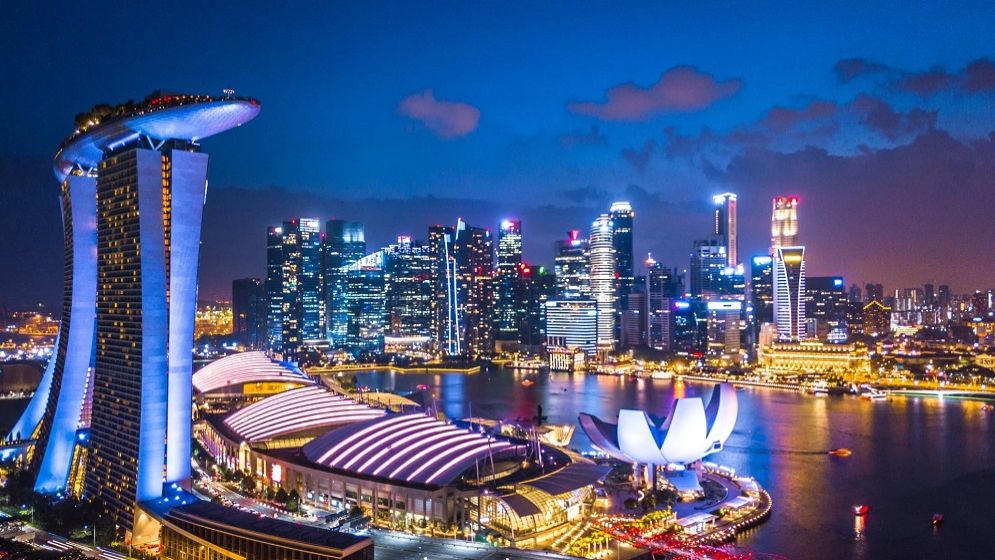
A general view of Singapore | File Photo: Collected
The “Singapore Model” refers to a set of interlinked governance, economic, and social strategies implemented under the leadership of Lee Kuan Yew (1959-1990) that transformed Singapore from a resource-deficient island into one of the world’s most competitive economies. Singapore’s GDP per capita rose from roughly USD 500 in 1965 to over USD 12,000 by 1990 and exceeded USD 70,000 by the early 2020s.
For developing economies like Bangladesh, characterised by high population density, infrastructure bottlenecks, and institutional weaknesses, the Singapore model presents both aspirational and practical lessons. However, replication requires careful adaptation to political culture, geographic realities, and the global economic environment.
Let us investigate core strategic pillars of the Singapore model. One of the key aspects of the model is meritocratic technocracy. Under this system, Civil Service recruitment and promotion were based on academic performance, professional competence, and moral integrity. And competitive salaries matched to private-sector standards reduced incentives for corruption. Ministers and senior civil servants were often drawn from the top 1% of academic achievers. This mechanism ensured policy continuity and execution efficiency, even during leadership transitions. On the contrary, Bangladesh’s bureaucracy often suffers from politicisation. However, a robust legal framework along with institutionalising a public service commission with greater autonomy could mirror Singapore’s depoliticised recruitment.
Besides, Singapore emphasised ensuring a strong rule of law and anti-corruption enforcement. The Corrupt Practices Investigation Bureau (CPIB) reported directly to the Prime Minister but operated with legal independence to investigate any public official. Penalties for corruption were severe, and prosecutions extended to high-ranking figures. As a result of such initiatives, Singapore ranked among the least corrupt nations globally (Transparency International CPI consistently in the top 10). On the other hand, the Anti-Corruption Commission (ACC) in Bangladesh has limited enforcement power and political independence. However, strengthening prosecutorial independence and implementing asset-declaration audits could follow Singapore’s precedent.
Additionally, Singapore adopted economic pragmatism and strategic industrial policy. The Economic Development Board (EDB) coordinated foreign investment attraction, sectoral targeting, and infrastructure planning. Singapore’s early focus on labour-intensive manufacturing evolved into electronics, petrochemicals, and financial services. As a result of the strategy, Singapore experienced rapid structural transformation: manufacturing’s share of GDP rose from <15% in 1965 to >25% in the 1980s. In contrast, Bangladesh is overdependent on the Ready-Made Garments (RMG) sector (~84% of exports in 2023). However, a Bangladesh Industrial Development Authority modelled after the EDB could identify high-growth sectors (ICT, pharmaceuticals, and shipbuilding) and link them to targeted skills development.
In addition, Singapore focused on infrastructure as a growth catalyst. Massive state-led investments in ports, airports, and industrial estates created world-class logistics. The Port of Singapore became a global transshipment hub due to efficiency, automation, and strategic location. This strategy reduced trade costs, attracted MNC headquarters, and integrated Singapore into global supply chains. On the contrary, Chattogram Port suffers from congestion, outdated handling systems, and bureaucratic delays. However, introducing port automation, digital customs clearance, and public-private partnerships could replicate Singapore’s logistics competitiveness.
Moreover, Singapore emphasised human capital and skills alignment. Education policy was tightly coupled with economic strategy. Emphasis on STEM, bilingualism, and vocational training matched evolving industrial needs. This model ensured workforce adaptability supported economic upgrading and reduced structural unemployment. On the other hand, Bangladesh is suffering from a skills mismatch between university graduates and industrial requirements. However, establishing Technical and Vocational Education and Training (TVET) systems with strong industry linkages could address this gap for Bangladesh.
Furthermore, Singapore placed due importance on social cohesion and political stability. For instance, ethnic quotas in public housing estates prevented ethnic enclaves; strict laws curbed hate speech; policies promoted a shared national identity while respecting diversity. This initiative helped them to ensure political stability and reinforced investor confidence. As opposed to this, political polarisation often disrupts governance cycles in Bangladesh. However, policies aimed at bridging partisan divides through inclusive economic benefits and community-based development could reduce instability.
The comparative picture of development between Singapore and Bangladesh can make it provocative to adopt the model of Singapore for countries like Bangladesh. Almost all indicators such as GDP per capita, Ease of Doing Business ranking, Corruption Perception Index, and Port Efficiency Score are demonstrating the difference between the two countries. In all aspects, Singapore exists among the top-ranking countries, while Bangladesh stands almost at the bottom of the list.
It is to be noted that the adoption of the Singapore model is not beyond challenges. There exist structural and contextual constraints for Bangladesh. While the Singapore model offers inspiration, three critical differences require caution. The primary issue is scale and geography. Singapore’s 728 km² land area allowed centralised, top-down infrastructure rollout. Bangladesh’s 148,000 km², with rural dispersion and riverine geography, complicates uniform service delivery. Besides, political structure is also a concern. Singapore’s one-party dominance enabled long-term policy continuity. Bangladesh’s competitive but highly adversarial party politics creates policy reversals and implementation delays. Additionally, Singapore rose during a Cold War-era boom in East Asian manufacturing and favourable FDI flows. Bangladesh operates in a more protectionist, climate-vulnerable, and competitive global economy.
Given the ground reality, Bangladesh may need strategic adaptation. Rather than wholesale imitation, Bangladesh could adapt the Singapore model through several strategies. We can adopt incremental governance reform by depoliticising bureaucracy in phases, starting with key economic agencies. Besides, Bangladesh can focus on industrial diversification by targeting 2-3 non-RMG export sectors for 10-year development roadmaps. Additionally, we need to emphasise port and logistics modernisation by prioritising automation and digitalisation at Chattogram and Payra ports. Moreover, we can establish education–industry linkage councils by creating tripartite bodies (government–industry–academia) to align skills with economic needs.
The Singapore model under Lee Kuan Yew remains relevant for Bangladesh as a strategic compass rather than a rigid blueprint. The core transferable lessons of meritocratic governance, uncompromising anti-corruption measures, infrastructure-driven growth, and human capital alignment could accelerate Bangladesh’s economic trajectory if adapted with sensitivity to its democratic framework, geographic scale, and socio-political dynamics.
The writer is a public administration and policy analyst