


 For all latest news, follow the Daily Sun's Google News channel.


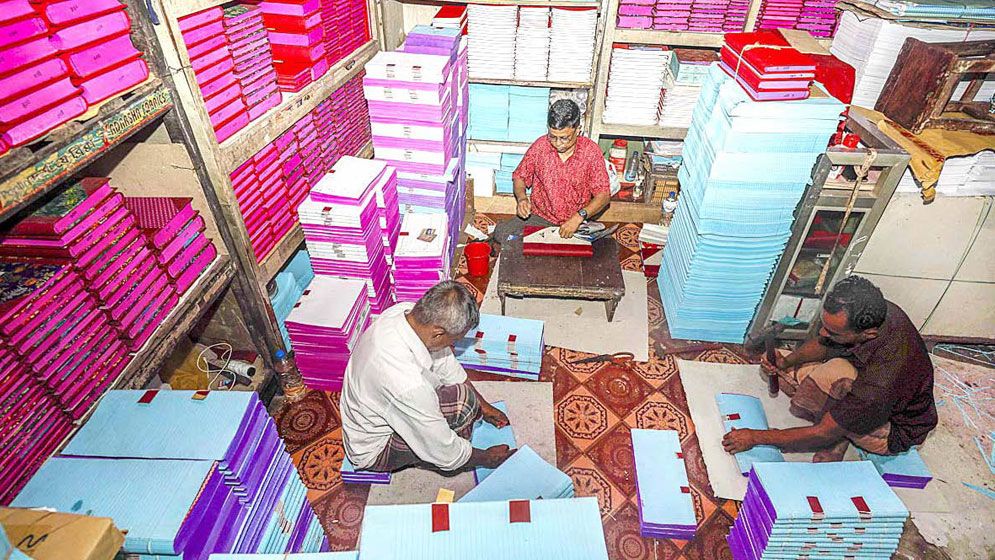
Workers are seen busy preparing halkhata (traditional account books) in the Teribazar area of Chattogram ahead of Pahela Baishakh celebrations. Despite the growing use of computers and digital accounting software in modern business, many traders continue to uphold this age-old tradition as part of their Bangla New Year observance. The photo was taken on Friday. - RABIN CHOWDHURY
Halkhata, once a vibrant tradition observed centring the Bengali New Year, is gradually losing its footing as digital transactions and changing business realities reshape practices, leaving the ritual sustained mostly in memory and emotional pull.
Instant, weekly or monthly online payments have largely removed the need for annual account settlements, weakening the appeal of this centuries-old practice.
Earlier, Halkhata meant elaborate preparations -- opening new ledgers, sending colourful invitation cards, and offering hospitality with sweets, said Shyamal, an employee at a shop in Banglabazar in the capital. Now it has declined due to social media and digitised account-keeping systems, he said.
Some also attribute the decline to increased competition. Suvendu Amin, a gold shop owner, noted that in the past, fewer shops meant larger customer bases and bigger arrangements. “Now, with more businesses, it is no longer possible to organise Halkhata on that scale,” he said.
This shift is also reflected in the ledger book market. Razzab Ali, owner of Janata Paper Store, who has been selling ledger books for about 45 years, said customers once travelled from across the country, not just Old Dhaka. While sales still rise during Pahela Baishakh, overall demand has fallen.
The Halkhata tradition is still somewhat alive in the city area amid decreasing appeal, especially it is a‘must observance’ in Old Dhaka’s gold market.
Madhab, a gold trader at Sharif Jewellers in Tantibazar, said, “It is still a kind of ritual for us. However, customers no longer crowd shops to clear old debts on Halkhata day like before. The price of gold is too high and the number of customers has decreased. How can people afford to make jewellery now at such high prices?”
Halkhata day was also a celebration for Old Dhaka’s residents. Suman Saha, a resident of Shankharibazar, said,
“The entire area used to be festive on Halkhata day with music, hospitality, and crowds. Now, the new generation does not even get the chance to experience that vibrant atmosphere.”
Historically, Halkhata traces its origins to the reign of Emperor Akbar with the introduction of the Bengali calendar to support the agrarian economy. From that time, the practice of renewing accounts at the beginning of the Bengali year gained prominence.
The word “Hal” comes from Persian, meaning “new”, and thus the tradition of closing old accounts and opening new ledgers came to be known as “Halkhata”. This was not merely a book of accounts but also strengthened relationships between traders and customers.
However, the tradition still has appeal in village areas of the country, especially in areas that are still largely dependent on agriculture compared to urban areas. According to villagers, they still follow the Bengali calendar to cultivate land and pay dues on Halkhata.
Babu Sardar, a farmer from Satkhira, said, “We do not have much liquid money in hand to buy things for cultivation, so we have to take them on credit. When we harvest crops from the fields, we repay the loans and debts.” “Almost every shop in our area still observes Halkhata to collect dues and offer sweets to customers,” he said, adding that farmers are the backbone behind keeping this tradition alive.