


 For all latest news, follow the Daily Sun's Google News channel.


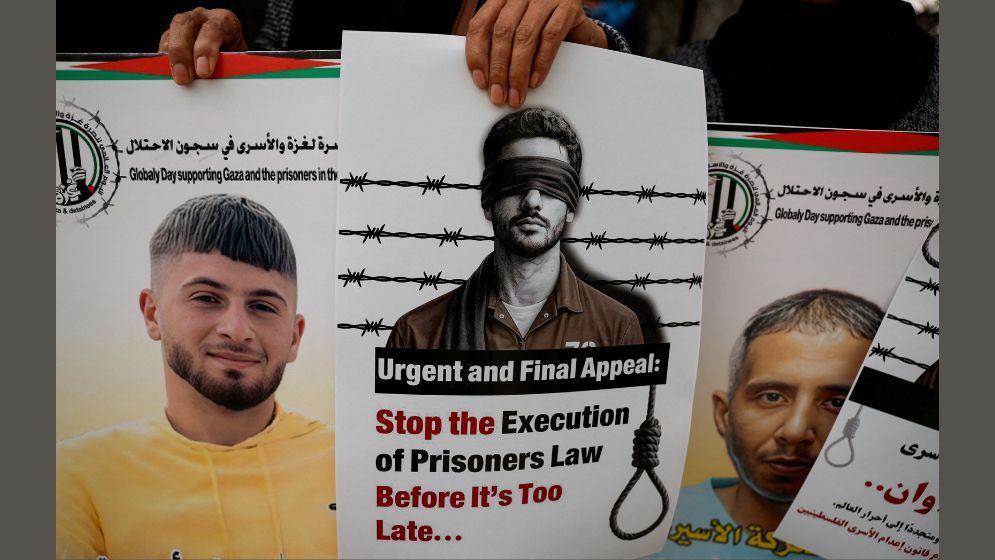
Palestinians take part in a protest against the execution of the Israeli death penalty law for Palestinians convicted of lethal attacks, in Ramallah, in the Israeli-occupied West Bank on 1 April 2026. Photo: Reuters
In a striking historical and political paradox, the Israeli Knesset’s approval of the death penalty law for Palestinian prisoners coincided with the fiftieth anniversary of Land Day, a date that has long symbolised the Palestinian struggle for land, existence and rights. The timing is not incidental. The law carries a political and legal message that transcends punitive legislation: it seeks to redefine the relationship between the occupying power and the people under occupation on a more brutal and discriminatory basis. At a moment when the global trend has moved decisively toward the abolition or restriction of capital punishment, Israel is moving in precisely the opposite direction.
The international response has been largely condemnatory. The vast majority of Organisation of Islamic Cooperation (OIC) member states and the European Union have voiced opposition to the Knesset’s decision. It is therefore regrettable that some countries, particularly Muslim-majority ones, have hesitated to declare their positions explicitly on what is, by any reasonable standard, a racially discriminatory piece of legislation.
This law does not emerge from within the framework of general criminal justice. It is rooted in a national and political conflict, which makes it function less as criminal legislation and more as a political instrument. Globally, most countries have either abolished the death penalty or suspended its application, and organisations such as Amnesty International and Human Rights Watch have spent decades leading campaigns to classify execution as a fundamental violation of human rights, foremost among them the right to life. The application of capital punishment to persons living under occupation raises serious legal problems under international humanitarian law and the Geneva Conventions, which impose strict restrictions on the penalties an occupying power may impose, particularly those issued by military courts or under conditions of armed conflict. If applied, this law would place Israel in direct legal and moral confrontation with the international legal order and further deepen existing accusations of violations of international humanitarian law.
Politically, the law is the product of National Security Minister Itamar Ben Gvir and the far-right faction within the Israeli government and has received the backing of Prime Minister Benjamin Netanyahu. This support reflects a profound shift within Israeli politics and society toward greater national and religious extremism. The law is not merely a security response to Palestinian armed operations; it is an expression of a growing political and social current that gravitates toward collective punishment, and that views Palestinians not as a political adversary in a territorial conflict, but as an existential enemy to be confronted with maximum force. In this sense, the law reflects a broader rightward transformation within Israeli society, one that now extends beyond political rhetoric into legislation, the judiciary and the very concept of justice.
Perhaps most alarming is the law's explicitly discriminatory character. The text defines its scope of application around crimes with "ideological or national" motivations, a definition broad enough to be directed, in practice, almost exclusively against Palestinians. No equivalent provision applies to Jewish settlers or citizens who commit nationally or religiously motivated violence against Palestinians, despite the existence of what is widely documented, internationally and in the media, as Jewish terrorism. In this asymmetry, the law ceases to be a general legal instrument and becomes a mechanism of legal discrimination based on nationality and identity, which is one of the defining characteristics of apartheid, precisely because the discrimination is codified in law rather than confined to practice.
The law effectively denies the existence of Jewish terrorism while classifying Palestinians broadly, including children, under the umbrella of “terrorism”. This sweeping classification opens the door to applying the death penalty not only to those who carry out attacks, but also to participants, planners, facilitators and even those accused of providing support or encouragement. The circle of persons potentially subject to execution could therefore expand dramatically, making this law not simply a punishment for acts of violence, but a collective deterrent directed at an entire society.
The procedural safeguards, or lack thereof, compound the concern. Legal observers have noted that the law grants the Minister of National Security broad executive powers, including the ability to push for executions without an explicit request from the Public Prosecution or without full unanimity among military judges. This significantly weakens the judicial guarantees that are universally recognised as essential in capital cases. More troubling still, the law grants absolute immunity to the Israeli officer who carries out the death sentence, effectively making that individual both judge and executioner, a condition that contradicts the most elementary principles of criminal justice, namely the separation of adjudicative and enforcement powers.
The law also eliminates meaningful avenues for appeal. Once issued, a death sentence cannot be commuted or cancelled, and execution can proceed within 90 days of the final decision, without even requiring a request from the public prosecutor. In virtually every legal system that retains the death penalty, capital cases are accompanied by multiple layers of review, precisely because of the irreversibility of the punishment and the gravity of judicial error. The design of this law appears oriented not toward ensuring justice, but toward accelerating finality.
It is estimated that the law initially targets hundreds of high-profile prisoners from the Gaza Strip, approximately 1,400 detainees, currently held in facilities including the underground sections of Ramle Prison. Crucially, the law’s retroactive potential means it could be applied not only to future cases, but to prisoners already in detention. This gives it the character of a retributive measure rather than a prospective criminal statute.
The broader context of Palestinian detention further darkens the picture. There are currently approximately 9,500 Palestinian prisoners in Israeli jails, including around 350 children and 66 women. Conditions of detention are documented to include torture, starvation and medical neglect. Since 7 October 2023, dozens of prisoners have died in custody as a result of these conditions, with some estimates placing the figure at around 100 deaths. Viewed against this backdrop, the passage of the death penalty law cannot be separated from the existing prison policy; it appears to mark a transition from systemic abuse to institutionalised killing.
Historically, Israel has carried out a judicial execution on only one occasion: the 1962 execution of Nazi war criminal Adolf Eichmann. That case was consistently invoked in Israeli legal discourse to illustrate that capital punishment was reserved for the most exceptional of crimes, those constituting crimes against humanity on a civilisational scale. The passage of this law represents an unmistakable departure from that principle, moving the death penalty from the realm of historical exception into the arsenal of ongoing national conflict. It is a profound transformation in the state, its law and society.
This law cannot be read as ordinary criminal legislation. It is a marker of deeper transformations within Israeli society, within its political institutions, and within the conflict itself, signalling a shift from a political dispute over land and rights toward an existential confrontation premised on the dehumanisation of the Palestinian people and the erosion of their most basic legal protections. That this legislation was passed on the anniversary of Land Day carries a symbolism that is difficult to ignore. If Land Day represents the struggle for land and identity, then what might be called the “Guillotine Law” announces a new and darker phase: a struggle no longer only over who controls the land, but over who holds the power of life and death itself.
The writer is Ambassador of Palestine to Bangladesh