


 For all latest news, follow the Daily Sun's Google News channel.


180-day plan: Govt prioritises first Free Trade Zone in Anwara
600-acre project aims to attract foreign investment, boost exports and create jobs

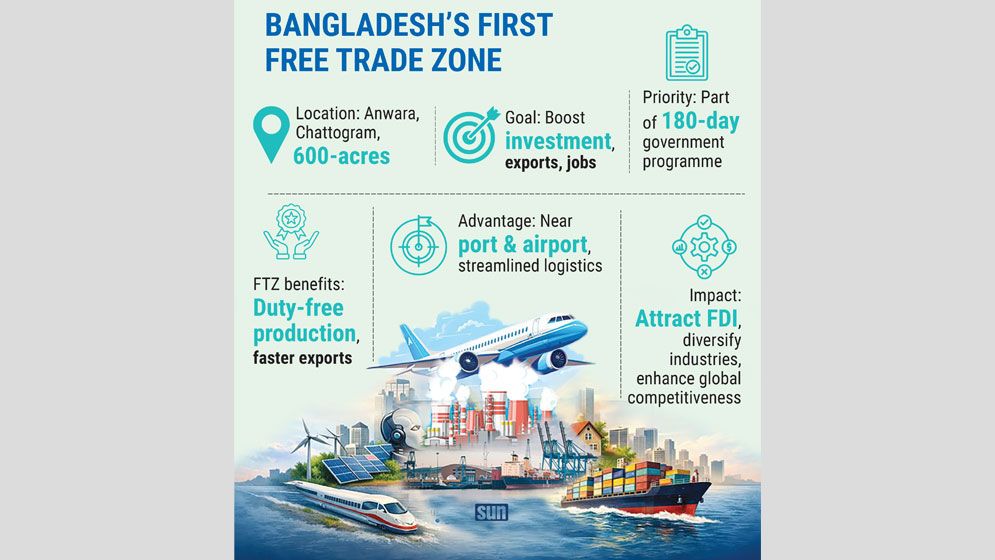
The government has taken a major step toward reshaping Bangladesh’s industrial and trade landscape by prioritising the establishment of the country’s first Free Trade Zone (FTZ) in Anwara upazila of Chattogram.
Planned on around 600-acres, the initiative is expected to attract foreign investment, generate employment, and position Bangladesh as a competitive global manufacturing hub.
The proposed FTZ has been included in the government’s 180-day action plan, highlighting its importance in the country’s economic agenda.
“The government’s decision to prioritise the Free Trade Zone under its 180-day action plan signals a strong commitment to accelerating economic reforms and attracting foreign investment,” a senior official of the Bangladesh Economic Zones Authority (BEZA) said.
The official added that BEZA will soon begin the implementation process.
On 15 March, Bangladesh Investment Development Authority (BIDA) Executive Chairman Ashik Chowdhury presented the 180-day roadmap for BIDA, BEZA, the Maheshkhali Integrated Development Authority (MIDA), and the Public-Private Partnership Authority (PPPA) to Prime Minister Tarique Rahman during a high-level meeting.
The roadmap outlines 25 initiatives under three strategic pillars -- robust infrastructure, investment facilitation, and investment development -- with the FTZ identified as a key project.
Executive Member of BEZA Md Nazrul Islam said amendments to business policies and related regulations will be required before the zone becomes operational.
However, he noted that the process will begin soon as the project is on the priority list.
In an FTZ, companies can import, store, and manufacture goods without paying duties immediately, reducing costs, accelerating production, and easing export procedures.
This model encourages businesses to establish operations, ultimately creating jobs and boosting industrial activity.
To ensure global standards, the government has formed a high-level national committee to prepare a comprehensive roadmap, including the operational framework and legal structure based on international best practices.
Strategic location
The selection of Anwara in Chattogram is considered strategic due to its proximity to Chattogram Port and the international airport, offering strong logistical advantages for import and export activities.
The FTZ will operate as an offshore customs territory, allowing businesses to import, process, and re-export goods without immediate customs duties.
This is expected to significantly lower production costs, simplify procedures, and speed up manufacturing and export processes.
Officials say the streamlined regulatory environment will also reduce bureaucratic hurdles, making it easier for companies to operate.
Free Trade Zones are widely used globally to attract multinational companies by offering tax incentives, simplified regulations, and efficient infrastructure.
Bangladesh hopes to replicate this success to draw high-quality foreign direct investment, particularly in export-oriented sectors.
Part of broader strategy
The initiative is part of a broader strategy to enhance Bangladesh’s competitiveness as a manufacturing destination and strengthen its position in global supply chains.
The idea gained momentum during the Bangladesh Investment Summit last April, where policymakers and business leaders stressed the need for modern trade infrastructure and investor-friendly zones near key economic corridors.
Following the summit, a national committee was formed to assess feasibility and address potential challenges.
Economic impact
If implemented effectively, the FTZ is expected to boost exports, attract foreign direct investment, create large-scale employment, support industrial diversification, and deepen Bangladesh’s integration into global markets.
With planning underway and policy backing in place, officials are optimistic that the Anwara FTZ could play a pivotal role in transforming Bangladesh into a regional manufacturing hub.
As the country seeks to sustain economic growth and diversify its export base, the project is expected to become a cornerstone of its future economic strategy.