


 For all latest news, follow the Daily Sun's Google News channel.


394 killed during Eid travels
Says Jatri Kalyan Samity report
Daily Sun Report, Dhaka
Published: 31 Mar 2026, 12:00 AM
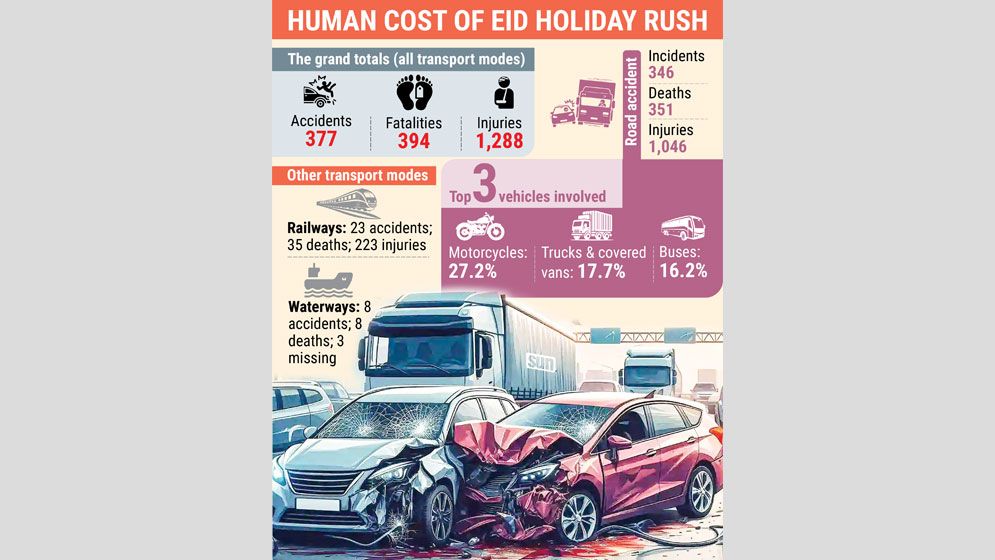
At least 394 people lost their lives and nearly 1,300 others were injured in a series of accidents on roads, railways, and waterways during the 15-day Eid-ul-Fitr holiday rush, according to a report released on Monday.
The findings, compiled by the Bangladesh Jatri Kalyan Samity (Passenger Welfare Association), highlight a grim uptick in transport-related fatalities compared to the previous year.
Data monitored by the organisation’s Road Accident Monitoring Cell showed that road crashes alone accounted for 351 deaths and 1,046 injuries across 346 separate incidents.
Presenting the report at the Dhaka Reporters’ Unity, the association’s Secretary General, Mozammel Haque Chowdhury, noted that the figures cover the period from 14 March, when the holiday exodus began, to 28 March.
A rising toll
The statistics reveal a worrying trend when set against the 2025 holiday period. Road accidents have risen by approximately 9%, while fatalities and injuries saw increases of 8.3% and 21% respectively.
Beyond the tarmac, the report recorded 23 railway accidents resulting in 35 deaths, while eight incidents on the country’s waterways left eight people dead and three missing.
The pressure on the healthcare system was equally evident. The National Institute of Traumatology and Orthopaedic Rehabilitation (NITOR)—locally known as Pongu Hospital—admitted 2,178 victims of road accidents during this fortnight alone.
The motorcycle menace
Motorcycles remain the deadliest mode of transport on Bangladeshi atolls. They were involved in over 36% of all road accidents, claiming 135 lives.
The victim profile paints a tragic picture of the holiday’s toll, involving 71 drivers, 55 children, and 51 women, as well as professionals ranging from teachers and engineers to journalists and physicians.
An analysis of the crash data reveals that motorcycles remained the primary concern, accounting for over 27% of all vehicles involved in accidents. They were followed by trucks and covered vans at 17.7%, while buses made up 16.2% of the total.
Battery-powered rickshaws and private cars also featured significantly in the figures, highlighting the diverse and often unregulated mix of transport on the country’s thoroughfares.
In terms of how these incidents occurred, head-on collisions were the most frequent, representing nearly 36% of cases. A further 32% involved vehicles running over pedestrians, while more than 22% of accidents were caused by drivers losing control and veering into roadside ditches.
The geographical spread of the carnage shows that the vast majority of incidents took place on the open road. National highways saw 43% of the total accidents, while 30% occurred on regional highways and nearly 22% on smaller feeder roads. Only a small fraction of the incidents were recorded within the metropolitan areas of Dhaka and Chattogram.
Systematic reform
Speaking at the press conference, Mozammel Haque clarified that the report was not intended as a critique of the incumbent administration but as a necessary data-driven tool for reform.
“We present these statistics annually to provide a roadmap for improved safety measures,” he said.
The Jatri Kalyan Samity has called for a suite of urgent interventions to curb the annual carnage. Key recommendations include the introduction of smart transport technology and fare systems, stricter curbs on the import of motorcycles and battery-powered rickshaws, and the implementation of digital vehicle fitness certifications.
The body also urged the government to invest in highway lighting and comprehensive driver training programmes.
Read More