



 For all latest news, follow the Daily Sun's Google News channel.



Eid in Bangladesh is a celebration of return, an annual migration linking cities to ancestral homes. Yet, in 2026, this year’s celebration once again exposed a deadly fault line.
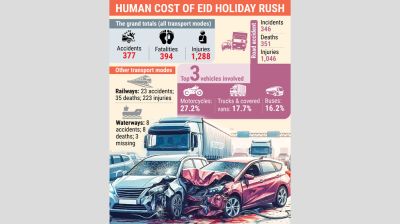
According to the estimation of the Road Safety Foundation, at least 274 people lost their lives and over 1,500 became injured in 342 road accidents between 16 and 26 March.
This alarming number of road accidents during the Eid rush is linked to various reasons such as highways exceeding capacity, a surge of unfit vehicles, and a transport system strained within a compressed travel window.
More troubling is the pattern’s persistence. There is law to ensure road safety, but its enforcement remains inconsistent and accountability fragmented.
These recurring tragedies show oversight, infrastructure, and compliance fail to align, normalising preventable deaths as a cost of movement.
The ten days of Eid vacation offer scary instances. In Rajbari, a passenger bus carrying Eid returnees plunged into the Padma River while trying to board a ferry.
At least 24–26 people, including women and children, died in the mishap. In Cumilla, a train smashed into a bus at a railway crossing, killing at least 12 people. Investigations revealed that there was no gatekeeper and the safety barrier was not lowered.
Elsewhere, a floating bridge collapsed under overcrowding, killing children; and multiple smaller accidents across districts added to the mounting death toll.
These cruel accidents have not only destroyed the lives of so many people but also shattered the dreams of so many families. These are not “accidents” in the true sense. They are the fruits of negligence.
Public discourse often reduces road fatalities to “reckless driving”. While driver behaviour contributes, accounting for roughly 42% of crashes, this narrative is dangerously incomplete.
The deeper causes are systemic: unfit vehicles operating without rigorous inspection; undertrained and overworked drivers enduring 12 to 16 hour shifts; corruption-tainted licensing regimes that place unqualified individuals behind the wheel; and fragile infrastructure, from unsafe ferries to unprotected railway crossings. Above all, enforcement remains sporadic, rendering laws largely symbolic.
Bangladesh’s extreme population density magnifies every structural weakness. During Eid, millions travel within a compressed timeframe, overwhelming already fragile systems.
Highways exceed capacity, ferries operate under unsafe pressure, railway crossings lack automation and manpower, and public transport expands without effective regulation.
The Rajbari ferry tragedy illustrates how a single lapse, poor traffic control at a terminal, can result in mass casualties.
Such incidents are not anomalies but symptoms of systemic strain. Infrastructure is not merely physical assets; it is the coordinated management of human movement.
When that coordination fails, mobility turns hazardous, exposing deep deficiencies in planning, oversight, and institutional resilience.
Core weaknesses include weak law enforcement, corruption in transport governance, unprofessional drivers, unsafe infrastructure, and absence of data-driven policy.
Licenses and permits are often bought, drivers are overworked, and critical infrastructure, from ungated rail crossings to overloaded ferries, fails under pressure.
The crisis is profound but reversible. Solutions demand coordinated governance and innovation. Strict enforcement, including fast-track courts for road accidents, can restore deterrence. Digitalising licensing, vehicle inspections, and traffic monitoring reduces corruption.
Regulating driver hours ensures fatigue does not become a killer. Upgrading infrastructure, automated railway barriers, modern ferry terminals, and expanded highways addresses high-risk bottlenecks, while regulated, high-capacity public transport reduces reliance on unsafe vehicles.
Nationwide awareness campaigns can shift public behaviour and embed accountability.
A new government holds a pivotal opportunity to break Bangladesh’s deadly cycle of road tragedies. Road safety must be recognised not merely as a transport challenge but as a test of governance, accountability, and societal responsibility.
Safety must be embedded into all infrastructure planning, from highways to ferries and railways.
Eid should bring gratitude, unity, and human connection, yet preventable deaths turn this festival into a season of grief.
Read More
The urgent imperative is clear: the government must act decisively, enforcing laws without exception and holding responsible parties publicly accountable. By punishing violators, drivers, owners, and officials alike, it can establish visible deterrence and restore public trust.
Reform is not enough; the creation of concrete examples through strict, transparent action is essential to break the cycle and safeguard future lives.
_______________________________
The writer is a Research Coordinator and Assistant Professor at the Institute of Development Studies and Sustainability (IDSS), United International University (UIU). She can be reached at [email protected]
Read More