


 For all latest news, follow the Daily Sun's Google News channel.


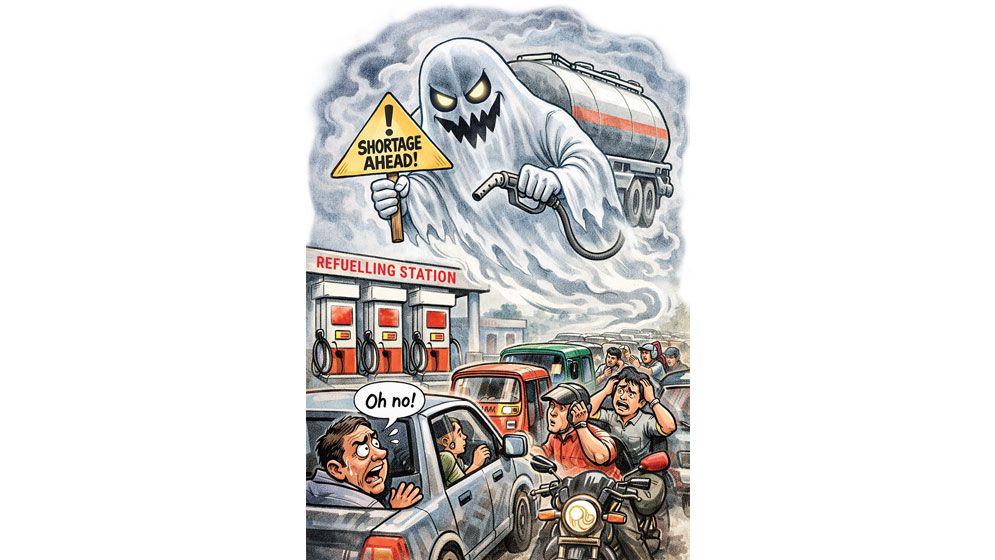
The sight of thousands of frantic motorists swarming petrol stations across Dhaka and elsewhere in the country over the past couple of weeks is more than a temporary disruption; it is a revealing moment of national psychology.
A country that has spent years quietly strengthening its energy architecture now appears gripped by a crisis that, on closer inspection, is as much about perception as it is about physical supply.
Triggered by the geopolitical tremors in the Middle East following the 28 February US-Israel strikes on Iran, and exacerbated by the predictable sabre-rattling over the Strait of Hormuz, the current panic has taken on a life of its own.
Yet, the sheer scale of this public anxiety seems increasingly decoupled from the hard economic data.
To suggest that Bangladesh could be instantaneously choked of its diesel, petrol, and octane reserves due to a regional flare-up in the Gulf is to cling to a fundamentally obsolete understanding of our energy economy.
This fear-mongering narrative relies on a “frozen-in-time” snapshot of the 2006-07 fiscal year—an era when a staggering 91% of our diesel arrived from the single source of Kuwait. In that era, a closure of the Strait of Hormuz was indeed an existential threat. But the Bangladesh of 2026 is a different beast entirely.
According to current operational data, our annual refined fuel demand stands at approximately 7.4 million tonnes. Diesel – the lifeblood of our agriculture and transport – accounts for 4.6 million tonnes of that total. Crucially, we no longer put all our eggs in one Middle Eastern basket.
Today, while the Middle East remains a foundational crude supplier, our refined products – the diesel and octane hitting the pumps right now – are sourced from a sophisticated global carousel.
We are now in the era of “Middle-East dominant but clearly diversified.” Bangladesh is currently importing roughly 1.4 million tonnes of refined fuel in the first half of the year alone through global spot markets and traders like Vitol.
Recent shipments have seen 27,000 tonnes arrive from China and 28,000 tonnes from various international traders. This is a flexible, resilient supply chain that does not live or die by a single geography.
Perhaps the most significant blow to the “Middle East or Bust” theory is the Bangladesh-India Friendship Pipeline. Since its completion in 2023, this 130-kilometre conduit has become a strategic masterstroke.
From a mere 70,055 tonnes in 2024, the volume of diesel flowing from India’s Numaligarh Refinery has climbed to 122,000 tonnes in 2025.
While this represents roughly 3%-5% of our total diesel imports, its value is qualitative, not just quantitative. It provides a land-based, maritime-independent fallback that can be scaled.
When the government reports the arrival of 5,000 tonnes of diesel via this pipeline amidst the current tension, it is sending a message: the oil is moving, and it is not coming through the Strait of Hormuz.

A manufactured scarcity
If the tanks are full – and the government insists they are, with stocks sufficient until April –then why the chaos?
Energy specialists argue that the current turmoil is primarily behavioural – a “demand shock” rather than a genuine supply deficit.
Dr M Shamsul Alam, a fuel market expert, noted that market uncertainty inevitably triggers a hoarding instinct.
“When uncertainty arises, people begin buying more than they need. This surge in demand disrupts the normal supply chain and creates an artificial shortage,” he explained.
The authorities have attributed the disruption largely to panic buying and illegal hoarding, and the evidence is mounting.
As Power, Energy and Mineral Resources Minister Iqbal Hassan Mahmood Tuku noted, a petrol pump that typically sells one lorry of fuel a day is now seeing that volume vanish in three hours. This is panic buying in its purest, most destructive form.
However, the public’s fear is being fed by a distribution system riddled with leaks.
Energy expert Prof Dr Ijaz Hossain told the Daily Sun that the conflicting stories from pump owners and the BPC point to deep-seated gaps.
“Fuel is being diverted from depots to unofficial channels, exploited by hoarders and black-market networks,”
Dr Ijaz Hossain observed, noting that this creates undue pressure on both ordinary consumers and the industrial sector.
On Saturday, Home Minister Salahuddin Ahmed characterised the stability of domestic fuel prices – even as neighbouring countries and global markets succumb to inflationary pressures – as a significant “success of the government.”
He noted that this was the result of meticulous “advance planning,” with a specific focus on ensuring that the Boro irrigation season remains unhindered through state-sanctioned subsidies. However, the minister also issued a stern warning: the government is tracking reports of fuel smuggling and will “take the harshest measures” to dismantle these illicit channels.
Echoing this sentiment, Chief Whip Nurul Islam Moni addressed the national anxiety by contrasting the “turmoil of a world at war” with Bangladesh’s steady hand on energy pricing.
He confirmed that supply is not the issue, revealing that a vessel carrying 200,000 tonnes of fuel has already docked, with another 200,000 tonnes currently being loaded for transit.
“There is no shortage; there is only a manufactured crisis,” the chief whip asserted, urging the public to resist the impulse to panic.
He further disclosed that members of parliament have been instructed to monitor their respective constituencies, with a clear mandate to crack down on those stockpiling fuel beyond their legitimate needs.
Despite these assurances, predatory hoarding continues to throttle the market.
Recent seizures of 4,500 litres of illegally stored petrol and 19,500 litres of diesel in Phulpur, Mymensingh, as well as 6,000 litres in Chattogram’s Patenga area and 2,500 litres in Jamalpur, prove that a hoarding cartel is active.
Energy expert Prof M Tamim noted that dishonest traders instinctively hoard fuel whenever supply appears under pressure.
“In some cases, petrol pumps are claiming ‘no fuel’ while secretly stockpiling it, or moving it to unauthorised locations, which intensifies the overall crisis,” he said.
Prof Tamim also issued a grim safety warning: fuel stored in unauthorised locations bypasses all official safety standards, meaning any accident could have “catastrophic consequences” for surrounding communities.
He suggested that regularly reconciling the detailed records of fuel withdrawal and sales maintained by every petrol pump could help control these irregularities.
The crisis of trust
Yet, it would be too convenient to reduce this episode solely to the “unscrupulous trader.”
Dr Ijaz Hossain stressed that these irregularities are not isolated incidents but part of an organised network, highlighting institutional accountability gaps.
While government interventions, including mobile courts, are moving in the right direction, he warned that without “visible, strong deterrents,” these actors will continue to thrive.
Communication remains the weakest link. Reassurances that there is “no shortage” ring hollow to a driver who has been in a queue for four hours. In the absence of verifiable, real-time data on stock levels and distribution schedules, rumour becomes the primary currency.
Public anxiety is not entirely irrational. Having endured the shocks of a pandemic and the fallout of the Russia-Ukraine war, the Bangladeshi consumer is understandably sensitive to talk of supply chain collapses.
However, the current episode reveals a jarring gap between structural progress and public confidence.
Bangladesh has done the hard work of diversifying its sources, yet these gains have not yet translated into a sense of security.
If Middle Eastern tensions persist, the state must move beyond defensive measures. Further diversification – finalising deals with Brunei or exploring US shipments – will add layers of safety.
Expanding storage to build a true 90-day strategic reserve is no longer a luxury; it is a necessity.
Above all, the modernisation of distribution through digital tracking is essential to ensure that fuel allocated at the depot actually reaches the nozzle.
What we are witnessing is not a classic supply crisis, but a crisis of trust. The fuel is arriving, the tankers are docking, and the pipelines are open. Managing our energy security is no longer just a matter of logistics; it is about managing expectations and ensuring that policy reality matches the public’s experience at the pump.