


 For all latest news, follow the Daily Sun's Google News channel.


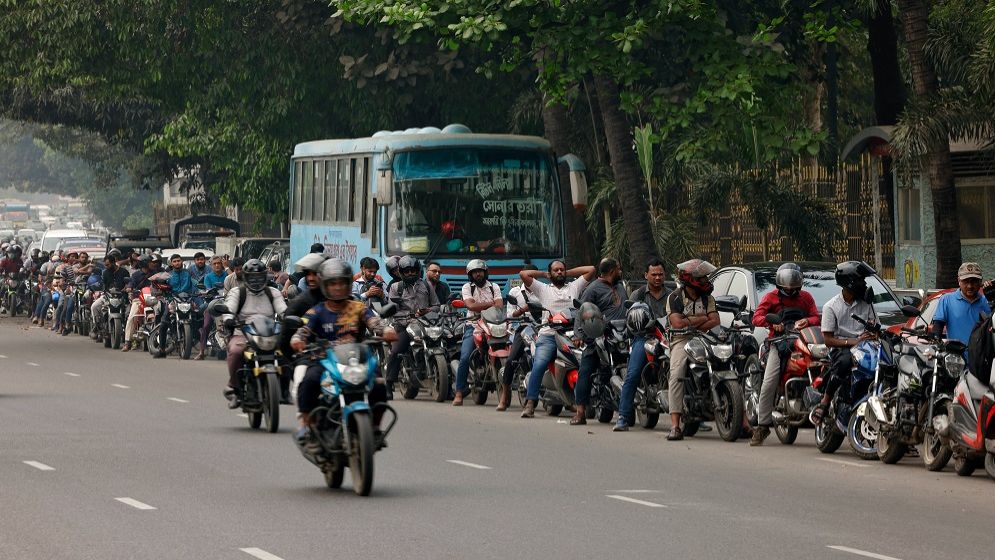
Motorists stand in a long queue at a fuel station, as concerns grow over fuel supply amid US-Israel conflict with Iran, in Dhaka, Bangladesh, 10 March 2026. Photo: REUTERS
The long queues outside petrol pumps across Dhaka over the past week or so offer a revealing snapshot of a deeper national problem. Motorcyclists waiting for hours, drivers moving from one filling station to another, and pumps hanging signs reading “No petrol” or “No octane” have created the impression of a severe fuel crisis. Yet government officials insist that there is no real shortage of petrol or octane in the country and that the rush itself is largely the result of panic buying.
In other words, what we are witnessing is not merely a supply crisis. It is also a crisis of public psychology.
Our nation has developed a recurring pattern in moments of uncertainty: fear spreads faster than facts. Markets react not only to actual shortages but also to the expectation of shortages. People start to panic buy products whenever they hear rumours or experience anxiety about potential product shortages. Thus, the situation that could have remained under control develops into into a genuine disruption.
The rush at petrol pumps exemplifies how easily this cycle begins. The Middle East conflict escalation has disrupted worldwide energy markets while creating doubts about maritime transport and supply chain operations. Bangladesh experiences natural anxiety from these developments because it relies on imported fuel and liquefied natural gas. The unease quickly developed into something else. Motorists rushed to fill their tanks earlier than usual, queues formed overnight, and some filling stations began running out simply because demand had surged far beyond normal levels.
Panic buying has a peculiar logic. For individuals, it feels sensible to secure supplies early. But when thousands act on the same impulse, the result is exactly the outcome everyone feared: shelves empty, pumps run dry, and the perception of scarcity intensifies.
This behaviour is hardly unique to Bangladesh. During crises across the world, from pandemics to wars, people have rushed to stockpile goods. What makes the Bangladeshi experience particularly damaging, however, is the fragile nature of its markets. Supply chains are often thin, oversight inconsistent, and trust between citizens and institutions limited. Under such conditions, fear spreads easily and markets react sharply.
Where panic appears, opportunism rarely stays far behind.
Bangladesh’s markets have long struggled with the problem of artificial scarcity. When rumours of shortages circulate, some traders quietly hold back supplies. Prices rise suddenly, often without clear justification. By the time authorities intervene, the damage is already done. Consumers pay more, while a small group benefits from the confusion.
The phenomenon becomes especially visible during Ramadan. Every year, as the holy month approaches, prices of essential food items tend to climb sharply. Official explanations often point to rising demand. Yet the increases frequently appear too steep to be explained by demand alone. Investigations repeatedly uncover stockpiling, manipulation of supply chains, and the quiet coordination of prices among traders.
For ordinary households, this pattern has become painfully predictable. Families preparing for Ramadan find themselves paying inflated prices for everyday essentials, even though Bangladesh’s agricultural output in many sectors remains strong. What should be a time of spiritual reflection becomes, for many, a month of economic anxiety.
The darker side of profit-seeking goes even further. In recent weeks, mobile court operations have uncovered food businesses using banned chemicals in sweets such as “jilapi” to enhance colour and texture. Such practices may appear unrelated to fuel shortages or price spikes, yet they stem from the same impulse: the pursuit of quick profit at the expense of public welfare. When ethical boundaries weaken, markets begin to function less as systems of exchange and more as arenas of exploitation.
Ironically, the dysfunction becomes even more visible when the country produces too much rather than too little.
Farmers harvesting potatoes across the country this season have found themselves trapped in the opposite problem. After a strong harvest, prices have collapsed dramatically. In some areas of the northern district of Thakurgaon, a 60-kilogram sack of potatoes is reportedly selling for as little as Tk200 – roughly Tk3 per kilogram. Farmers say they spent about Tk40,000 per bigha on cultivation but now struggle to recover even a fraction of their investment.
Cold storage facilities cannot absorb the entire harvest, buyers are scarce, and many farmers are unsure whether storing their produce will be worth the cost. The result is a painful paradox: abundance has become a burden.
Such cycles have long plagued the country’s agricultural economy. When farmers harvest large quantities, prices fall sharply because storage and marketing systems remain weak. Months later, once farmers have exhausted their stocks and intermediaries control supply, the same produce often appears in markets at dramatically higher prices. Potatoes that left farms at a Tk5-6 per kilogram can later sell for Tk50-60.
This situation cannot be explained by supply and demand alone. It reveals deeper structural weaknesses in the functioning of the market. Farmers bear the risks of cultivation but seldom benefit from favourable prices. Consumers, on the other hand, often face abrupt price increases after goods pass through several layers of traders and distributors. Between these two groups lies a network of intermediaries who frequently profit from volatility rather than stability.
Information’s role also merits consideration. People mainly rely on the media to comprehend what is going on around them during uncertain times. By offering context and confirmed information, responsible reporting can help reduce anxiety. However, anxiety can occasionally be exacerbated by the current information environment, especially with the growth of social media. huge before official explanations are available, public opinion is shaped by images of long lines, dramatic headlines, and bits of unsubstantiated accusations that quickly circulate across digital media.
This does not imply that journalists should minimise actual issues. In any democracy, scrutiny is still vital. However, it does draw attention to the fine line that must be drawn between educating the public and unintentionally inciting fear. The speed at which information spreads in a highly interconnected world frequently surpasses the thorough verification that is necessary.
Government policy also plays a central role in shaping how crises unfold. The authorities have already taken steps to stabilise the current energy situation, including allocating substantial subsidies to cope with rising global prices of fuel and liquefied natural gas. Such measures aim to protect consumers and prevent sudden economic shocks.
Yet these responses also underline a broader vulnerability. Bangladesh remains heavily dependent on imported energy, leaving the economy exposed to geopolitical turbulence far beyond its borders. When conflicts disrupt shipping routes or drive up international prices, the country has limited room to manoeuvre. The country needs emergency subsidies and austerity measures for short-term solutions, yet these solutions do not solve the basic problem that leads to these emergencies.
Yet, the recurrent patterns in the country’s markets lead to panic buying and artificial shortages which create collapsing farm prices and sudden price hikes. Markets function best when there is trust: trust that supplies will remain available, trust that rules will be enforced, and trust that institutions act in the public interest.
People begin to act defensively when that trust weakens. Consumers hoard goods before others can. Traders seek short-term profit rather than long-term stability. Farmers gamble on uncertain markets. The result is an economy that oscillates between surplus and scarcity, rarely achieving balance.
Bangladesh has demonstrated remarkable resilience in many areas of national life. The country has overcome natural disasters, political upheaval, and global economic shocks. Yet building a mature market system requires more than resilience. It requires consistent governance, ethical business practices, and a public willing to resist the instinct to panic.
The motorcyclist waiting outside the petrol pump in Dhaka may eventually find fuel elsewhere. The queues will shorten, deliveries will resume, and the immediate crisis will fade. But the deeper lesson remains.
At times, the most dangerous shortages are not those of fuel or food. Rather, they are shortages of trust, discipline, and collective responsibility – the invisible foundations upon which stable societies are built.
The writer is the Deputy Editor at Daily Sun
Read More