


 For all latest news, follow the Daily Sun's Google News channel.


On the third day of Ramadan, Habibur Rahman, of Teknaf’s Hrila Pankhali, was offered a passage to Malaysia by a friend.
His story is one of hundreds.
Teknaf upazila in Cox's Bazar district has for years served as a primary hub for human trafficking networks that lure victims, Bangladeshis and Rohingya alike, with promises of a better life in Malaysia, hold them in coastal and hillside dens, and then dispatch them by sea.
Despite sustained operations by the Bangladesh Coast Guard and the Rapid Action Battalion, local elected representatives say the trade remains beyond control, with the role of other security forces falling short of what is needed.
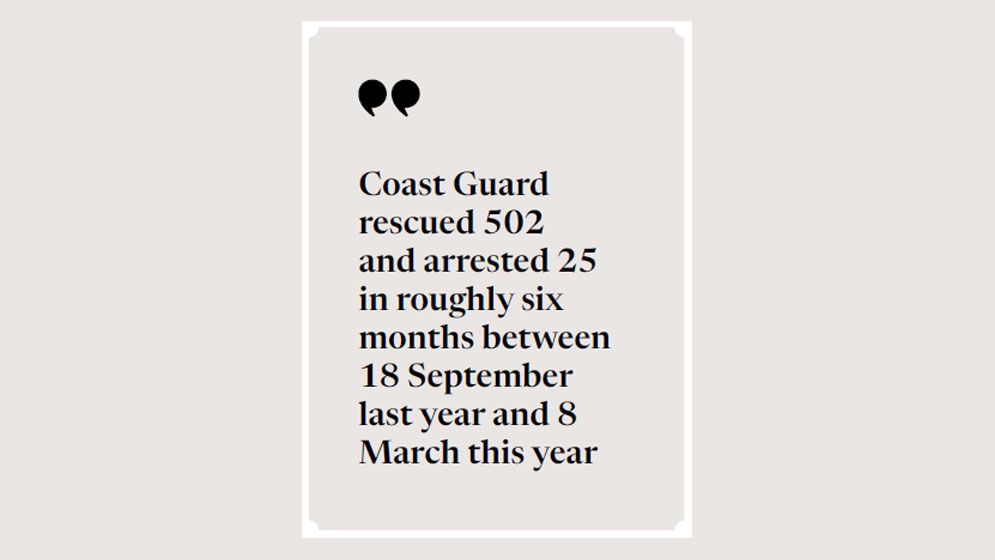
Coast Guard East Zone, which covers Teknaf among other areas, rescued 558 victims in the past year – 103 children, 161 women and 294 men – and arrested 41 alleged traffickers. Of them, 502 rescues and 25 arrests took place in roughly the six months between 18 September last year and 8 March this year, reflecting the pace at which the trade operates.
Armanur, a 21-year-old Rohingya woman from Camp 17 at Balukhali in Ukhiya, said she had been in contact with a Bangladeshi man living in Malaysia who promised to marry her if she could reach the country.
A broker held her for a day in Teknaf's Lambari area before transferring her to a large trawler, she said, adding that the Coast Guard intercepted the vessel in the Bay of Bengal near Saint Martin's Island and rescued her along with other passengers.
She was subsequently verified and returned to her family.
Oli Ahmed, of Hariakhali in Sabrang union, described being kept in a small room for seven days and beaten before being transferred to a trawler on 26 February. He too had travelled to Teknaf on the word of a broker named Faisal, introduced through a mutual acquaintance. The Coast Guard seized the trawler at sea and rescued him and other victims.
Brokers play a central role in the trafficking chain, recruiting victims from their communities and handing them to the rings for a fee.
Hafez Ahmed, a member of Baharchhara Union Parishad, told this newspaper that brokers in his ward area received Tk20,000 per person from the trafficking rings.
As per the case documents obtained by the Daily Sun, some of the notorious in the areas are Abdul Amin, Muhammad Riduan, King Saiful, Nurnabi Majhi, Tofail Ahmed, Muhammad Faruk, Nurul Islam, Ferdous Akhter, Muhammad Yunus,
Muhammad Rafiq, Muhammad Ayub, Kefayet Ullah, Muhammad Russell, Muhammad Zubair, Mahabubur Rahman, Muhammad Amin, Muhammad Alam, Noor Nabi, Sikandar Ali, Mumtaz, Zafar Alam, Hedayet Ullah, Ayat Ullah, Panja Farooq and Mota Faruk.
Contacted, Saiful Alam, officer-in-charge of Teknaf police station, said most traffickers had been arrested during raids with operations continuing against those still at large.
Lieutenant Commander Sabbir Alam Suzan, media officer of Bangladesh Coast Guard, said the force maintained round-the-clock patrol and intelligence surveillance along the coast and riverbanks, and was working in coordination with other agencies to combat the trade.