




 For all latest news, follow the Daily Sun's Google News channel.


Financial reports used to mislead investors
Audit findings reveal widespread irregularities in financial reports of listed firms, raising concerns over investor protection

Listed companies are increasingly using financial statements – documents meant to reflect a company’s annual business performance – as tools to mislead investors.
Critical issues such as unpaid receivables, inadequate or absent provisions, tax and VAT disputes, violations of labour laws and accounting standards, unverified assets and inventories, excessively risky investments and capital shortages are often concealed in financial reports.
As a result, profits appear artificially inflated and companies project an overly optimistic outlook about their future performance.
The Bangladesh Securities and Exchange Commission (BSEC) reviews the financial statements of listed companies through 45 registered audit firms each year.
Through these audits, discrepancies and concealed information in financial reports often come to light.
Over the past nine years, the number of such audit objections has steadily increased.
Of the 421 companies listed on the capital market, auditors found errors or misleading information in the financial reports of 215 companies that published statements in 2025.
Capital market analyst and Chairman of ICB, Abu Ahmed, said financial statements reflect a company’s business condition and serve as a key basis for investors’ decisions.
“If the information in those statements is inaccurate, investors will naturally make flawed investment decisions,” he said, adding that weak regulatory oversight has allowed companies to use financial reports as tools for manipulation.
Fouzia Haque, FCA, partner at FAMES & R Chartered Accountants, audited the 2025 financial statements of Kattali Textile Limited.
She told the Daily Sun that their firm conducts external audits for companies assigned by the Dhaka Stock Exchange (DSE).
Whenever the DSE seeks detailed explanations regarding audit findings, they provide the necessary information, she said.
According to Haque, greater emphasis must be placed on internal audits to ensure transparency and accountability among listed companies.
“When auditors are appointed, they usually review major investments or significant transactions. But they often do not have the opportunity to examine a company’s activities throughout the entire year,” she said.
Companies publish quarterly reports every three months, which are also audited, she added, noting that stronger monitoring of these reports would make it easier to track companies’ financial activities throughout the year.
Rising audit objections
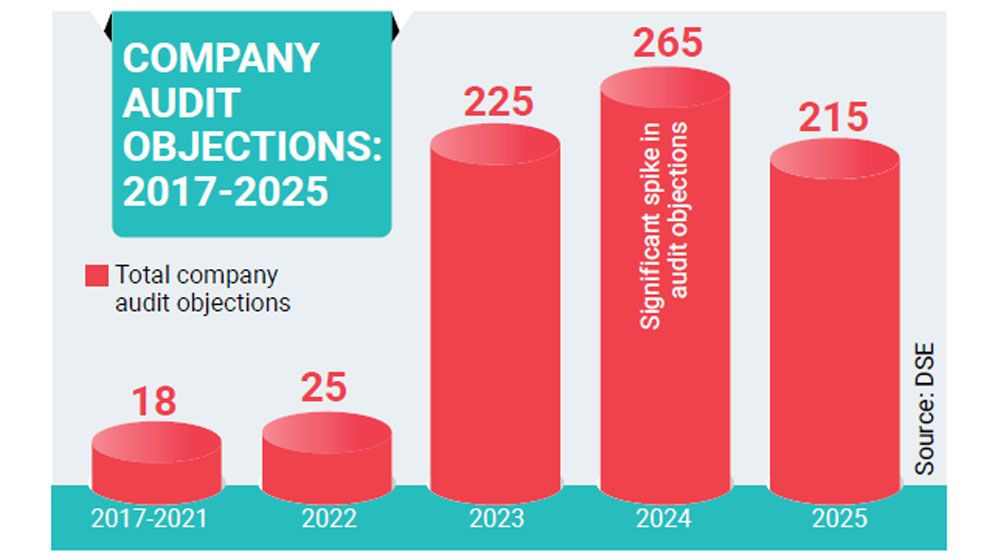
Data analysis from the Dhaka Stock Exchange shows a sharp rise in audit objections in recent years.
Between 2017 and 2021, auditors raised objections to the financial statements of only 18 listed companies. The number increased to 25 companies in 2022.
In 2023, the number jumped dramatically to 225, followed by 265 in 2024. In 2025, auditors found unlawful or misleading financial information in the reports of 215 companies.
Case examples
Apollo Ispat Complex Limited, listed in 2013, raised Tk100 crore from investors through the capital market.
The company is now classified under the Z category, indicating weak performance, and currently incurs nearly Tk50 crore in annual losses.
Auditors reviewing its latest available financial report for 2021 found that several claims in the statements could not be supported by documents provided by the board of directors.
Although the company reported investing hundreds of crores of taka for business development, it failed to produce any agreements or supporting documentation.
In addition, the financial statements showed nearly Tk1,000 crore in accounts receivable, but the company could not specify who owed the money or where the related sales had taken place.
Similar irregularities have also been identified in the banking sector.
Union Bank, which was recently merged into Islami Bank, also presented misleading information in its financial statement for 2024.
While the report suggested strong financial potential, auditors later identified serious irregularities.
According to the audit findings, 74.20% of the bank’s total investments – worth Tk20,989.72 crore – were concentrated in a single borrower group.
However, the financial statements did not disclose the identity of the borrowers, and the bank failed to provide auditors with proper documentation regarding the loans.
Auditors also found major inconsistencies in the financial statements of Sea Pearl Beach Resort & Spa Limited for the fiscal year ending 30 June 2025.
The company faces several ongoing tax disputes in FY21 and FY23.
Despite these claims, the company did not maintain any provisions or recognise liabilities in its financial statements.
Irregularities were also found in VAT-related cases amounting to Tk28.47 crore for FY13, FY14 and FY15.
Although a High Court ruling later reduced the claim to Tk2.07 crore following reassessment by the Chattogram VAT authority, the company still did not maintain any provision against the liability.
Another example involves the non-bank financial institution FAS Finance & Investment Limited, whose financial report for the year ending 31 December 2024 also revealed major inconsistencies.
The company has been incurring continuous losses for several years. As of 31 December 2024, its accumulated losses stood at Tk18,669 crore, while total liabilities exceeded total assets by Tk16,858 crore.
The report also showed a Cash Reserve Ratio (CRR) shortfall of Tk5.92 crore and a Statutory Liquidity Ratio (SLR) shortfall of Tk21.36 crore.
Auditors further noted that a significant portion of the reported SLR consisted of fixed deposits placed with International Leasing and Financial Services Limited and Social Islami Bank PLC, whose recoverability remains uncertain.
Some fixed deposit receipts placed with Premier Leasing and Finance Limited and Social Islami Bank could not be verified.
Additionally, a system error during the adjustment of interest rates on defaulted loans led to Tk34.6 lakh being incorrectly accounted for, resulting in loans and advances being reported lower than their actual value.
BSEC spokesperson Abul Kalam said companies are required to have their financial reports audited externally to ensure financial transparency and market discipline.
“If major discrepancies are found in a company’s financial reports, senior officials of that company are called for hearings. Similarly, auditors are also summoned if inconsistencies are identified in their audit reports,” he said.
Audit oversight
According to BSEC, 45 audit firms are currently enlisted in its panel, effective from 1 October 2024.
Recently, three firms were removed from the panel, reducing the number from 48 to 45.
Only audit firms approved by the BSEC are authorised to audit the financial statements of listed companies.
Under the Companies Act 1994 and securities regulations, auditors are responsible for verifying financial statements and ensuring they present a true and fair view of a company’s financial position.
Their duties include maintaining the accuracy of accounting records, detecting fraud or irregularities, ensuring compliance with legal and accounting standards, maintaining independence and neutrality, and verifying share allocations and dividend distributions.