


 For all latest news, follow the Daily Sun's Google News channel.


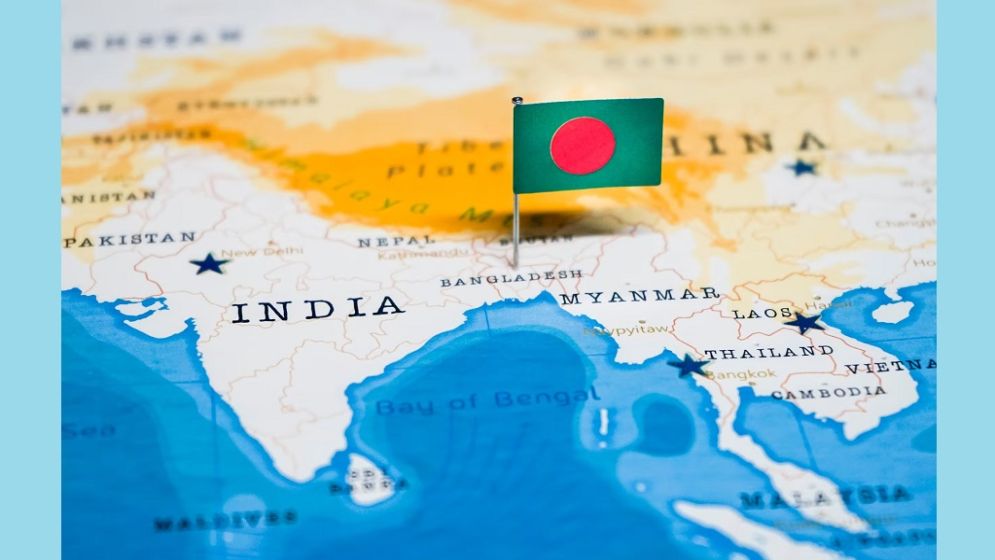
Illustration: Mappr
Bangladesh stands at a defining moment in its history. More than five decades after the Liberation War of 1971, the events of 2024 have reopened a deeper national conversation about political freedom, sovereignty and the direction of foreign policy. The fall of Sheikh Hasina’s long authoritarian rule, following a powerful student-mass uprising, has created both uncertainty and opportunity. At the heart of this transition lies a renewed call for a “Bangladesh First” foreign policy, one that prioritises national interest, democratic accountability, economic self-reliance and balanced regional engagement. The new political reality reflects a broader public demand: Bangladesh must never again allow internal autocracy or external overreach to dilute its sovereignty. While Sheikh Hasina’s tenure delivered notable economic growth and infrastructure expansion, it was also marked by serious allegations of repression, shrinking civic space and excessive concentration of power. Equally contentious was the perception that Bangladesh’s foreign policy tilted too heavily towards one regional power, raising concerns about strategic imbalance.
India’s historical role in Bangladesh’s liberation remains undeniable and deeply embedded in collective memory. However, history alone cannot define present-day diplomacy. Over time, many Bangladeshis came to view several bilateral agreements covering trade, transit, security cooperation, and water sharing as disproportionately beneficial to India. Trade imbalances widened, water disputes such as the unresolved Teesta agreement lingered, and transit arrangements were criticised for lacking reciprocal economic gains. Whether these perceptions were entirely fair or not, they shaped public sentiment and fuelled a desire for recalibration. The “Bangladesh First” approach emerging from this new chapter is neither anti-Indian, nor isolationist. Rather, it is rooted in the principle that every sovereign nation must formulate policy based on its own priorities. This doctrine seeks equilibrium: friendship with all, dependence on none. It recognises geography but refuses subordination. Under this framework, Bangladesh’s foreign policy is expected to pursue diversification. Economic resilience requires expanding trade and investment partnerships beyond any single country. Strengthening ties with Southeast Asia, the Middle East, East Asia, Africa and Europe can reduce structural vulnerabilities. Engagement through BIMSTEC, ASEAN dialogue mechanisms, and broader Indo-Pacific initiatives offers opportunities for multi-vector diplomacy. By widening its network of partnerships, Bangladesh increases its bargaining power and strategic autonomy.
Economic sovereignty is central to this recalibration. A Bangladesh First policy emphasises strengthening domestic industries, reducing trade deficits and negotiating equitable agreements. Rather than rejecting foreign investment, the focus shifts to ensuring transparency, technology transfer, local employment generation, and safeguards against monopolistic dominance in sensitive sectors such as telecommunications, energy and digital infrastructure. National interest becomes the benchmark for evaluating every agreement. Water diplomacy will likely become another priority area. Shared river systems are existential issues for millions of Bangladeshis dependent on agriculture and fisheries. A balanced foreign policy insists on fair, science-based and time-bound water-sharing agreements that reflect humanitarian and ecological realities. Diplomacy in this sphere must be persistent, evidence-driven and assertive without being confrontational. Security cooperation will also undergo scrutiny. While regional collaboration in counterterrorism and border management remains important, Bangladesh First requires that security arrangements clearly align with Bangladesh’s own strategic priorities. Intelligence-sharing, military exercises and border policies must be reciprocal and transparent. Sovereignty is not compromised through cooperation but it must never be diluted through imbalance.
Another dimension of the new foreign policy outlook concerns narrative sovereignty. In an era of information warfare and media influence, Bangladesh is increasingly aware of how external narratives can shape global perception. A Bangladesh First approach includes proactive public diplomacy, strategic communication and engagement with international media to ensure that the country’s political transitions and internal dynamics are portrayed accurately. Protecting national reputation becomes an extension of protecting national interests. The recalibration also reflects generational change. The 2024 movement was driven significantly by young Bangladeshis demanding accountability, democratic renewal and national dignity. Their aspirations extend beyond economic metrics. They seek transparent governance, institutional independence and a foreign policy that reflects confidence rather than dependence. For them, sovereignty is both symbolic and practical means, having the capacity to negotiate as equals. Importantly, Bangladesh First does not imply hostility toward India. Geography ensures interdependence. Cultural ties remain deep, and economic connectivity benefits both sides. However, partnership must be rooted in equality. The recalibration calls for transparent negotiations, fair trade practices, timely resolution of water disputes, and sensitivity in border management. A stable, independent Bangladesh ultimately benefits India as well. Regional stability thrives when smaller states feel respected, not overshadowed.
Diversification may also include deeper engagement with China, Japan, Turkey, Gulf nations and Western economies. Infrastructure financing, energy cooperation, technology partnerships and export markets can be broadened. However, Bangladesh First equally cautions against replacing one dependency with another. Strategic balance, not strategic shift, defines the doctrine. Multi-alignment ensures flexibility in an increasingly polarised global environment. Domestically, strengthening democratic institutions reinforces external credibility. A government that upholds rule of law, press freedom, judicial independence and electoral transparency negotiates from a position of moral strength. International partnerships become more durable when anchored in democratic legitimacy. Sovereignty abroad begins with accountability at home. The new policy vision also recognises that economic self-reliance enhances diplomatic leverage. Investments in education, vocational training, digital innovation, renewable energy and local manufacturing reduce vulnerability to external pressure. When a nation produces competitively and exports diversely, it negotiates confidently. Bangladesh’s growing economy, if strategically managed, can become the foundation of diplomatic independence.
At its core, Bangladesh First revives the spirit of 1971. It acknowledges that independence is not a static achievement but an ongoing responsibility. Autocracy from within and overreach from outside are equally inconsistent with that legacy. A Bangladesh First foreign policy aims to institutionalise balance: open to cooperation, firm on sovereignty. The road ahead will require discipline, unity and strategic patience. Yet the opportunity is historic. By aligning foreign policy with national interest, strengthening domestic institutions and diversifying partnerships, Bangladesh can emerge as a self-assured, resilient state, honouring its past while shaping its future on its own terms.
The writer is a retired Major General, geopolitical and security analyst. He can be reached at [email protected]
Read More