




 For all latest news, follow the Daily Sun's Google News channel.


When Rumeen Farhana, now a member of the 13th National Parliament from Brahmanbaria-2, campaigned before the 12 February election, she repeatedly invoked the legacy of her father, the late politician Oli Ahad.
“He had many dreams. I want to fulfil my father’s dreams by winning this election,” she told voters at campaign rallies.
For many voters, the reference mattered. “Oli Ahad’s reputation has given her a soft corner among voters,” said Naimul Islam, a lecturer at Dhaka University who hails from Brahmanbaria.
Rumeen, daughter of Language Movement figure Oli Ahad who died in 2012, said her father had also contested from the same constituency in 1973 as an independent candidate.
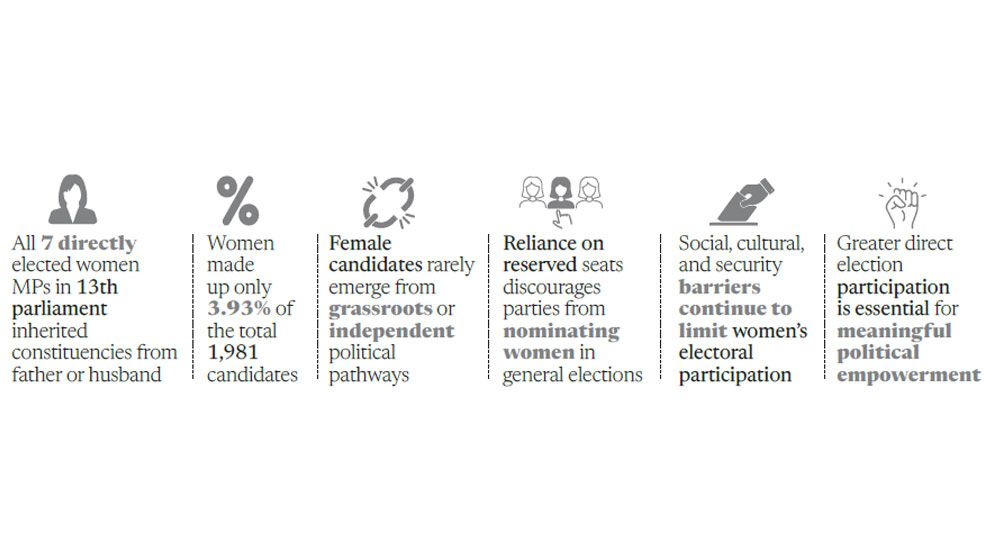
Her path reflects a broader pattern. All seven women directly elected to the 13th parliament from general seats entered politics through family political ties — mostly as daughters or widows of male politicians.
The other six are Afroza Khanam Rita (Manikganj-3), Shama Obaed Islam (Faridpur-2), Farzana Sharmin Putul (Natore-1), Chowdhury Nayab Yusuf Ahmed (Faridpur-3), Esrat Sultana Elen Bhutto (Jhalakathi-2), and Tahsina Rushdir Luna (Sylhet-2). The first three have joined the BNP-led cabinet.
A narrow entry route
Profiles show that all of them came into politics through kinship ties or inherited political legacies.
Five won from constituencies previously represented by their late fathers. Elen Bhutto and Luna secured seats once held by their late husbands.
Rita, elected from Manikganj-3 for the first time and now a minister, is the daughter of Harunar Rashid Khan Monno, a four-time MP and former minister. Her political involvement began during the 2001 election when she served as her father’s chief election coordinator.
Shama Obaed Islam follows the legacy of her father, former minister and ex-BNP secretary general KM Obaidur Rahman. She entered politics after his death in 2007 and has now been elected from Faridpur-2, long regarded as his constituency.
Putul, elected from Natore-1, is the daughter of the late BNP leader and former state minister Fazlur Rahman Patal, who represented the seat four consecutive times.
Nayab Yusuf Ahmed won Faridpur-3, a constituency represented several times by her father, former minister Chowdhury Kamal Ibne Yusuf.
“You had repeatedly voted for my father. This time his daughter is contesting the election. Think of it as casting your vote for Kamal Ibne Yusuf again,” she told voters during her campaign.
Bhutto’s victory in Jhalakathi-2 similarly reinforces a long-standing family presence in the constituency. She first entered parliament in a 2000 by-election following the death of her husband, three-time Jatiya Party MP Zulfikar Ali Bhutto.
“I will always be by their side and strive to honour their trust in our family,” she said after winning again.
Luna’s win in Sylhet-2 is closely tied to the legacy of her husband, BNP leader Ilias Ali, who disappeared years ago.
“This victory comes from people’s love and emotion for Ilias Ali,” Luna said. “People voted to honour his name and expressed their respect and attachment.”
A Sylhet businessman, Rayhan Uddin, said sympathy and loyalty among her husband’s supporters played a major role. “Along with Ilias’s popularity, his disappearance has created a special sympathy for his family, which has brought Luna’s victory.”
Representation at a 25-year low
Despite the presence of these seven MPs, women’s representation through direct elections remains extremely limited.
Only 2.33% of MPs – seven out of 300 – were directly elected women in the 13th parliamentary election, the lowest figure in 25 years. The same number was recorded in the 2001 election.
Women’s representation had been higher in recent parliaments. The 9th, 10th, 11th and 12th parliaments each had more than 20 directly elected women, averaging about 7.67% of MPs.
In the latest election, the number of female candidates also remained small. Of 1,981 candidates, only 78 – about 3.93% – were women.
Less than 8% of female candidates won seats, compared with more than 15% of male candidates.
Political parties fielded few women. BNP nominated only 10 female candidates, around 3% of its nominees, while 30 of the 51 participating parties did not field a single woman.
Barriers to wider participation
Experts and activists point to several structural obstacles behind the low numbers.
Dr Md Shahabul Haque, a professor in the Department of Political Studies at Shahjalal University of Science and Technology, and other analysts say patriarchal political culture, male-dominated party structures and social barriers discourage women from contesting elections.
Kazi Shek Farid, a professor of rural sociology at Bangladesh Agricultural University, believes the role of muscle power in elections discourages female participation.
He also notes that reliance on reserved seats reduces incentives for parties to nominate women in general seats. Women themselves often opt for reserved seats, which are less difficult to secure.
Rumeen Farhana highlighted party reluctance to nominate women candidates.
“Women were made MPs from reserved seats as part of preparations for the general elections later,” she said. “I played a vital role in the parliament as a BNP MP from reserved seats, but the party nominated me for the 13th general elections.”
She eventually contested as an independent after failing to secure the party nomination and was expelled by the party.
“My victory from Brahmanbaria-2 by a huge margin proves that I needed to be nominated,” she said. “Maybe it was because of the patriarchal mentality that I was not given the nomination.”
Women’s rights activist Mardia Mamtaz also points to social attitudes.
“The patriarchal society doesn’t want to see women in extreme power,” she said.
Former BNP MP Nilufar Chowdhury Moni describes the pattern as women entering “the male quota”.
“Each of those who are nominated come from the family of some male leader who could not become candidate due to case or he died,” she said. “It is a kind of quota, because of her father or husband.”
According to her, grassroots women politicians rarely receive the same recognition within parties.
Policy commitments and gaps
Bangladesh has several policy commitments aimed at increasing women’s participation in politics.
The July Charter states that parties will gradually increase women’s representation to 33% and nominate at least 5% female candidates in elections.
The Representation of the People Order also requires political parties to ensure that 33% of their committee members are women. The target, initially set for 2020, has been extended to 2030 after parties failed to meet it.
However, analysts say these commitments have yet to translate into substantial change.
Kazi Farid argues that political parties have largely failed to meet even the 5% candidate target.
Kazi Jesin, convener of Women in Democracy (WiND), said parties should place greater emphasis on women’s nominations.
“The political parties should not neglect women in nomination,” she said. “We hope that women’s participation in various sectors, including parliament, will increase by overcoming various obstacles.”
Representation beyond parliament
The decline in women’s participation is not limited to national elections.
Local government bodies, including union parishads, upazila parishads, municipalities and city corporations, reserve seats for women. Yet participation has also been falling there.
About 90,000 women contested in Union Parishad elections in 1997 when direct elections for reserved seats were introduced. That number gradually declined, reaching around 39,530 candidates in 2016 and remaining roughly similar in 2021.
Very few women have been elected as chairpersons.
Saleha Begum, a former reserved-seat member of Dakshin Banigram Union Parishad in Sylhet’s Kanaighat upazila, said structural constraints limit women’s ability to act.
“Women members cannot do anything meaningful due to the structural constraints,” she said.
Participation in upazila parishad elections has also declined. Around 2,900 women contested in 2009 when a reserved vice-chairman post for women was introduced. The number fell to about 1,507 in 2014 and around 1,450 in 2019.
Maryam Begum, a former vice-chairman of Kanaighat upazila parishad elected in 2014, said the role is often symbolic.
“The representation of women in the upazila parishad is basically symbolic,” she said, explaining why she did not run again.
Toward stronger participation
Despite the decline in direct representation, the current parliament will still have 57 women once the 50 reserved seats are allocated – about 16% of the total 350 seats.
However, researchers say stronger democratic participation requires more women winning seats through direct elections rather than through reserved quotas or family political legacies.
“All but a few of the women we see directly elected in parliament have established themselves in politics because of family connections,” said Mohammad Faisal Akber, a college teacher whose MPhil research examined political family dynasties.
Advocates argue that expanding nominations, addressing security concerns, and creating a more supportive political environment could gradually widen women’s entry into competitive politics.
Mardia Mamtaz said greater participation in decision-making is crucial for the country’s democratic development.
“Participation of women in governing and decision-making processes through gender-sensitive policies is a prerequisite for achieving sustainable development in Bangladesh and building a democratic and equitable social structure,” she said.