



 For all latest news, follow the Daily Sun's Google News channel.


Mansur’s turbulent reform drive at Bangladesh Bank
From exposing record NPLs and dismantling the influence of S Alam Group to stabilising the dollar market amid internal protests, the governor’s term marks a decisive yet contentious chapter for Bangladesh’s banking sector

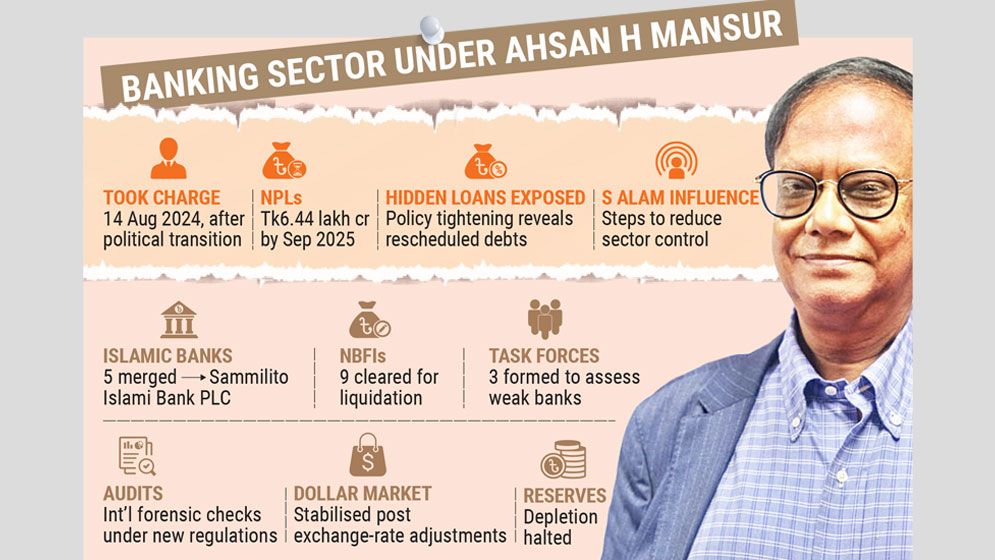
When economist Dr Ahsan H Mansur assumed office as governor of Bangladesh Bank on 14 August 2024, the country’s banking sector was already under severe strain.
Record-high inflation, a volatile dollar market, declining foreign exchange reserves and years of alleged financial irregularities had left the system fragile and vulnerable.
His appointment came in the immediate aftermath of the political transition following the fall of the Awami League government on 5 August 2024.
The then governor, Abdur Rouf Talukder, resigned days later, and Mansur took charge at what many described as one of the most precarious moments in Bangladesh’s financial history.
Reform drive amid instability
Mansur’s tenure has been defined less by administrative continuity and more by structural confrontation.
Under his leadership, the central bank moved to expose the full scale of non-performing loans (NPLs), restructure the boards of several troubled banks and merge weak institutions. These measures brought long-suppressed financial weaknesses into the open.
Three separate task forces have been proposed to determine the true asset values of banks affected by irregularities.
International forensic audits are scheduled to begin next month under newly framed regulations. The outcome is expected to shape capital restructuring plans and resolution strategies for financially distressed institutions.
At the macroeconomic level, the external sector showed partial stabilisation during his tenure, particularly in the dollar market and remittance inflows.
However, liquidity shortages in banks, depositor anxiety and employment uncertainty have continued to pose significant challenges.
Despite the reform push, Mansur’s tenure has not been without controversy.
On Wednesday afternoon, amid reports that he was “being removed,” the governor abruptly left the central bank headquarters.
Later, speaking to journalists, he said, “I have not resigned, but I have heard it in the news,” declining to comment further.
The situation escalated when Bangladesh Bank officials staged a protest rally demanding the withdrawal of show-cause notices and transfer orders issued against three employees.
They also called for the governor’s resignation and announced plans for a pen-down strike if their demands were not met.
In an impromptu press conference following the protest, Mansur responded firmly: “It would take me only two seconds to resign. I came here to serve the nation.”
Overall, his tenure reflects a period of transition rather than stability. It has brought greater transparency to the banking sector and initiated long-overdue structural reforms.
At the same time, resistance from within institutions and lingering systemic weaknesses continue to test the reform process.
For now, Bangladesh’s banking sector remains in a delicate phase – more exposed and reform-oriented than before, yet still striving to regain durable stability.
Read More
Exposing the real picture of banks
One of the most significant developments during Mansur’s tenure has been the exposure of the true scale of NPLs.
By September 2025, defaulted loans surged to Tk6.44 lakh crore, accounting for nearly 36% of total disbursed loans, a historic high.
Following the political transition in 2024, previously concealed loans were brought to light, contributing to the sharp spike.
A white paper published after the change in leadership highlighted long-suspected irregularities in the sector. Industry insiders alleged that during the previous regime, influential borrowers had benefited from regulatory forbearance and policy relaxations that masked the actual volume of bad loans.
Under Mansur, the central bank signalled a shift toward transparency, allowing the full extent of banking-sector vulnerabilities to surface.
Breaking the grip of S Alam Group
Perhaps the most visible and politically sensitive move of 2024 was the dissolution of boards at several banks and efforts to reduce the influence of the S Alam Group.
The group had reportedly gained control of at least eight banks, including Islami Bank Bangladesh Ltd, alongside First Security Islami Bank, Social Islami Bank, Union Bank, Global Islami Bank, Bangladesh Commerce Bank, Al-Arafah Islami Bank and National Bank.
The central bank described the intervention as essential for restoring governance and depositor confidence.
However, substantial liquidity support was required to keep affected institutions operational.
At the time, Governor Mansur assured that no bank would be allowed to collapse, while acknowledging that liquidity support remained insufficient relative to demand.
Merger of five Islamic banks
In another unprecedented step, five financially weak Islamic banks – First Security Islami Bank, Social Islami Bank, Union Bank, Global Islami Bank and EXIM Bank – were merged under the Bank Resolution Ordinance into a new entity, Sammilito Islami Bank PLC, which formally began operations in early December.
The five banks collectively held Tk1.42 lakh crore in deposits from around 75 lakh customers, against Tk1.93 lakh crore in loans, a significant portion of which had defaulted.
Withdrawal restrictions imposed after the merger triggered public anxiety, particularly among small depositors. The move also raised concerns about job security for approximately 16,000 employees.
Although the central bank pledged no layoffs for three years, reports of salary cuts fuelled unease. Since the political transition, more than 6,500 bankers are estimated to have lost their jobs across the sector.
In November last year, the Bangladesh Bank board also approved the liquidation of nine non-bank financial institutions (NBFIs) under the newly framed Bank Resolution Ordinance 2025, the country’s first comprehensive framework for resolving failing banks and non-banks.
The nine NBFIs facing liquidation are FAS Finance, Bangladesh Industrial Finance Company, Premier Leasing, Fareast Finance, GSP Finance, Prime Finance, Aviva Finance, People’s Leasing and International Leasing.
Dollar market stabilisation and remittance growth
While structural weaknesses persisted, Mansur’s tenure also saw signs of macroeconomic stabilisation.
After years of volatility, the dollar market showed relative stability following exchange-rate adjustments by the interim government.
Remittance inflows improved significantly, exceeding US$2 billion per month over the past six months. Between July 2025 and 23 February 2026, remittances grew by nearly 21.9%.
A key policy shift was the suspension of dollar sales from reserves, a move aimed at halting reserve depletion.
According to Bangladesh Bank data, as of 24 February, foreign exchange reserves stood at $30.30 billion under the IMF’s BPM6 methodology, while gross reserves reached $35.05 billion.
Recommended Stories
Read More