


 For all latest news, follow the Daily Sun's Google News channel.


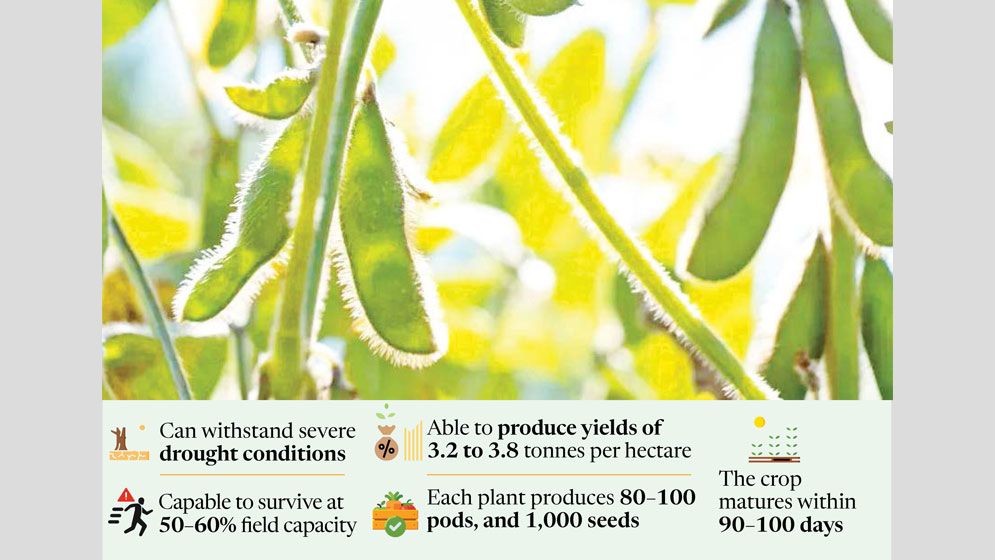
Gazipur Agricultural University (GAU) has developed the country’s first high drought-tolerant inbred soybean variety, named ‘GAU Soybean 6’, marking a significant advancement in climate-resilient agriculture.
The variety was developed under the leadership of Prof Dr MA Mannan of the Department of Agronomy. It is the 94th crop variety released by the university.
The research began nearly a decade ago with the evaluation of about 250 germplasm lines collected from the Asian Vegetable Research and Development Centre, Bangladesh Agricultural Research Institute, and South Korea.
After years of rigorous trials, germplasm ‘G00056’ was identified as drought tolerant. Following further field validation in Noakhali, Lakshmipur and Bhola with support from Solidarity Network Asia, the variety received official approval from the National Seed Board on 11 November 2025.
According to the researchers, GAU Soybean 6 can survive at 50–60% field capacity under severe drought conditions while producing yields of 3.2 to 3.8 tonnes per hectare. Each plant produces 80–100 pods, and 1,000 seeds weigh approximately 230 grams. The crop matures within 90–100 days, allowing farmers to harvest earlier and better manage cropping cycles.
The variety also offers notable nutritional and economic benefits. It contains 40–45 percent high-quality protein and 18–20 percent oil, contributing to efforts to address malnutrition and promote heart health. Its lower trypsin inhibitor content enhances protein absorption in poultry feed, benefiting the poultry industry.
Prof Dr Mannan said the new variety was the result of years of sustained research and field-level efforts. “For drought-prone coastal char lands, where uncertainty once defined soybean cultivation, this variety opens a new horizon of stability and opportunity,” he said.
Vice-Chancellor Prof Dr GKM Mustafizur Rahman described the development as a milestone for Bangladesh’s agriculture, expressing hope that the variety would strengthen national food security and promote sustainable farming systems.
With five previously developed high-yielding salt- and waterlogging-tolerant soybean varieties, the GAU research team continues to advance climate-smart agricultural innovation to support farmers across the country.