




 For all latest news, follow the Daily Sun's Google News channel.


In a significant move to enhance civic services and strengthen governance, the government has undertaken a major reshuffle of the administration.
Officials say the reshuffle is intended to increase efficiency, accountability, and coordination between administrators and stakeholders at the grassroots level, ensuring citizens’ needs are more effectively addressed.

Within a week of assuming office, the BNP-led government removed previously appointed administrators from six city corporations, including Dhaka North and South city corporations, and installed new administrators. All six newly appointed administrators are leaders from the BNP.
In an effort to avoid public confusion over the continuity of governance, the government has announced plans to hold local body elections at the earliest feasible time, reaffirming its commitment to improving household living standards nationwide.
Soon after taking office as the minister of local government, rural development, and co-operatives, Mirza Fakhrul Islam Alamgir emphasised that local government elections would be held as early as possible.
Speaking to reporters at the BNP’s Nayapaltan central office in Dhaka on Monday, Fakhrul said that while administrators have been appointed temporarily, elections will take place “at the right time.”
Fakhrul, who also serves as secretary general of the BNP, noted that according to established procedures, some local government bodies’ terms have not yet expired, while others have.
“We will make arrangements to hold these elections at an appropriate time; however, they will undoubtedly be given priority,” he said.
The statement came shortly after the Local Government Division (City Corporation-1 Branch) announced the appointment of six new administrators across the country’s city corporations.
The reshuffle follows a turbulent political period. After the ouster of the Awami League government in a mass uprising in August 2024, the interim administration took charge and dismissed all mayors and local government chairpersons nationwide. The interim government had later appointed administrators to replace the mayors.
Now, the BNP-led government has replaced those interim administrators with politically affiliated figures.
City corporation administrators
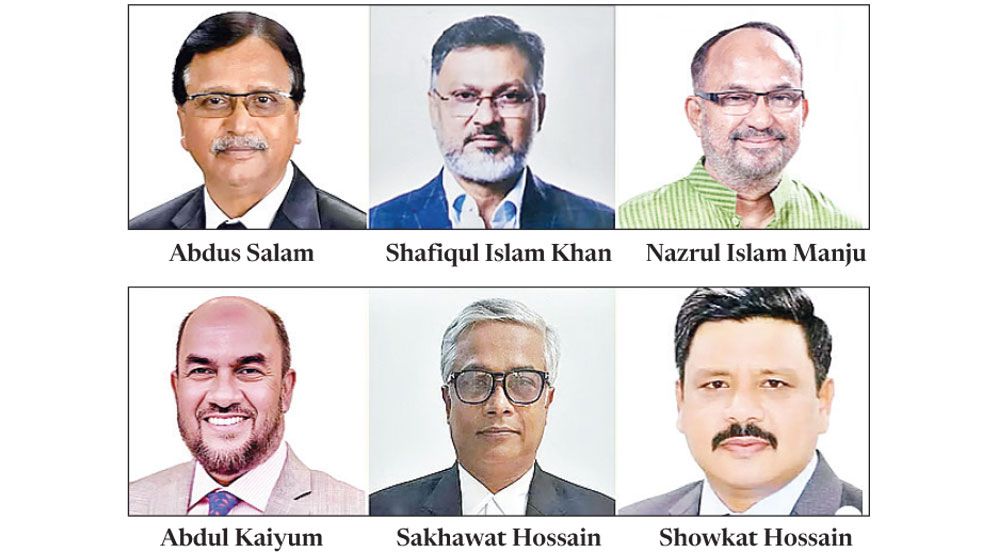
Abdus Salam, a senior BNP leader and former deputy mayor of the undivided Dhaka City Corporation, has been appointed as the new administrator of the Dhaka South City Corporation (DSCC). He is also president of the Dhaka South BNP unit and serves as an adviser to BNP Chairman and now Prime Minister Tarique Rahman. Salam replaces Md Mahmudul Hasan, who had temporarily held the position.
Shafiqul Islam Khan, former BNP-backed candidate in Dhaka-15 during the 13th parliamentary election, has been appointed as Dhaka North City Corporation (DNCC) administrator. Khan, who defeated Bangladesh Jamaat-e-Islami Ameer Dr Shafiqur Rahman in that election, is central vice president of Jatiyatabadi Jubo Dal, the youth wing of BNP. He replaces Suraiya Akhter Jahan.
In Gazipur City Corporation (GCC), Showkat Hossain Sarkar has been appointed administrator. He is president of the Gazipur Metropolitan BNP unit and served ten years as chairman of Kashimpur Union Parishad. Showkat replaces Sharaf Uddin Ahmed Chowdhury, appointed by the interim administration.
In Narayanganj City Corporation (NCC), Sakhawat Hossain Khan, senior vice president of Narayanganj Metropolitan BNP unit, has been named administrator. Known as the lawyer for the Seven-Murder Case, Sakhawat also served as president of the Narayanganj District Bar Association.
He previously ran as the BNP candidate in the 2016 NCC election, losing to Awami League-backed Selina Hayat Ivy by 78,967 votes. Sakhawat replaces former interim administrator Abu Nasir Mohammad Abdullah.
In Sylhet City Corporation (SCC), Abdul Kaiyum Chowdhury, president of Sylhet district unit of BNP, has been appointed administrator.
Abdul Kaiyum has a long political and administrative history, including roles as central office secretary of the BNP Student Wing, organizational secretary and vice president of Jatiyatabadi Jubo Dal, and political secretary to former finance and planning minister M Saifur Rahman. He also served as director of the Bangladesh Cricket Board and is currently a syndicate member at Shahjalal University of Science and Technology. He succeeds Khan Md Reza-un-Nabi, appointed by the interim government.
In Khulna City Corporation (KCC), Nazrul Islam Manju, BNP central organising secretary and long-time leader in the Khulna Metropolitan BNP unit, has been appointed as administrator.
Manju ran unsuccessfully for Khulna-2 in the 13th parliamentary election and previously contested KCC mayoral elections in 2018. He replaces Mokhtar Ahmed, the interim government appointee.
Broader administrative reshuffle
The government has indicated that this reshuffle is part of broader efforts to ensure a pro-people public administration. Plans include strengthening the police force and reshuffling key positions in both the civil and military administrations.
In the Bangladesh Army, several senior appointments were recently announced: Lt Gen Md Mainur Rahman, formerly GOC of the Army Training and Doctrine Command (ARTDOC), has been appointed chief of general staff (CGS). Brig Gen Kaisar Rashid Chowdhury was promoted to Maj Genand named DGFI chief. Meanwhile, former DGFI chief Maj Gen Mohammad Jahangir Alam and previous PSO Lt Gen SM Kamrul Hassan have been posted as ambassadors under the Ministry of Foreign Affairs.
In the civil administration, the government has withdrawn three secretaries from their positions through notifications issued by the Ministry of Public Administration. The secretaries are Md Kamal Uddin (Religious Affairs), Md Saifullah Panna (Prime Minister’s Office), and Rehana Parveen (Secondary and Higher Education Division). All three have been attached to the Ministry of Public Administration.
Criticism of political appointments
The appointment of six politically affiliated administrators has drawn sharp criticism from experts and watchdogs.
Speaking to the Daily Sun, Iftekharuzzaman, executive director of Transparency International Bangladesh, said, “This is a bad example of partisan political control of local government institutions. If people with political affiliation are elected by popular votes through free and fair elections, no one would raise concerns. But ahead of local government elections, already declared by the government, this may be viewed as a strategic measure to influence the upcoming polls.”
He added, “The government should have avoided such a bad precedent so soon after a historic national election that is being widely expected to move away from the culture of monopolistic control of the politico-governance eco-system.”
Prof Sabbir Ahmed of Dhaka University’s Department of Political Science echoed concerns, emphasising that citizen needs should remain a priority despite political considerations.
“I would expect the administrators to ensure that the common people’s needs are addressed without any partisan basis,” he said.
Prof Sabbir also highlighted internal challenges for the BNP, noting that changing mindsets within the party remains a significant hurdle, “It is the biggest challenge for BNP to control hunger in its own party.”
Read More