



 For all latest news, follow the Daily Sun's Google News channel.


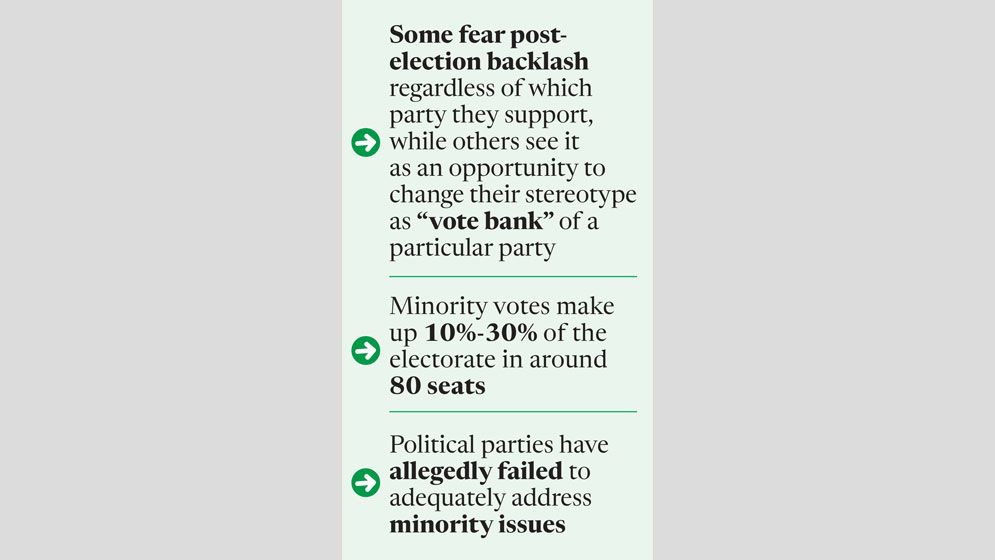
While some voters of minority communities in the country feel apprehensive about the outcome of their participation in the voting process, many others see this year’s election as an opportunity to change the stereotype imposed on them as a “vote bank” of any particular political party.
“We are in a real dilemma. If we vote for BNP, then Jamaat will come after us, and if we vote for Jamaat, then BNP will not take this positively. Even if we don’t go to polling centres, they will tag us as Awami League supporters. No matter what we do, we will be in trouble,” Manoshi Rani Nag, a voter of Aranghata village in Dighalia upazila in Khulna district, told the Daily Sun.
Taking a deep breath, she said apparently no one will trust them due to their religious identity even if they cast their votes in public.
At the opposite end of the spectrum of opinions, many voters belonging to religious or ethnic minority communities have expressed their interest in casting their votes, claiming that this would be an opportunity for them to change the stereotype of being portrayed as Awami League sympathisers.
While talking to this correspondent, Niranjan Sarkar, a voter of Kishoreganj’s Adampur village in Austagram upazila, said, “There are concerns and fears of violence but I will vote. This is my right as a citizen. I think all minority voters along with others should visit the polling centres and exercise their franchise. In the absence of Awami League, it is an occasion to prove that we are not the vote bank of any particular political party.”
According to the Election Commission (EC), a total of 127,711,895 people will be eligible to vote in the 13th national parliamentary election and the referendum. Of them, 64,825,151 are male, while the number of female voters is 62,885,524 and the number of third-gender voters is 1,120.
Can be decisive factors
According to the Election Commission, around 1.22 crore minority voters have been registered to cast their votes. Among them, Hindu voters make up the largest share at approximately 1.1 crore. In addition, there are about 365,000 Christian voters, 790,000 Buddhist voters, and nearly 30,000 voters from other minority communities.
Although they are a minority in terms of numbers within the national vote bank, in certain constituencies these votes can become the deciding factors between victory and defeat.
As per earlier published data, the number of minority voters, in 90 constituencies, particularly Hindu voters, is between 70,000 and nearly 170,000. In 100 constituencies, it ranges from 50,000 to 69,000, while in 110 constituencies there are roughly 20,000 and nearly 49,000 minority voters.
Making up 10% to 30% of the electorate, minority voters can play a big role in determining the fate of candidates in some 80 constituencies, as per the speakers who participated at a discussion arranged by the Centre for Governance Studies (CGS).
In the past, it has been observed that the vote margin between the main rival candidates in these seats is very small; they said, adding that if minority votes swing to one side, the outcome can change entirely.
Parties interested in grabbing minority votes
Political parties are well aware of the minority factor, though their selection of candidates hasn’t largely reflected their understanding.
Minority leaders have expressed frustration, claiming that political parties have failed to address their issues.
The Bangladesh Hindu Buddhist Christian Unity Council has stated that the election manifestos of political parties for the 13th parliamentary election do not provide any assurance of safeguarding the interests and rights of minorities.
Electoral promises, however, cannot confirm advantages every time as despite the Awami League having made several promises in its 2018 election manifesto, including the formation of a “National Minority Commission” and the enactment of a “Special Protection Act”, it did not fulfil these commitments.
In the 13th national parliamentary election, 80 candidates from religious and ethnic minority communities, including 12 independents, are contesting.
Apart from nominating six candidates, BNP has tried to use Hindu Buddhist Christian Welfare Front leaders and its minority leaders to gather support from minority voters in its favour, while Jamaat-e-Islami surprised many by nominating a minority candidate in Khulna-1 constituency for the first time in its history.
Questions of security and trust
Going to the polling stations, safety after voting, and potential reactions after the election results can influence minority voters’ decisions. According to leaders of the Hindu community, the biggest concern for minority voters remains security.A CGS study, published on Sunday, found that some 50.7% of minority voters have expressed concern about their safety, and 25.8% consider participating in voting to be unsafe or extremely unsafe.
Many voters from Hindu, Buddhist, Christian, and other religious and ethnic minority communities are worried about whether they can vote freely and without fear as some recent incidents in Chattogram’s Raozan, Mirsarai and other southern districts have raised concerns among them.
Nirmal Rosario, one of the president of the Bangladesh Hindu Buddhist Christian Unity Council, said, “We do not want to abstain from voting. Voting is our civic duty. But the first condition for exercising that right is life and safety. If life is not secure, then the right to vote becomes meaningless.”