



 For all latest news, follow the Daily Sun's Google News channel.


As Bangladesh enters the long night before decision day, anticipation and quiet tension hang over the country, with millions of voters preparing to head to the polls tomorrow in the 13th parliamentary election – an exercise set to determine the nation’s political course for the next five years after a 17-year gap in competitive national voting.
The election is widely seen as a defining moment in Bangladesh’s democratic journey, following years of political unrest and the July mass uprising that culminated in the collapse of the authoritarian Sheikh Hasina-led government on 5 August 2024.
Across cities, towns and rural communities, people from all walks of life are expressing rare enthusiasm, many describing the election as a long-awaited opportunity to vote freely in a festive atmosphere.
For a generation of voters, including first-time voters, this is the first experience of a genuinely participatory national election.
Years of alleged election rigging and engineering under the previous administration had eroded public trust to the extent that many citizens found it difficult to believe a credible election could take place.
Political analysts say the current environment has helped restore confidence, encouraging voters, including minority communities, to exercise their franchise without fear.
All political parties have wrapped up weeks of campaigning marked by nationwide rallies, door-to-door outreach and mass-contact programmes, during which candidates presented their agendas and visions for rebuilding the country.
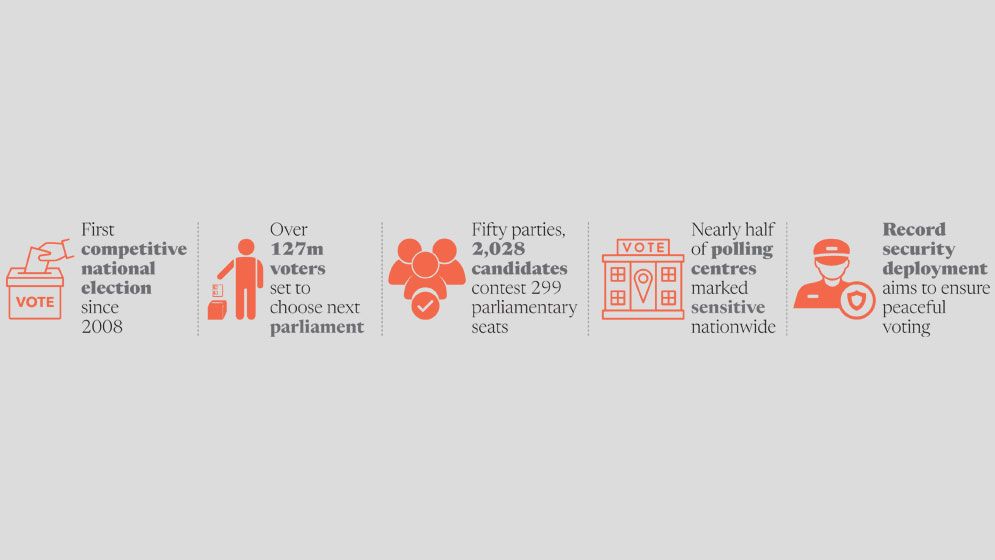
According to the Election Commission (EC), 50 political parties are contesting the election with a total of 2,028 candidates, including 273 independents and 83 women, competing for 299 parliamentary seats.
Polling for the 13th National Parliamentary Election and the referendum will begin at 7:30am and continue uninterrupted until 4:30pm, the EC said.
Bangladesh has approximately 127.71 million registered voters, including 64.82 million men, 62.88 million women and 1,232 voters identified as hijra.
Voting will take place at 42,779 polling centres across the country. Of these, 21,273 are general centres, while 21,506 have been classified as important or risky. Nearly half of all polling centres have been identified as sensitive, according to the EC.
The parliamentary election in the Sherpur-3 (Shribordi–Jhenaigati) constituency has been postponed following the death of a candidate. As a result, voting will be held simultaneously in 299 constituencies instead of the full 300.
Major political parties contesting the polls include the Bangladesh Nationalist Party (BNP), Islami Andolan Bangladesh, Bangladesh Jamaat-e-Islami, Jatiya Party (JaPa), National Citizen Party (NCP) and a significant number of independent candidates.
Candidate distribution shows 290 contenders from the BNP, 227 from Jamaat-e-Islami, 257 from Islami Andolan Bangladesh, 200 from the Jatiya Party, 32 from the NCP and 94 from Gono Odhikar Parishad.
The contest is expected to centre primarily on the BNP-led seven-party alliance and the Jamaat-e-Islami-led 11-party coalition. The Jatiya Party, previously a domestic opposition force in parliament, is contesting 200 seats.
The BNP concluded its campaign with pledges including the introduction of family, farmer and health cards, women’s empowerment, good governance and employment generation for unemployed youth, framing its agenda within the ideals of the Liberation War and the July 2024 uprising.
The Jamaat-led alliance, meanwhile, urged voters to help build a resilient, justice-based, humane and secure Bangladesh, though it faced allegations of misleading voters by invoking religion during campaigning.
On the final day of campaigning, BNP Secretary General Mirza Fakhrul Islam Alamgir said his party saw no “so-called risk” of election engineering in the 12 February polls, citing checks and balances in the electoral system.
Speaking to reporters at his residence in Thakurgaon, he expressed confidence of securing a landslide victory, attributing it to a congenial electoral atmosphere nationwide.
Jatiya Party chairman GM Quader, however, accused the authorities of failing to ensure a level playing field.
“Efforts have been hatched to keep us aside from the election process unfairly, but it finally went in vain,” he told The Daily Sun in his final remarks before polling, pledging to continue politics to ensure the wellbeing of the oppressed and victims of inequality.
While acknowledging uncertainty over how many seats his party might secure, he said the election would strengthen the party’s organisational base and energise its leaders and activists.
In his final address, Bangladesh Jamaat-e-Islami Ameer Dr Shafiqur Rahman said his party was determined to build a Bangladesh free from politics of vengeance and division if it received a mandate from voters on 12 February.
The Election Commission, the constitutional authority overseeing the polls, has accredited 31,801 domestic and international election observers. Journalists from local and international print and electronic media will also monitor the election under the electoral code of conduct.
To maintain law and order, the EC said a total of 970,948 personnel from various law-enforcement agencies have been deployed nationwide.
The deployment includes 100,003 army personnel, 5,000 navy members, 3,730 air force personnel, 37,453 Border Guard Bangladesh members, 3,585 Coast Guard personnel, 187,603 police officers, 9,349 Rapid Action Battalion members and 576,483 Ansar-VDP members.
Additionally, 1,922 BNCC cadets and 45,820 village police members, including chowkidars and dafaders, have been deployed to support security arrangements.
Inspector General of Police Baharul Alam said around 24,000 polling centres – roughly half of the total – have been identified as high or medium-risk.
Political analysts have offered differing views ahead of polling day. Speaking to the Daily Sun, Prof Mahbub Ullah, a writer, journalist and political analyst, said he hoped for a free, fair and transparent election with broad participation.
A large turnout, he said, would help validate the credibility of the election and support a smooth democratic transition.
“If any untoward incident takes place ahead of the election, that will be a big digester for the nation and the credibility of the election will be held questionable,” he said. “I hope no such incidents will take place and the election will be held in a free, fair and peaceful manner.”
Prof Dr Sabbir Ahmed of Dhaka University’s Department of Political Science warned that risks of ballot stuffing, rigging or electoral engineering could not be ignored.
He referred to media reports alleging the inflow of arms and ammunition through border areas ahead of the election, cautioning that if verified, the situation could take a dangerous turn.
On transparency, he noted allegations that the incumbent administration had acted in a biased manner in favour of a particular party.
“We must ensure that the daytime election does not, under any circumstances, take place at night as it did in 2018,” he said, adding that voter turnout would play a decisive role in assessing the credibility of the polls.
The Election Commission has assured voters that all necessary preparations, including security and logistics, are in place to ensure peaceful voting.
As the nation prepares to wake to decision day, millions of voters are expected to determine the direction of governance and policy for the next five years—making this election a critical test of Bangladesh’s democratic renewal.
Three pre-election surveys released in early February have produced mixed projections. Two suggest a strong lead for the BNP, while another indicates a close contest between the BNP and Jamaat-e-Islami, further intensifying political debate and public anticipation.
Chief Election Commissioner AMM Nasir Uddin is scheduled to address the nation today, the day before polling. According to the Election Commission, the speech was recorded at 6pm on Tuesday.