


 For all latest news, follow the Daily Sun's Google News channel.


Technology takes centre stage in most digitised election yet
AI-driven campaigns, mass surveillance and election apps reshape the 2026 polls, raising stakes over security, transparency and trust

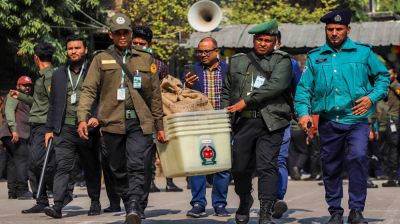
Technology has emerged as a central pillar of Bangladesh’s 2026 national election
Technology has emerged as a central pillar of Bangladesh’s 2026 national election, scheduled for 12 February, transforming campaign strategies and election administration while intensifying debate over digital security, transparency and accountability.
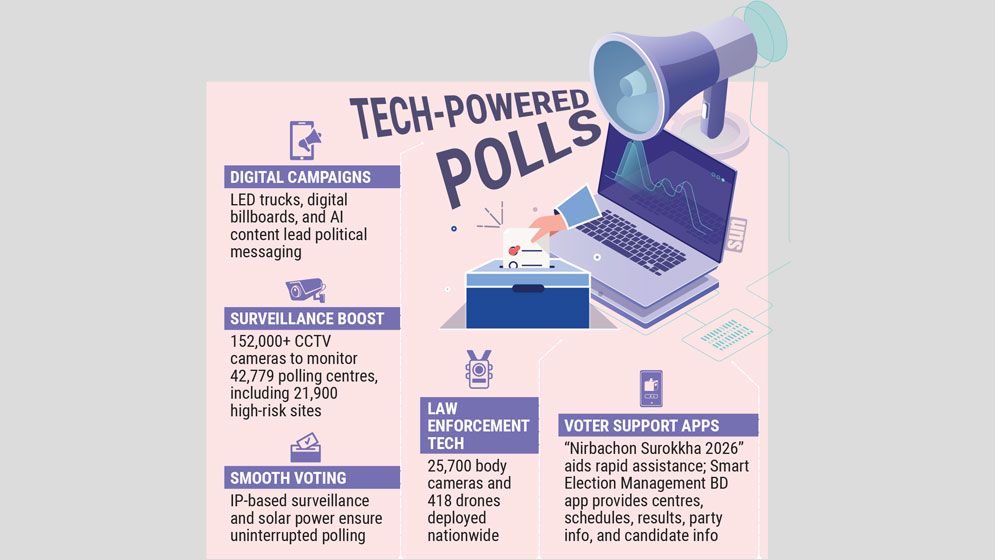
Across major cities, mobile LED advertising trucks and large digital billboards now dominate constituency streets, broadcasting campaign videos and slogans around the clock.
Political parties are also increasingly using artificial intelligence to expand their online reach, producing videos, graphics and simulated scenarios for rapid circulation on social media – marking a sharp shift from campaign practices seen a decade ago.
Beyond electioneering, authorities are deploying an unprecedented range of technologies to secure the polls.
The Election Commission (EC) says more than 1.52 lakh CCTV cameras will be installed at 42,779 polling centres nationwide, ensuring full surveillance coverage.
Of these, over 21,900 centres have been classified as important or high-risk and will be equipped with at least six cameras each.
An IP-based monitoring system will allow returning officers and EC headquarters to observe voting activities in real time.
To mitigate disruptions from power outages, solar panels will be installed at 299 polling centres without grid connections, while generators will serve as backup.
Law enforcement agencies will reinforce security using 25,700 body-worn cameras, primarily at sensitive polling stations. Of these, 15,000 devices will be capable of live streaming via SIM cards and internet connections.
To manage the data, 720 docking stations have been set up at police commissioner offices, range Deputy Inspector General (DIG) offices, superintendent of police offices and police stations, enabling central command centres to monitor live feeds.
Aerial surveillance will also play a key role. Authorities plan to deploy 418 drones operated by the Army, Navy, Police, Coast Guard, Rapid Action Battalion and Ansar to monitor crowd movement and detect potential disturbances.
Digital platforms are expanding their role in election management and voter services.
Members of Bangladesh Ansar and the Village Defence Party will use the “Nirbachon Surokkha 2026” app to report real-time conditions at polling centres, allowing mobile response teams to act quickly using geo-location data.
For voters, the EC has launched the “Smart Election Management BD” app, available on major app stores.
The application provides polling centre locations through geo-mapping, directions, election schedules, results, party information and affidavits submitted by contesting candidates. Voters can verify their status by entering their National ID number and date of birth to receive personalised voting details.
Another application, “Postal Vote BD”, has been introduced to enable digital postal voting for eligible groups, including election officials, postal employees, certain government staff, detained voters and expatriates.
While authorities portray these initiatives as steps toward greater efficiency and transparency, technology policy experts have urged caution.
In a recent paper, the Tech Global Institute noted that digital systems now underpin nearly every stage of Bangladesh’s electoral process – from voter registration and roll preparation to overseas voting and results aggregation.
The organisation warned that heavy reliance on centralised digital infrastructure could amplify governance failures, access-control weaknesses and oversight gaps across the entire electoral cycle.
It identified voter registration, which relies on the national identity database, as a particularly sensitive phase vulnerable to manipulation.
Digital result management has also drawn scrutiny. Although constituency-level results are expected to be shared through the EC’s mobile platform, the report questioned whether verification mechanisms, data delays or selective disclosures could undermine public confidence in early tallies.
Concerns were further raised over the extensive use of CCTV and body-worn cameras.
Without explicit legal safeguards and operational guidelines, the report argued, such systems could be misused, while the absence of clear penalties for disabling equipment or mishandling recordings may weaken accountability.
As Bangladesh moves toward one of its most technologically intensive elections, officials are betting that innovation will bolster security and credibility.
Analysts, however, stress that robust legal frameworks, transparent system design and independent oversight will be critical to ensuring that digital tools strengthen, rather than erode, public trust in the democratic process.