




 For all latest news, follow the Daily Sun's Google News channel.


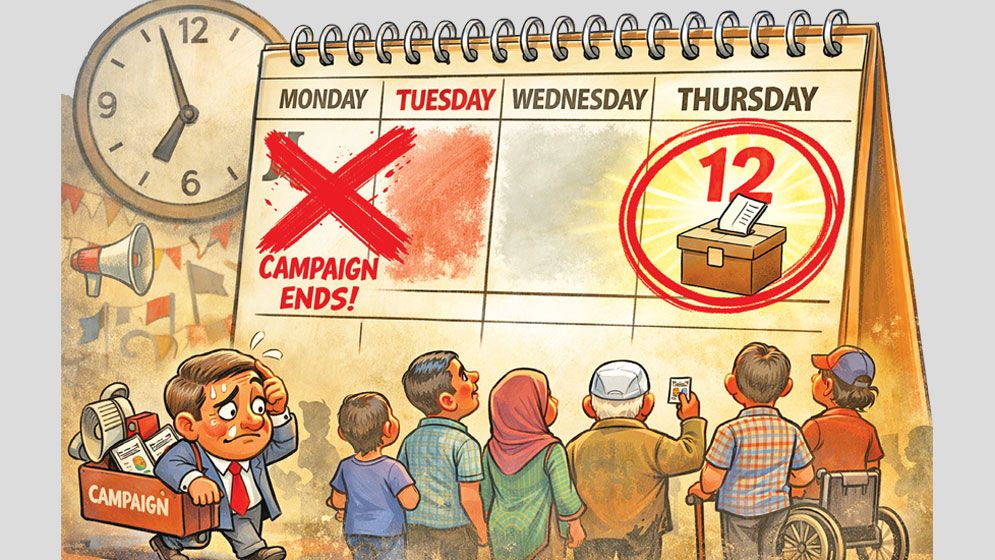
Voters across the country are set to go to the polls on Thursday as campaigning for the 13th parliamentary election and referendum formally ends 7:30am on Tuesday, with the country bracing for voting amid a mix of anticipation, caution and festive enthusiasm.
The election will be held in 299 constituencies, with voting scheduled from 7:30am to 4:30pm on Thursday.
Polling in the Sherpur-3 (Sreebardi-Jhenaigati) constituency has been postponed following the death of a candidate.
A total of 2,029 candidates are contesting the election.
Of them, 51 political parties and 275 independent candidates are in the race. According to the Election Commission (EC), major parties fielding candidates include the BNP with 290 candidates, Bangladesh Jamaat-e-Islami with 227, Islami Andolan Bangladesh with 257, the Jatiya Party with 200, the National Citizens Party with 32, and Gono Odhikar Parishad with 94.
Campaigning began on 22 January and concluded at 7:30pm on 10 February, in line with the official election schedule.
Md Saiful Islam, director (operations) of the National Identity Registration Wing of the EC and Member Secretary of the Central Coordination Committee for the polls and referendum, said all preparations had been completed to ensure a free, fair and peaceful election.
As part of security measures, a ban has been imposed on all public meetings, rallies and processions for 96 hours before and after polling day. In addition, the Election Commission has restricted the movement of individuals outside their respective electoral areas.
Under the directive issued by EC Senior Assistant Secretary Md Shahidul Islam, no individual –except election officials, authorised personnel and registered voters or residents of the constituency –will be allowed to stay in an electoral area from 7am on 10 February to 4:30pm on 13 February.
The restriction covers 48 hours before voting and 24 hours after its completion.
The EC said the measure aims to ensure that the election and referendum are conducted in a neutral, orderly and peaceful environment.
EC withdraws mobile phone ban after backlash
Meanwhile, the Election Commission withdrew its decision to ban mobile phone possession within polling centres just hours after issuing the directive, following widespread criticism from political parties, journalists and civil society groups.
A directive issued on 8 February by the EC’s Election Management and Coordination-1 wing had stated that carrying mobile phones would be completely prohibited within a 400-yard radius of polling centres.
Only presiding officers, officers-in-charge of police duty, and two Ansar members using the “Election Security 2026” app were permitted to carry phones.
The move sparked immediate backlash. Jamaat-e-Islami, the National Citizens Party and several other political parties criticised the decision, while journalist organisations described it as an attempt to restrict information flow and conceal potential irregularities at polling centres.
Facing mounting pressure, EC Senior Secretary Akhtar Ahmed told reporters on Tuesday afternoon that the decision had been withdrawn.
An official from the EC’s election management wing said a formal circular would be issued later the same day.
The episode has raised questions among observers about the commission’s policy consistency, transparency and independence.
EC orders uninterrupted telecom services
In a separate directive, the Election Commission instructed authorities to ensure uninterrupted telecommunications services across the country during the election period.
In a letter signed by Md Shahidul Islam, the EC asked the Local Government Division, the Road Transport and Highways Division, the Power Division, and the Ministry of Posts and Telecommunications to prevent disruptions to communication networks caused by road repairs or development works.
The EC stressed that fast and uninterrupted communication is essential for election-related activities.
All road and highway development work before and after polling must be coordinated with the Bangladesh Telecommunication Regulatory Commission (BTRC), and care must be taken to avoid damage to underground optical fibre cables and other critical transmission lines.
Foreign observers arrive; massive security deployment
A total of 540 foreign observers and journalists have arrived in Bangladesh ahead of the election and referendum, according to an EC press release issued on Monday.
Of them, around 60 are representatives of election commissions and related institutions from various countries, invited directly by the EC. About 330 observers are from international organisations, while nearly 150 foreign journalists representing 45 international media outlets will cover the polls.
To ensure security, approximately 970,000 members of law enforcement agencies have been deployed nationwide. The deployment includes 576,483 members of the Ansar and Village Defence Party, 103,000 from the Army, 5,000 from the Navy, 3,730 from the Air Force, 37,453 from Border Guard Bangladesh, 3,585 from the Coast Guard, 187,603 police personnel, 9,349 members of the Rapid Action Battalion, and 45,820 chowkidars and dafaders.
In addition, 1,051 executive magistrates have been deployed across the country from 8 to 14 February to maintain law and order and conduct mobile courts.
Read More
Tk32 lakh fines for code violations
Over the past month, mobile courts have filed 259 cases across the country for violations of the electoral code of conduct, collecting fines amounting to Tk3,215,950.
According to an EC report covering the period from 8 January to 8 February, executive magistrates detected 461 incidents of code violations nationwide, with cases filed in 259 instances.
The highest number of violations in a single day was recorded on 3 February, when 33 incidents were detected and fines totalling Tk254,400 were imposed in 13 cases.
Monitoring remained tight in the days leading up to the end of campaigning. On 6 February, 28 violations resulted in 12 cases and fines of Tk185,000. On 7 February, 28 incidents led to eight cases and fines of Tk440,000, while on 8 February, 22 violations resulted in 10 cases and fines totalling Tk87,600.
Election officials said mobile court drives would continue to ensure a free and impartial electoral environment, warning that strict legal action would be taken against any candidate or party violating the code of conduct.
The reporter can be reached at: [email protected]
Recommended Stories
Read More