


 For all latest news, follow the Daily Sun's Google News channel.


It was an early winter morning. The surrounding areas of Dinajpur’s Kalitola bus stand were almost dark. Thick fog and wintry wind made things tougher.
After reaching there all the way from Dhaka, while sipping a cup of tea, this correspondent came to know that battery-run auto rickshaw was the only transport to go to historic Kantaji Temple, located 20 kilometer away from the district town on the bank of Dhepa River along the Dhaka- Panchagarh highway.
Passing Hajee Mohammad Danesh Science and Technology University, BKSP, Doshmile, Thakurgaon Road and Tebhaga Square, the auto rickshaw reached the Kaharole bridge, which connected the Dhaka- Panchagarh highway with the road adjacent to the temple.
The Dhepa River has dried up, leaving sandbanks exposed. After crossing the bridge, the Kantanagar Archaeological Museum lied on the left. At such an early hour, it was closed.
But more surprise was waiting as the gates of the Kantaji Temple were closed too. It was 7:45am. Repeated knocking at the two gates of the temple failed to manage any response from inside. A local farmer informed that the gates will be opened at 10:00am.
With the help of another farmer, this correspondent managed to find a way to enter the temple through a cowshed managed by the caretakers of the temple though they didn’t want to allow entrance initially.

It reminded of why eminent archaeologist Abul Kalam Mohammed Zakaria, in his “Bangladesher Protnosompod” (Archaeological Heritage of Bangladesh), described the temple as an unparalleled example of terracotta art and the renowned geographer and researcher of flora and fauna, Francis Buchanan-Hamilton, remarked that he had not seen a more beautiful temple in all of Bengal.
Therefore, following indigenous traditions, the artisans engaged in constructing the Kantaji Temple created remarkable work using terracotta.
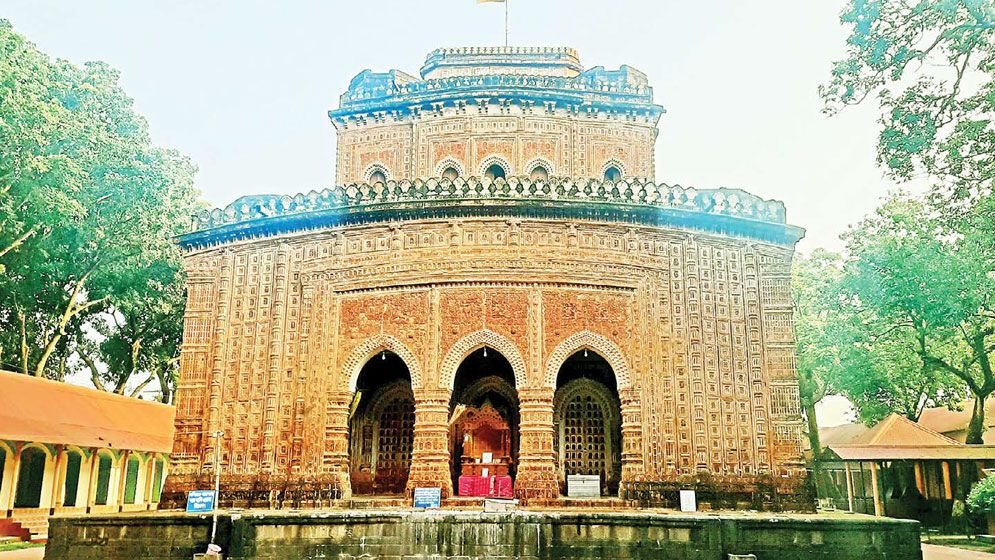
Among the architectural works of Bengal, this temple stands out for its distinction: the terracotta ornamentation on its walls vividly depicts scenes from the “Ramayana”, “Mahabharata”, various other mythological tales and everyday life of the then commoners. It is as though the epics have been rendered visible. Such intricate craftsmanship in terracotta is rare across the entire subcontinent.
The Kantaji Temple stands on a square stone plinth one metre high, each side measuring 60 feet 3 inches. Each side of the temple itself is 51 feet long. A continuous veranda, eight feet wide, runs around the temple, with three entrances on each side. Inside the temple stands the image of Kantaji - that is, Krishna.
Although the temple compound is rectangular, the structure standing on a stone foundation is square in shape. All the entrances on the ground floor feature multi-recessed arches, separated by pairs of brick pillars richly decorated with ornamentation.
From the second veranda on the western side, a staircase ascends to the upper levels. There are 21 doorways and arches on the ground floor and 27 on the first floor, while the third floor has only three on each side.
Originally, the spires rose to a height of 70 feet. In 1897, when the Kantaji Temple was struck by an earthquake, the spires collapsed. Maharaja Girijanath later carried out extensive renovations, though the spires were never rebuilt.
Abul Kalam Mohammad Zakaria, citing the temple’s inscription, notes that the construction was completed in 1752 by the zamindar’s adopted son, Maharaja Ramnath Roy.