



 For all latest news, follow the Daily Sun's Google News channel.


PUBLIC EXPECTATIONS FROM AN ELECTED GOVERNMENT – PART II
Building positive relations in the international arena
Special Correspondent, Dhaka
Published: 02 Feb 2026, 12:00 AM
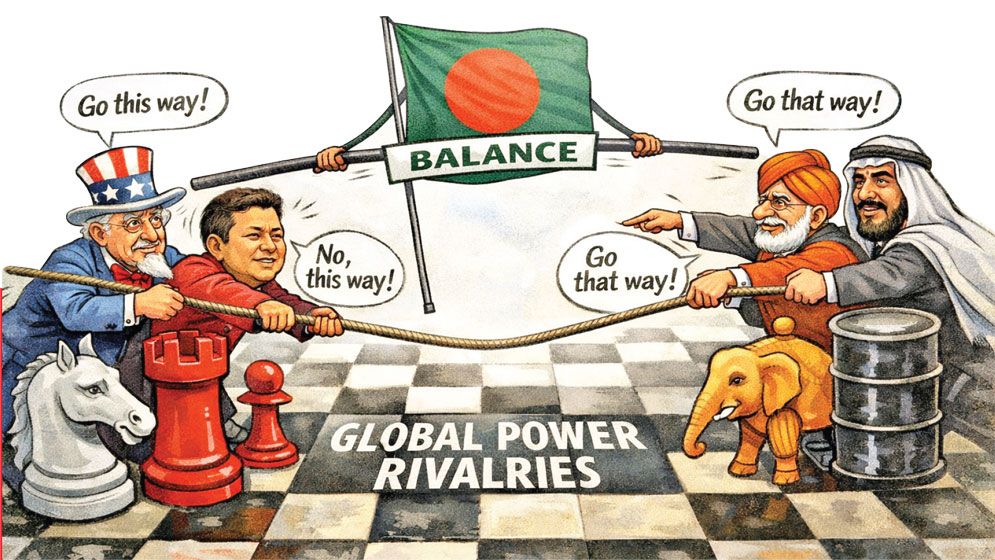
The core principle of Bangladesh’s foreign policy is “friendship with all, malice toward none”. Yet even after fifty-four years of independence, this principle has rarely been reflected consistently in practice. Bangladesh has failed to develop a sustainable and stable foreign policy. Whenever a new party comes to power, foreign policy tends to change direction according to partisan preferences. One party is branded as pro-India, another as pro-Pakistan. One government shows excessive closeness to the United States, while another tilts strongly towards China. These repeated U-turns have created an image crisis for Bangladesh. As a result, some countries hesitate to build long-term relations, while others that were once friendly suddenly become critical and campaign against Bangladesh in international forums. This inconsistency has ultimately harmed national interests.
Over the past fifteen years, Bangladesh’s diplomacy was largely India-centric. In the effort to maintain close relations with India, broader global realities were often overlooked. Relations with the United States deteriorated, while little attention was paid to strengthening ties with Middle Eastern countries. Many diplomatic observers believe that during the last Awami League government, foreign policy was shaped largely in line with India’s interests. On several key issues, including the Teesta water-sharing agreement, Bangladesh appeared weak and overly accommodating.
Following the fall of the Awami League, the interim government initiated a sharp shift in foreign policy. Over the last seventeen months, Bangladesh moved from an India-friendly approach to an overtly hostile stance. Relations between the two countries are now at their lowest point. Hostility with a neighbouring country is never beneficial. Just as the people of Bangladesh do not wish to live under India’s dominance, they also do not want the country to suffer because of extreme anti-India sentiment. Relations with neighbours must be based on friendship, mutual respect and dignity. It must also be recognised that neighbours cannot be changed.
During this period, several negative developments have emerged in Bangladesh’s diplomatic relations. Many countries have restricted or stopped issuing visas to Bangladeshi citizens, which has caused humiliation and frustration among the public. Efforts by the interim government to repatriate the Rohingya to Myanmar have failed, and Bangladesh currently lacks clear direction in economic diplomacy. These failures underline the urgent need for a coherent and effective foreign policy under the next elected government.
Global politics has undergone rapid changes in recent years, and Bangladesh’s position in the international arena is facing increasing scrutiny and pressure. In this context, foreign policy after the election will not be a routine responsibility. It will be a decisive factor linked directly to national security, economic growth and international standing.
National interest must form the foundation of Bangladesh’s foreign policy. The first responsibility of the new government will be to formulate diplomatic strategies that reflect current global realities. The world order is shaped by complex power rivalries, including competition between the United States and China, Europe’s security crisis, instability in the Middle East and the growing strategic importance of the Indo-Pacific region. Bangladesh is not isolated from these developments. On the contrary, its geographic location has made it increasingly significant. The new government must pursue pragmatic diplomacy, free from emotion and partisan bias. Excessive dependence on any single power is risky, but distancing the country from all sides is equally damaging.
Maintaining balance must be at the heart of Bangladesh’s foreign policy. Relations with the United States, China, India, the European Union and the Muslim world all require careful handling. The United States remains one of Bangladesh’s largest export destinations and a major global power. China is a key partner in infrastructure and trade. India is the closest neighbour and a dominant regional force. The European Union is the largest market for ready-made garments. If foreign policy tilts too far in favour of one actor, relations with others will inevitably suffer. Balanced diplomacy, based on professionalism and national interest, is therefore essential.
Economic diplomacy must be prioritised after the election. As Bangladesh prepares to graduate from least developed country status, domestic policy alone will not be enough to meet emerging challenges. Active engagement in trade negotiations, investment promotion and market diversification is crucial. Diplomatic missions must move beyond ceremonial duties and play a proactive role in attracting foreign investment, expanding export markets and creating overseas employment opportunities. Skilled manpower export to the Middle East, East Asia and Europe should be pursued strategically, while clear messages of political stability and policy transparency must be communicated to rebuild investor confidence.
In recent years, Bangladesh has faced criticism over democracy and human rights. While this presents a challenge, it also offers an opportunity. If the new government can ensure democratic governance, uphold the rule of law and protect freedom of expression, these issues will no longer function as external pressures. Instead, they will strengthen Bangladesh’s position internationally. A confident foreign policy begins at home, with credible domestic reforms rather than diplomatic rhetoric.
The Rohingya crisis remains one of the most serious failures of Bangladesh’s foreign policy. Despite carrying a heavy humanitarian burden for years, no meaningful progress has been made on repatriation. The new government must adopt a fresh and realistic strategy. Alongside humanitarian appeals, effective pressure must be applied on Myanmar through international law, regional alliances and sustained diplomatic engagement. Coordinated efforts in forums such as ASEAN, the OIC, the United Nations and international courts are essential.
Strong regional cooperation is equally important. Relations with neighbouring countries, including India, Nepal, Bhutan and Myanmar, are central to Bangladesh’s foreign policy success. Cooperation in power sharing, water management, transit and trade must be strengthened. At the same time, Bangladesh must play a more active and effective role in regional groupings such as BIMSTEC and IORA. Weak relations with neighbours inevitably undermine a country’s global diplomatic standing.
Finally, foreign policy must be kept above partisan politics. Professionalism in diplomatic appointments, continuity in policy direction and the avoidance of abrupt shifts with changes in government are essential features of a mature and credible state. If the new government can pursue a confident, balanced and interest-driven foreign policy, Bangladesh will not only navigate global challenges but also strengthen its position as a respected member of the international community. In today’s world, foreign policy is no longer a luxury; it is a strategy for national survival.