



 For all latest news, follow the Daily Sun's Google News channel.


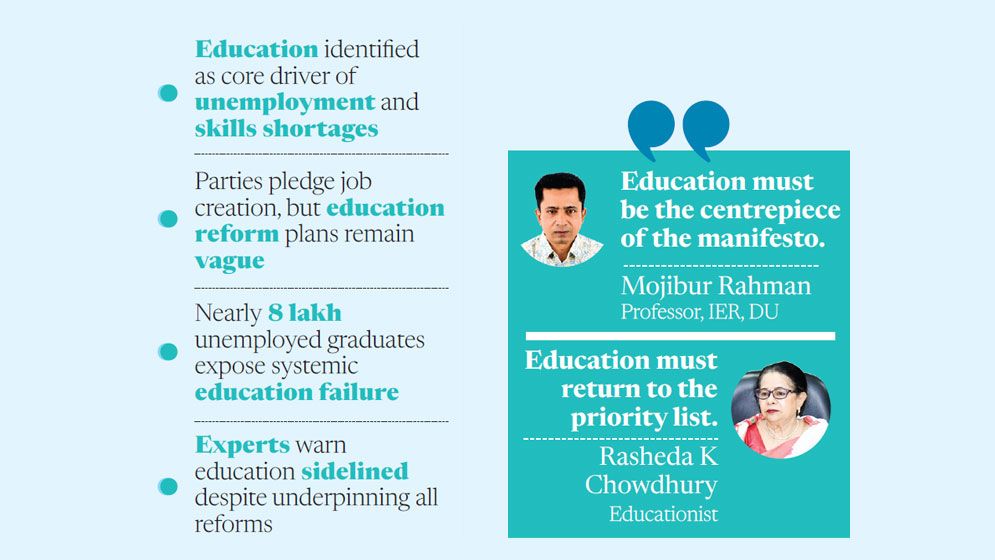
As Bangladesh heads towards the 13th parliamentary election 2026, education has emerged as a defining fault line – linking unemployment, skills shortages and declining academic standards –prompting analysts to urge political parties to place the sector at the heart of their manifestos.
With major parties finalising their election pledges, debate is intensifying over whether education will receive the priority many believe it urgently requires.
Analysts argue that the success of any manifesto commitment – whether on jobs, health or economic growth – ultimately depends on the quality of the education system.
Despite the interim government setting up more than a dozen reform commissions, none has been dedicated specifically to education, a gap experts say undermines broader reform efforts.
Against this backdrop, questions are being raised about how political parties plan to address education reform and youth empowerment, particularly at a time when young voters could play a decisive role.
Mohammad Mojibur Rahman, professor at the Institute of Education and Research (IER) at the University of Dhaka, said education must be the central pillar of any election manifesto.
“Everything in the election manifesto will be implemented through education – in other words, education will be the centrepiece of everything,” he told the Daily Sun.
“First and foremost in the manifesto should be education, along with employment for young people. There must be emphasis on technical education to produce skilled workers. Next should come health. The environment is equally important because all our environmental indicators are alarming. There must also be a comprehensive roadmap for agriculture,” he said.
Mojibur Rahman added that civil liberties and national security were inseparable from education policy.
“Freedom of expression is also important. People should be able to express their opinions and beliefs and move forward while maintaining their individuality. Due to geopolitical reasons, security is also important. Education is at the heart of all of this,” he said.
Youth vote and unemployment pressure
An estimated 30 million young voters are expected to influence the outcome of the election, prompting parties to unveil youth-focused pledges, particularly around jobs.
According to the Bangladesh Bureau of Statistics Labour Force Survey, the country currently has 2.6 million unemployed people, including nearly 800,000 graduates. The figure continues to rise amid limited employment opportunities.
In response, the BNP has pledged to create one crore jobs. Jamaat-e-Islami, at a recent policy summit, proposed providing interest-free monthly loans to unemployed graduates until they secure employment.
The National Citizen Party (NCP) has also included job creation in its manifesto.
Analysts say employment promises must be backed by skills-based education reforms, entrepreneurship support, expanded training centres, political stability, overseas employment strategies, and stronger monitoring mechanisms.
Recommended Stories
Falling standards and policy uncertainty
Rasheda K. Chowdhury, education adviser to the former caretaker government, said tackling unemployment required not only increased investment but better targeting and transparency.
“If we want to eliminate unemployment, we need to increase investment. But it is not enough to simply increase spending – we must decide clearly where and how that money is allocated. Investment must be used properly and transparently,” she said.
She warned that education quality at all levels – primary to university – had failed to meet acceptable standards. Budgetary allocations remain inadequate, while several initiatives under the previous government were widely questioned.
A newly introduced curriculum was implemented without sufficient preparation and has since been scrapped by the interim government, leaving students, teachers and parents frustrated by constant policy shifts.
Meanwhile, a series of irregularities – from teacher recruitment to admission tests and public job exams – has further eroded confidence in the system. Many educators fear education quality is approaching “rock bottom”.
“These problems are why political parties must give education extensive priority in their manifestos,” Chowdhury said.
“The economy and politics are important, but why have education and health fallen behind? Education must be restored to a place of priority. There must be decentralisation in education management and decision-making. There is no alternative to increasing investment.”
She added that Bangladesh was slipping behind in both equitable access to education and overall quality.
“All stakeholders must be involved in planning. It cannot be done with only teachers. Everyone must be brought together. Political parties must reflect these realities in their manifestos,” she said.
Recommended Stories
Fragmented system, divided curricula
Bangladesh currently operates multiple streams of education across primary, secondary, higher secondary and university levels, with different curricula running in parallel – an arrangement critics say deepens social and educational divides.
Professor Rahman argued that while institutional diversity should be preserved, all systems must be connected to the national mainstream.
“To build a nation, there needs to be unified thinking. Everything must be done through education, and the election manifesto must have a clear keyword,” he said.
He also highlighted the country’s literacy challenge.
“One-fourth of the population is still illiterate. It is impossible to advance while keeping several crore people illiterate. The manifesto must clearly state by which year 100% literacy will be achieved. A crash programme can be undertaken for this purpose,” he added.
The reporter can be reached at: [email protected]/01521208190