


 For all latest news, follow the Daily Sun's Google News channel.


Myanmar election delivers victory for military-backed party
Volker Turk condemns the Military staged polls
Reuters, Myanmar
Published: 31 Jan 2026, 12:00 AM
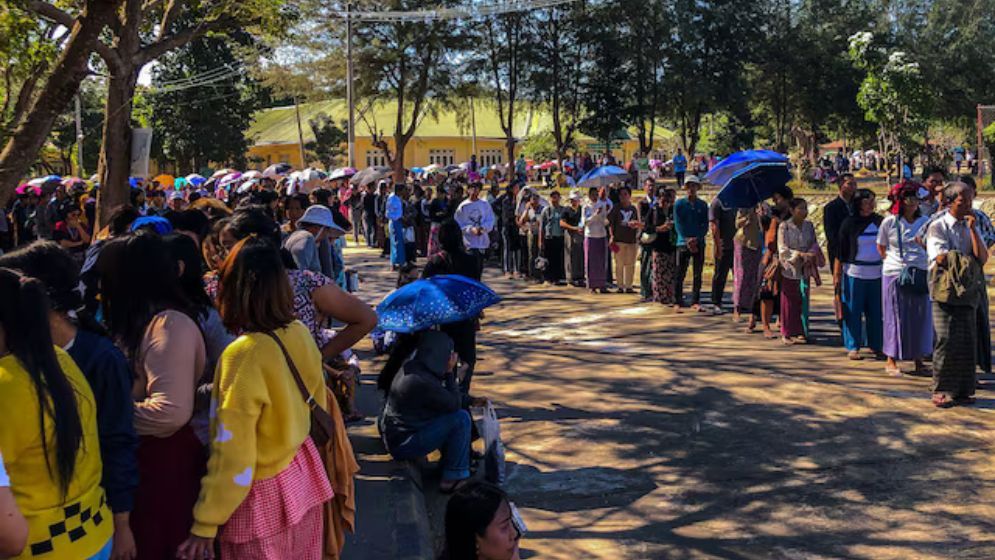
People queue to cast their votes at a polling station during Myanmar's general election in Naypyitaw, Myanmar, 28 December, 2025. Photo: Reuters
Myanmar's military-backed party has completed a sweeping victory in the country's three-phase general election, state media said, cementing an outcome long expected after a tightly controlled political process held during civil war and widespread repression.
The Union and Solidarity Party (USDP) dominated all phases of the vote, winning an overwhelming majority in Myanmar's two legislative chambers. It secured 232 of the 263 seats up for grabs in the lower Pyithu Hluttaw house and 109 of the 157 seats announced so far in the Amyotha Hluttaw upper chamber, according to results released on Thursday and Friday.
Myanmar's parliament is expected to convene in March to elect a president, with a new government set to take over in April, pro-military Eleven Media Group reported earlier this month, citing junta spokesman Zaw Min Tun.
The final round of voting in late January brought an end to an election that began on December 28, more than four years after the military seized power in a coup that overturned the elected government of Nobel Peace Prize laureate Aung San Suu Kyi.
The 11-member Association of Southeast Asian Nations has said it would not endorse the process, and human rights groups and some Western countries have also denounced the election as a sham.
Suu Kyi's National League for Democracy (NLD) was dissolved along with dozens of other parties, and some others declined to take part, drawing condemnation from critics who say the process was designed to entrench military rule.
Under Myanmar's political system, the military is also guaranteed 25% of parliamentary seats, ensuring continued control even after power is formally transferred to a civilian-led administration.
The party is chaired by a retired brigadier general and packed with other former high-ranking officers. It contested the poll with 1,018 candidates, a fifth of the total registered.
Junta chief Min Aung Hlaing is also expected to play a central role in the next administration.
Meanwhile, condemning the election Volker Türk on Friday deplored that the military-imposed elections failed to respect the fundamental human rights of Myanmar’s citizens and the process served only to exacerbate violence and societal polarisation.
The military staged election has deepened the profound despair the people of Myanmar have felt since the Junta seized the power, Volker remarked in a UN press release.
Volker said, “The conflict and insecurity continued unabated in large parts of the country. Opposition candidates and some ethnic groups were excluded.”
Credible sources verified that the military arrested 324 men and 80 women under its election protection law and imposed disproportionate penalties, including a 49-year sentence for posting anti-election material.
Voter coercion was reported nationwide, including over 100 villagers in Sagaing detained and forced to cast advance ballots on 6 January, while others voted under threats of conscription, food loss, or denial of passport renewals or university registrations.
Volker said, “Now, the military is seeking to entrench its rule-by-violence after forcing people to the ballot box. This couldn’t be further from civilian rule.”
Volker also called for the immediate release of NLD leader Aung Suu Kyi and President Win Myint, both of whom remain held at undisclosed locations with no information about their condition and well-being.
He said that due to the disastrous mismanagement of the country’s economy by the military, a quarter of Myanmar’s population now faces high levels of food insecurity, and a third are in urgent humanitarian need.
Calling the States with influence to redouble efforts to end the violence Volker said, “Now is the time to find new pathways to restoring democracy and respect for all human rights, as demanded by the Myanmar people for half a decade.”