


 For all latest news, follow the Daily Sun's Google News channel.


BTMA warns of indefinite shutdown over yarn import policy
Textile millers demand withdrawal of duty-free 10-30 count yarn imports, citing mounting losses, factory closures, and risks to $23b in investments
Daily Sun Report, Dhaka
Published: 23 Jan 2026, 12:00 AM
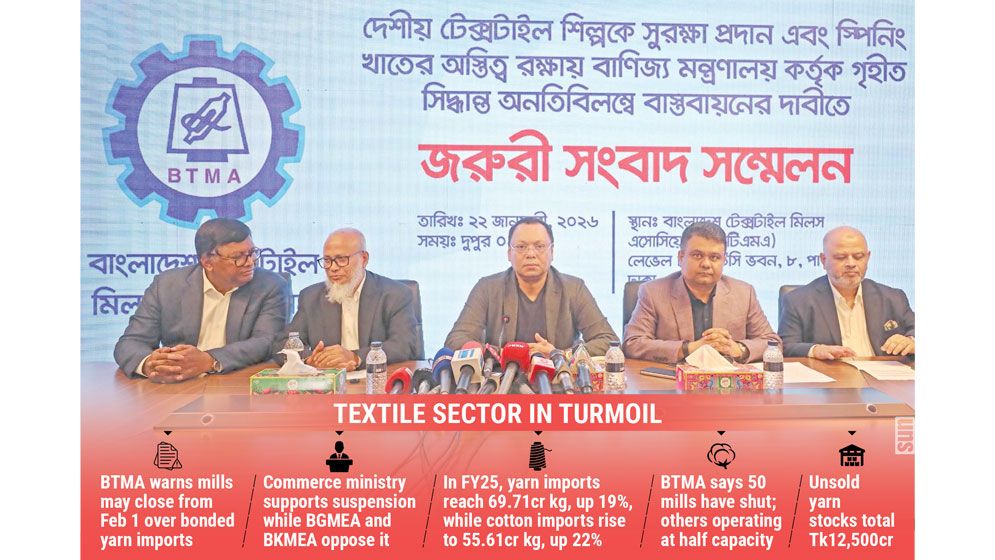
The Bangladesh Textile Mills Association (BTMA) warned of an indefinite shutdown of spinning mills from 1 February if the government fails to withdraw the duty-free import facility for 10-30 count cotton yarn within the next seven days.
BTMA President Showkat Aziz Russell issued the warning at a press conference at the association’s auditorium in the capital on Thursday.
BTMA Directors Badsha Mia, Chowdhury Mohammed Hanif Shoaeb and Mohd Khorshed Alam, former director Md Mosharraf Hossain, and Rajib Haider, among others, were present.
Showkat said the commerce ministry had already recommended suspending the bonded facility on imports of 10-30 count yarn to protect local spinning mills, and conveyed the decision to the National Board of Revenue (NBR) through a letter on 12 January. However, the recommendation has yet to be implemented.
According to BTMA data, imports under HS codes 52.05, 52.06 and 52.07 rose sharply – from 35.08 crore kg in FY23 to 58.84 crore kg in FY24, and further to 69.71 crore kg in FY25.
During the same period, Bangladesh imported 55.61 crore kg of cotton in FY25, up 22.22% from the previous fiscal year.
The millers said they are incurring losses of about 30 cents per kilogram of yarn, eroding their capital to less than half.
They said many entrepreneurs were on the verge of losing their ability to import cotton. In such a situation, there is no alternative but to shut down factories. They warned that any further delay would worsen the crisis.
The BTMA leaders said that if decisions were not taken immediately, the consequences would be far more severe, and they would become evident once an elected government came to power.
Showkat cautioned that any labour unrest resulting from factory closures would be the government’s responsibility.
“It will no longer be possible for us to repay liabilities to banks and financial institutions. As a result, the government will have to bear full responsibility for any crisis in the banking and financial sectors,” he said.
He also criticised what he described as a lack of policy support for the domestic textile industry.
“Recently, we have seen strong patriotism from the government on cricket-related matters, but we do not see the same commitment to protecting the domestic textile industry. This raises questions about whether there is a larger conspiracy at work,” he said.
Calling the situation a “national crisis,” Showkat said the textile sector contributes 13% to the country’s GDP, yet the interim government has not spared “13 minutes” to listen to the industry.
He added that 50 textile mills have already shut down, while others are operating at around 50% capacity. Unsold yarn worth Tk12,500 crore is currently lying in factories.
Showkat warned that investments of $22-23 billion are at risk, which could have a serious impact on employment, non-performing loans in the banking sector, and the overall economy. The sector employs mil-lions and has invested around $23 billion, he said.
He noted that with government support, the industry had earlier achieved 100% yarn self-sufficiency for knit garments and 70% for woven garments, but the spinning sector is now facing a severe crisis.
He urged the government to provide a 10% incentive, citing policy support offered to the textile sector in India.
The BTMA president also expressed concern over Bangladesh’s upcoming graduation from least developed country (LDC) status without adequate preparation. “Where is the government’s preparation?” he asked.
“Although we are going through a difficult time, the government is benefiting from ports and the Export Development Fund (EDF). This is not the time to remain silent,” he said, adding that policy support is essential to develop man-made fibre production.
The spinning mills are also under pressure from corporate tax, turnover tax and VAT payments, Showkat said.
“If the bonded facility for yarn imports is not withdrawn, it appears the decision has been taken to deliberately stop domestic cotton yarn production,” he added.