


 For all latest news, follow the Daily Sun's Google News channel.


Tarique Rahman calls for democratic renewal, unity, accountability
Daily Sun Report, Dhaka
Published: 11 Jan 2026, 12:00 AM
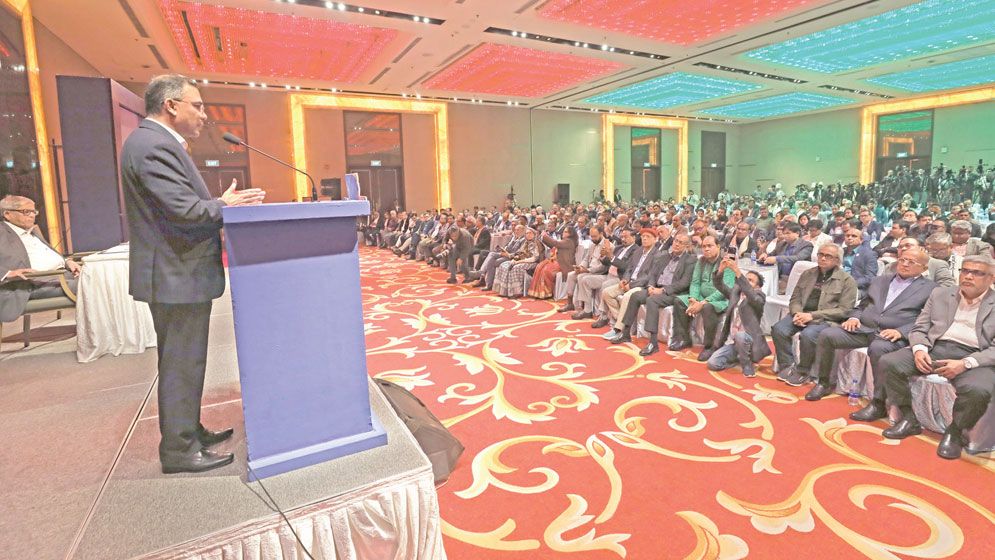
BNP Chairman Tarique Rahman addresses a views-exchange meeting with editors and senior journalists from national media outlets at a city hotel on Saturday. -kamrul Islam Ratan
BNP Chairman Tarique Rahman on Saturday emphasised that Bangladesh must move forward by strengthening democratic processes, unity and accountability, rather than slipping back into vengeance, intolerance and political division.
Addressing editors and senior journalists at a views-exchange meeting in the capital, he said there was no justification for returning to the political situation that prevailed before 5 August 2024, stressing that political differences of opinion must never be allowed to turn into divisions that fracture the nation.
Tarique Rahman made the remarks while exchanging views with editors and senior journalists from various print, electronic and online media outlets at Hotel Sheraton in Banani.
The event marked his first formal interaction with journalists since assuming the post of BNP chairman on Friday night.
“We had our challenges and we still do, but we must not want to go back to the situation before 5 August,” he said categorically, underscoring the need for a forward-looking political culture grounded in tolerance and democratic values.
He reiterated that the BNP, if voted to power in the upcoming general election scheduled for 12 February, intends to take the nation in the right direction by prioritising democracy, inclusivity and institutional accountability.
Reflecting on personal and national experiences, Tarique Rahman said, “If I think from my position, a funeral in 1981, another on 31 December 2025 lie on my one side, while the event of 5 August 2024 lies on my other side. So, I believe this is not just a lesson for me alone, but for the leaders and activists of my party and for the people of the country as a whole.”

“These examples are perhaps the clearest reminders that there is absolutely no reason for us to go back to the situation before 5 August,” he added.
Referring to the political upheaval of 5 August 2024, the BNP chairman said the day served as a stark warning of the consequences that individuals, parties or groups face when politics is driven by envy, revenge and vengeance.
“On 5 August, we witnessed the consequences that a person, a party, or any group can face when politics is driven by envy, revenge and vengeance. That is why I urge everyone, irrespective of party or opinion, to address differences if they persist among us through constructive criticism,” he said.
He cautioned that differences must never be allowed to degenerate into divisions.
Tarique Rahman stressed the importance of restoring democratic practices at all levels of governance.
He said democracy must function not only at the national level but also in grassroots institutions, including union parishad elections, municipal polls and even elections of professional and trade bodies.
Calling for sustained civic engagement, he urged members of all political parties and people across society to remain actively involved in democratic processes. “As a political worker, I see many tough challenges ahead,” he said.
Tarique Rahman returned to Bangladesh on 25 December last year after nearly 18 years of exile in London.
His return came amid profound personal loss, as his mother, former prime minister and ex-BNP chairperson Begum Khaleda Zia, passed away on 30 December. He formally assumed the role of party chairman on 9 January.
Speaking about his recent interactions outside Dhaka, he said, “After returning to my country, I have had a few opportunities to go outside of the capital. I went to Savar and a few other places. It seems to me that the new generation is looking for guidance and hope of light.”
“Not just the new generation,” he continued, “it seems to me that every generation is looking for some guidance. We who are politicians, there may be a lot of expectations for us, but it may not be possible to fulfil all the expectations.”
Nevertheless, he expressed confidence that principled leadership could guide the country forward.
“But if we politicians keep events like 1971, 1990 and 5 August 2024 in mind and work for the country’s independence and sovereignty, then I firmly believe, as a politician, we will be able to guide the nation in the right direction,” he said.
Highlighting the plight of farmers, Tarique Rahman pointed out that around 1.5 crore farmers feed a population of nearly 20 crore, yet lack platforms to articulate their demands.
“They do not have a place to speak about their demands like those of journalists. The politicians must listen to the farmers,” he said.
Turning to social policy, he cited several achievements of former prime minister Begum Khaleda Zia, particularly her role in expanding women’s education.
He said that if the BNP forms the next government, it would focus on empowering women by making them financially self-reliant.
“According to our calculation, there are four crore families in the country. If we divide it into families, on average, a family has five members. I have already spoken about the family cards and it will aim to empower the women so that they can build the society,” he said.
The BNP chairman also outlined plans to introduce farmers’ cards and spoke about the complexities of implementing a nationwide health card system in a country of 20 crore people.
“There is a challenge in introducing health cards,” he acknowledged, adding, “but we can at least say we will ensure health facilities for everyone.”
Drawing comparisons with international healthcare systems, he said, “Whether it is bypass surgery, cardiac treatment, or cancer care, the UK government provides a wide range of medical services. But what we are now seeing is that even the developed European countries like the UK are struggling to manage this. Their current focus is on prevention.”
He explained that disease prevention through public awareness could significantly reduce state expenditure.
“If we can now prevent these diseases by creating awareness among the people, then they will remain healthy, while it will help reduce the state expenses a lot. The European countries are now relying on this process and we want to appoint healthcare providers based on this to make the efforts successful,” he said.
Seeking the cooperation of the media, Tarique Rahman urged journalists to offer constructive and meaningful criticism.
“I expect criticism that is aimed at helping move the country forward, not criticism for the sake of criticism,” he said.
“We want to receive such criticism from you that will help solve the problems that the people of the country are facing now,” he added.
In a gesture that drew appreciation from those present, Tarique Rahman requested journalists not to address him as “honourable”.
At his instruction, the security enclosure separating him from journalists was also removed, creating a more open and informal environment for dialogue.
In his welcome address, BNP Secretary General Mirza Fakhrul Islam Alamgir said the people of Bangladesh were looking to Tarique Rahman with great expectations amid the country’s current challenges.
He expressed hope that Tarique’s return would help create the conditions for establishing a genuinely liberal and democratic system.
“Our leader Tarique Rahman returned to the country from abroad at a very difficult time, when the people of the entire country are looking at him with great expectations,” Fakhrul said.
At the outset of his speech, Fakhrul paid tribute to the late Begum Khaleda Zia and remembered the freedom fighters of 1971 as well as the martyrs of the student uprising of 2024.
“We would like to remember with respect those of our sons and daughters who gave us an unprecedented opportunity to build a democratic Bangladesh in 2024,” he said.
Upon entering the venue, Tarique Rahman exchanged greetings with editors and senior journalists from a wide range of media organisations, marking his first engagement with the press since taking charge of the party.
The meeting provided a platform for open dialogue between senior media figures and the BNP leadership, with discussions centring on democracy, press freedom, governance, political culture and emerging national challenges.
Editors and journalists shared their concerns, expectations and visions for Bangladesh’s democratic future during the exchange of views.
Speaking at the programme, Mahfuz Anam, editor of The Daily Star, said, “We want democracy, independent journalism, and good governance.”
He also noted that political parties were paying insufficient attention to climate change, despite Bangladesh being among the most climate-vulnerable countries in the world.
“It is quite incredible how we are moving towards river pollution and doing nothing about it. Another major issue is our groundwater, which also needs to be addressed,” he said.
Nurul Kabir, editor of New Age, said that instead of blaming one another, the time had come to discuss how to move forward by giving political and social developments an institutional shape.
“If we want a democratic transformation in Bangladesh in the future, there must be a democratic environment for journalism alongside democratic politics,” he added.
Addressing Tarique Rahman directly, Mahmudur Rahman, editor of Amar Desh, said that having been outside the country for 17 years, the BNP chairman might not have fully realised what had transpired in Bangladesh during that period.
Manabzamin Editor-in-Chief Matiur Rahman Chowdhury and Jai Jai Din Editor Shafik Rehman also spoke at the programme, along with several other senior journalists, contributing to a wide-ranging and candid exchange of views on the nation’s political future.