



 For all latest news, follow the Daily Sun's Google News channel.


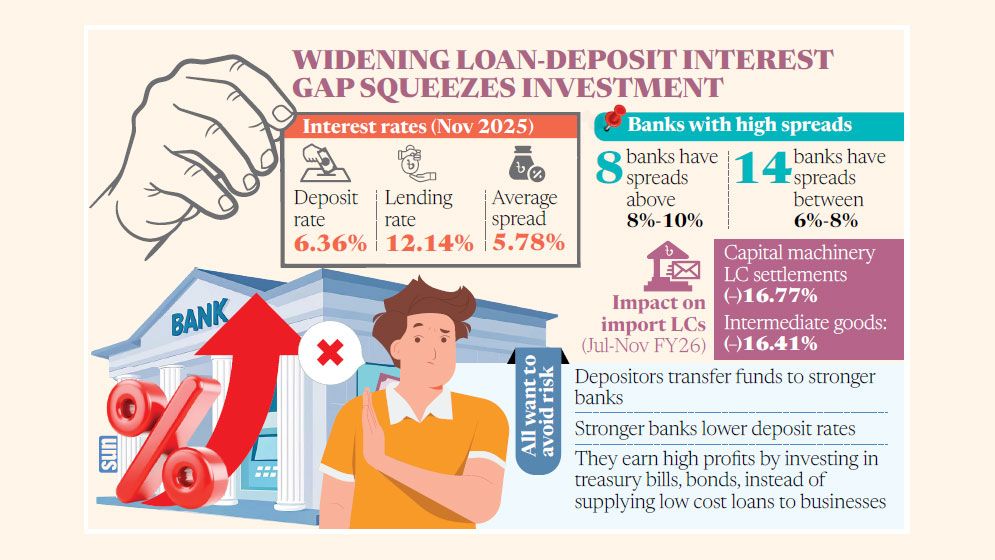
After the withdrawal of the maximum 9% interest rate cap on bank loans, the gap between lending and deposit rates (spread) has widened rapidly, causing the loan interest rates to become almost double those of deposit rates, with the spread in some cases exceeding 8%-10%.
As borrowing has become more expensive, private investment is declining, while the tendency to open import letters of credit (LCs) has also fallen, reflecting sluggish investment tendencies as well as slow economic activity.
According to the Bangladesh Bank data, the average deposit interest rate at banks in November stood at 6.36%, while the average lending rate stood at 12.14%. As a result, the average spread stood at 5.78%. However, eight banks have spreads above 8%-10%, and another 14 banks have spreads between 6%-8%. In contrast, in November 2023 – the month when the cap on the spread was lifted – the average spread was only 3.35%.
Economists say that although interest rates have been fully liberalised, a lack of competition in the banking sector and banks’ risk-averse behaviour have pushed spreads to unusually high levels. This is disrupting the flow of funds to productive sectors.
Dr Zahid Hussain, former Lead Economist at the World Bank's Dhaka office, told the Daily Sun, “When deposit rates are falling but lending rates do not decline proportionately, it shows that the market is not fully functioning. High spreads discourage investment and pose a major obstacle to economic recovery.”
“Banks are currently unwilling to take risks. Instead of lending to industry and businesses, they are earning easy profits by investing in treasury bills and bonds. This is squeezing the flow of funds to the real economy”, he added.
He warned that if non-performing loans are not reduced, banks will choose to compensate for risk by raising lending rates, ultimately increasing pressure on consumers and investors.
Dr AB Mirza Azizul Islam, a former advisor to the Caretaker Government, said, “Market-based interest rates do not mean a lack of oversight. Alongside moral suasion, the central bank needs to enhance transparency and swiftly resolve the risks of weak banks; otherwise, stronger banks will exploit the situation.”
He added that “If spreads remain above 6%-7% for a prolonged period, small and medium entrepreneurs will suffer the most, putting both employment and industrial production under pressure.”
Sources said the rising interest spread was discussed at a bankers’ meeting held at Bangladesh Bank on 7 December. A central bank executive director said that although interest rates were made fully market-based under a 2024 directive, banks have excessively increased spreads, making loans costly and hurting businesses. While neighbouring countries maintain a lending-deposit rate gap below 3%, Bangladesh’s spread has long hovered around 6%.
Bangladesh Bank Governor Dr Ahsan H Mansur described the situation as worrying and urged collective efforts to bring spreads down to a tolerable level at the meeting.
According to sources at the Bangladesh Bank, the commercial banks will be asked to reduce spreads through moral pressure, though no specific ceiling will be imposed for now.
Why spreads are rising
Discussions with bankers reveal that due to the weak condition of some banks, a section of depositors is shifting funds to comparatively stronger banks. As a result, well-positioned banks are attracting large volumes of deposits even by offering lower interest rates. However, since private sector credit demand is weak, they are not reducing lending rates at the same pace.
In addition, banks are earning risk-free returns of over 10% by investing in treasury bills and bonds. This allows them to generate good income without lending to industry and commerce. Consequently, spreads have widened, boosting bank profits but creating stagnation in investment and business activity.
Negative impact on investment and LCs
High lending rates have reduced entrepreneurs’ appetite for new investment, with many industrial firms shelving expansion plans. At the same time, rising import costs have led to a decline in LC openings, putting pressure on production and supply chains.
The Bangladesh Bank data shows that in the first five months (July-November) of the FY26, LC openings for capital machinery imports rose by 32.22%, but settlements declined by 16.77% compared to the same period of the previous year. During that period, LC openings for intermediate goods increased by 1.95%, while settlements fell by 16.41%. Meanwhile, LC openings and settlements for raw materials rose marginally by 0.45%.
As a result, private sector credit growth has remained stuck below 7% for six consecutive months. At the end of November 2025, growth fell to 6.58%, below the target set by Bangladesh Bank.
Bangladesh Chamber of Industries (BCI) President Anwar-ul Alam Chowdhury (Parvez) said, “Banks have reduced deposit rates but have not lowered lending rates accordingly, causing spreads to rise abnormally. Borrowing at 14%-16% to invest in production is not realistic. It raises production costs, weakens competitiveness and hurts domestic industries.”
From April 2020 to June 2023, a 9% cap on bank lending rates was in place. In line with IMF conditions, the “Six-Month Moving Average Rate of Treasury Bill (SMART)” interest rate mechanism was introduced in July 2023, and the 4% cap on spreads was lifted in November that year. Later, on 8 May 2024, interest rates were fully liberalised. At the same time, a crawling peg was introduced in the foreign exchange market, raising the dollar rate by Tk7 in one step.
The reporter can be reached at: [email protected]