



 For all latest news, follow the Daily Sun's Google News channel.


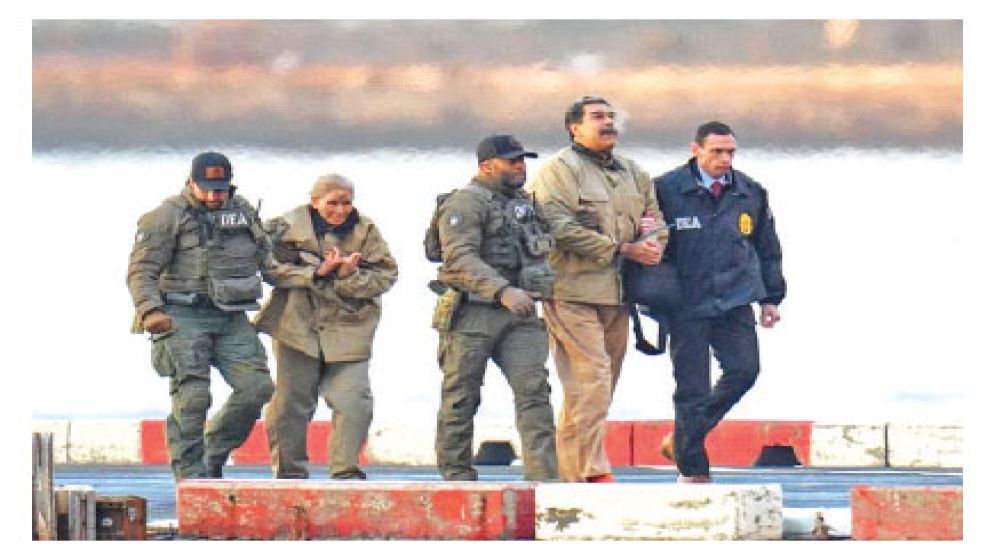
One need not consult international law to see whether the US could abduct Venezuelan President Nicolás Maduro and run the country as outlined by President Donald Trump. There are countless instances where the US has disregarded international law, regardless of who holds the Oval Office. From the recent Israeli genocide in Gaza to twentieth century’s regime change operations in Guatemala, Panama, Honduras, Iraq, and Libya, the US has been repeatedly accused of violating international law. While many of these states are still reeling from the scars left by US-orchestrated regime changes, particularly in the Middle East, Washington has rarely faced any legal consequences.
Most regime change operations succeeded in installing puppet governments, leaving the affected states with little recourse to challenge US intervention. However, the US did face some legal challenges initiated by other entities, such as Nicaragua and Afghanistan, which suffered directly from its imperialist ambitions. In 1979, the people of Nicaragua overthrew the US-backed Somoza dictatorship through the Sandinista Revolution. Labelling the post-revolution leftist government as a communist threat, the US began funding, training, and arming Contra rebels to destabilise the country. The administration of President Jimmy Carter also conducted covert military operations and imposed economic pressure. In 1984, Nicaragua brought a case before the International Court of Justice (ICJ), accusing the US of violating the UN Charter, customary international law, and the principle of non-intervention.
The ICJ ruled against the US, finding it guilty of violating international law and ordering it to pay reparations. The US, however, rejected the court’s jurisdiction and vetoed any enforcement moves at the UN Security Council. A similar legal effort regarding US actions in Afghanistan also yielded no results. The United States deployed forces to Afghanistan following the 9/11 attacks on the Twin Towers in 2001, targeting al-Qaeda and the Taliban, and remained until its withdrawal on 31 August 2021. After navigating several legal and procedural hurdles, the International Criminal Court (ICC) initiated a formal investigation into the situation in Afghanistan on 5 March 2020. In response, the United States declared the ICC “illegitimate,” imposed sanctions and visa restrictions on ICC Prosecutor Fatou Bensouda and senior ICC officials, and threatened economic and legal retaliation.
Thus, Donald Trump’s desire to take control of Venezuela by overthrowing its sitting president is far from unprecedented in the US history of disregarding international law. Vulnerable states have plenty of reasons to remain alert and address the loopholes that could allow US intervention.
One of the most effective strategies to protect a nation from foreign interference is the legitimacy of power derived from the people, which Maduro lacks. The liability for the repercussions Venezuelans now face falls squarely on Maduro himself.
The last two presidential elections he won, in 2018 and 2024, were widely criticised internationally for alleged irregularities and lack of transparency. International observers, including the Carter Center and a UN panel of experts, criticised Venezuela's National Electoral Council (CNE) for not publishing vote breakdowns by polling station, making independent verification impossible. Given the US’s overt interest in Venezuela’s oil and its persistent hostility, Maduro should not have risked the country’s sovereignty simply to secure his own power. There is a wise saying: clean your own doorstep before cleaning your neighbour’s.
People of Bangladesh have also paid the price for failing to prevent Sheikh Hasina from emerging as a dictator. Many were quite positive about foreign interference in 2024 when diplomatic discussions suggested the US would impose sanctions unless a fair election was held. Thankfully, Washington refrained, proving once again that it only cares about democracy when it serves its interests. Nevertheless, the people of Bangladesh suffered under enduring autocracy, which ended on 5 August 2024 through a mass uprising. The revolt cost more than 1,400 lives, left thousands wounded, and severely shocked the economy, affecting GDP growth, employment, exports and foreign direct investment.
Despite these repercussions, the ordeal is far from over, as the nation has yet to elect a legitimate government. Concerns remain about ensuring fairness in the upcoming election on 12 February, particularly since the shadow of autocracy has not fully departed. Vicious activities persist across the state apparatus and political arena, threatening to derail the election and rob the people of their right to choose their preferred leader.
The fate of Venezuela serves as a stark reminder for both politicians and citizens in Bangladesh. In the event of a failure to form a strong government legitimised by the people’s vote, there will be no shortage of foreign powers ready to swoop in and pursue their interests at the expense of the lives and livelihoods of the people of Bangladesh.