


 For all latest news, follow the Daily Sun's Google News channel.


Fatema Begum : Khaleda’s companion in power, silence
Daily Sun Report, Dhaka
Published: 03 Jan 2026, 12:00 AM
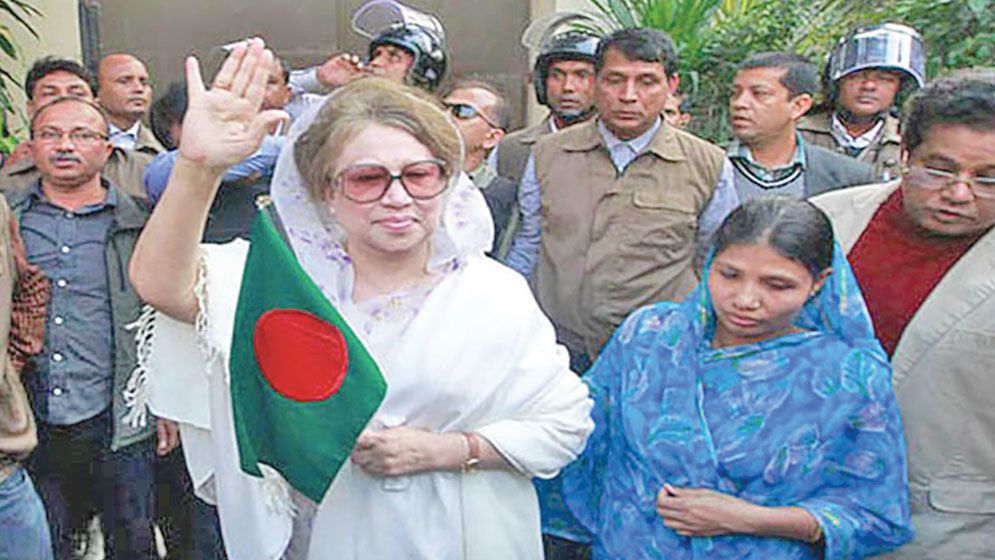
When senior Army officers carried the coffin of Begum Khaleda Zia into the mausoleum of her husband, Shaheed President Ziaur Rahman, family members followed in solemn silence. Among them walked one woman who did not share blood with the Zia family, yet stood beside them during the final rites.
Her presence spoke of a bond that had long surpassed titles and hierarchy.
She was Fatema Begum, Khaleda’s house help for more than a decade and a half, and, in truth, her closest companion.
For years, Fatema existed quietly in the background of Bangladesh’s most turbulent political chapters.
She was there in prison cells and under house arrest, through hospital corridors and foreign treatment trips, in moments of frailty and isolation when power meant nothing and loyalty meant everything.
Beyond her role as a domestic worker, she became the person Khaleda leaned on when the world narrowed around her.
Fatema was born in Shah-Madar village in Bhola Sadar’s Kachia union, the eldest of five children of Rafiqul Islam and Maleka Begum. Responsibility arrived early for her.
After marrying Harun Lahari, a farmer from her village, she struggled alongside him on the Meghna river’s islands. Their daughter Zakia Islam Riya and son Mohammad Rifat were born into a life shaped by uncertainty.
In 2008, when her son was just two, her husband fell ill and died suddenly. Overnight, survival became her sole purpose.
She returned to her parents’ home with her children, but her father’s modest grocery shop income could not sustain the family.
In 2009, Fatema made the hardest decision of her life. Leaving her children behind, she travelled to Dhaka in search of work. Through an acquaintance, she found employment at Khaleda’s residence. What began as a job soon became a relationship built on care, trust and shared solitude.
As Khaleda’s health declined and her political life became increasingly constricted, Fatema’s role deepened.
She assisted her to the bathroom, administered medicines, and steadied her when weakness overtook.
These acts were not performed as routine duties; they were gestures of devotion. Khaleda, deprived of the constant presence of her sons and daughters-in-law, came to depend on Fatema not just physically, but emotionally.
During the 2014 “March for Democracy”, when sand-laden trucks blocked the road outside the BNP Chairperson’s Gulshan Office and police pressure mounted, Khaleda stood at the doorway of Feroza addressing journalists. As she struggled to remain steady, it was Fatema who held her firmly by the hand.
The bond was tested most starkly on 8 February 2018, when Khaleda was sentenced in the Zia Orphanage Trust case and taken to the old central jail on Nazimuddin Road. Ill, ageing and isolated, she entered prison alone.
Six days later, with special court permission, Fatema walked into that jail – not as an accused, but by choice. She accepted confinement solely to serve her leader. In that bleak prison, she was Khaleda’s only companion.
The then prime minister Sheikh Hasina remarked caustically that even in jail, Khaleda would need Fatema. The comment, intended as a jibe, unintentionally captured a truth.
In April 2021, when Khaleda contracted Covid-19 and spent 53 days in hospital, Fatema remained at her side. At a time when fear kept families apart, she stood unwavering – caretaker, shield and shadow.
She continued that role during Khaleda’s advanced treatment in London and remained with her at Evercare Hospital until the final moments of her life.
Fatema Begum’s name rarely appears in political narratives or public remembrance. Yet her life stands as quiet testimony that not all relationships are defined by power or position. Some are shaped by duty, compassion and humanity.
Amid the noise of politics, Fatema chose silence – and in that silence, she revealed a different kind of strength.