


 For all latest news, follow the Daily Sun's Google News channel.


HAZARD LOOMS LARGE IN RURAL AREAS – PART II
Billions spent, waste still dumped into water bodies and forests

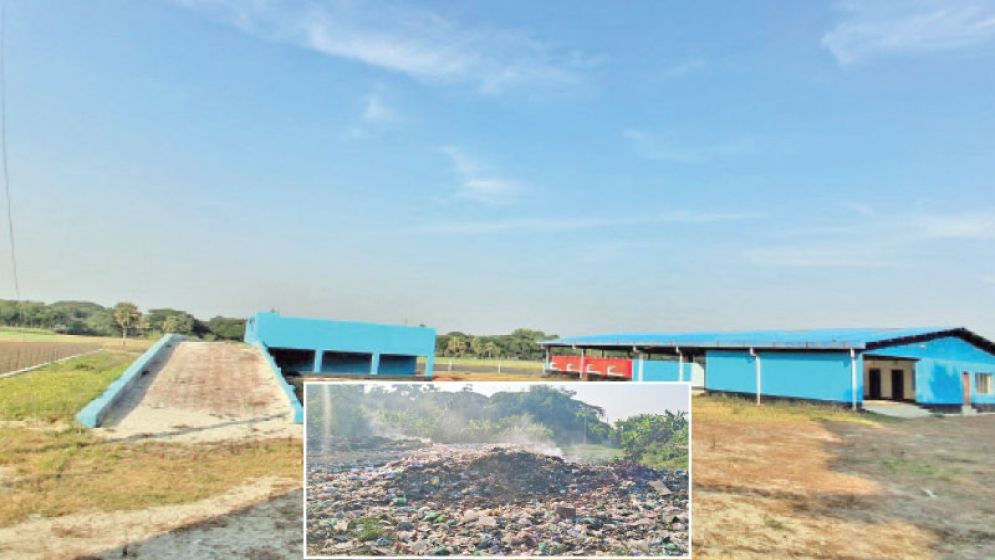
The photo shows the newly constructed Integrated Waste Treatment Plant in Boalmari, Faridpur. (Inset) Dumped waste lies right next to the plant meant to process it. Daily sun Photo
The environmental cost of the government’s stalled municipal sanitation drive is no longer abstract.
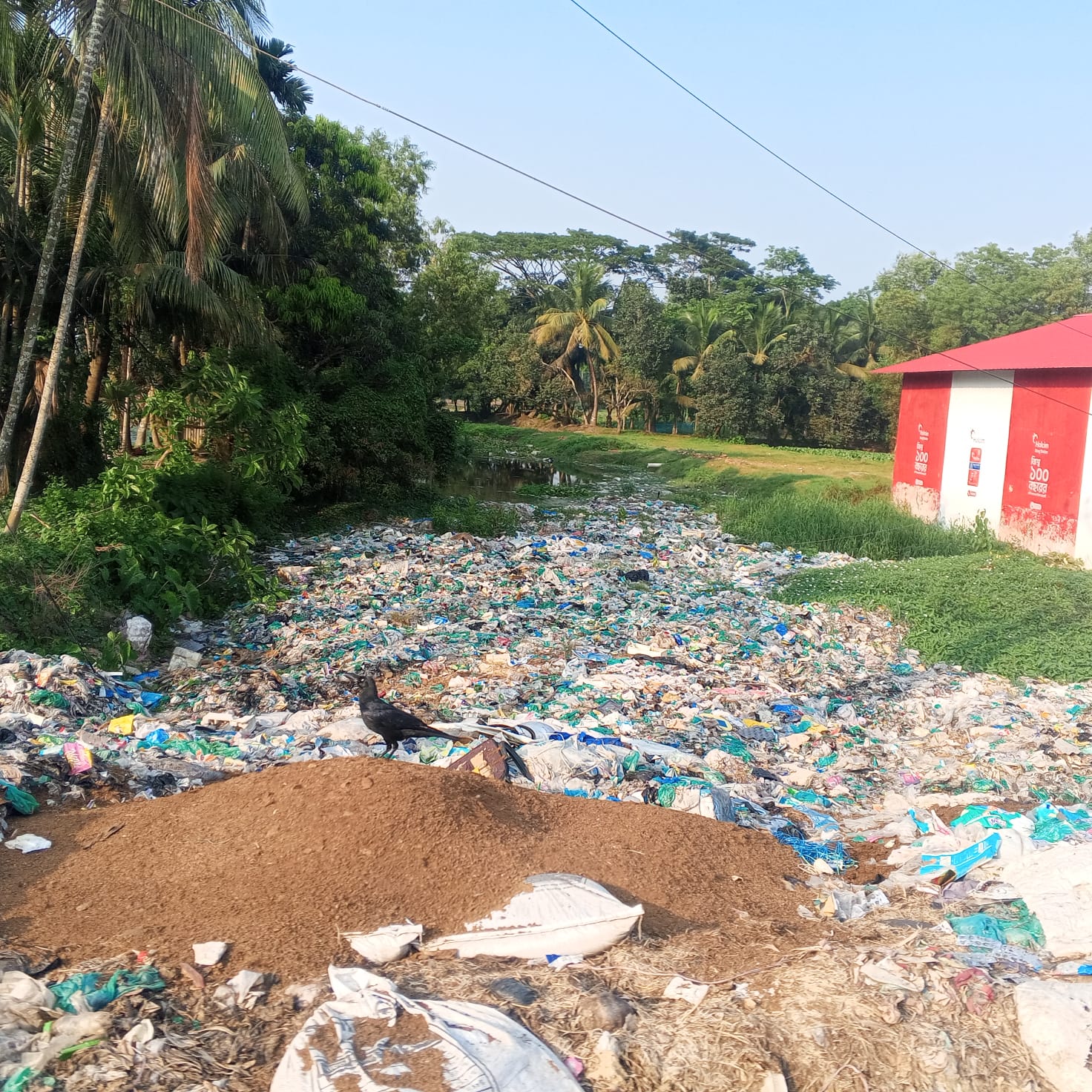
Across municipality areas, untreated waste is choking canals, poisoning rivers, and creeping into forests, as municipalities continue dumping solid and human waste into open spaces despite crores of taka spent on waste management infrastructure that remains unused or incomplete.
Under three major government projects to install Integrated Waste Treatment Plants (IWTPs) in 85 municipalities, the state failed to secure land in 45 municipalities and could not complete construction in another 21.
More troubling still, of the 16 IWTPs and three faecal sludge treatment plants (FSTPs) that were completed, most are not operational due to shortages of manpower, equipment, access roads and institutional ownership.
As a result, water bodies that once served irrigation and household needs are becoming polluted beyond use, forests are being slowly buried under waste, and air and soil quality are steadily deteriorating, particularly in areas where groundwater tables are already low.
Experts warn that the continuing failure to operationalise the facilities has left municipalities with little choice but to persist with environmentally destructive practices, undermining public health, biodiversity and livelihoods.
Treatment plants built, but left idle
Out of 85 municipalities covered by the sanitation projects, the government managed to complete IWTPs in just 16 and FSTPs in three.
The Daily Sun visited at least 20 municipalities under the project and found that only one IWTP – at Nachole municipality – to be fully functional.
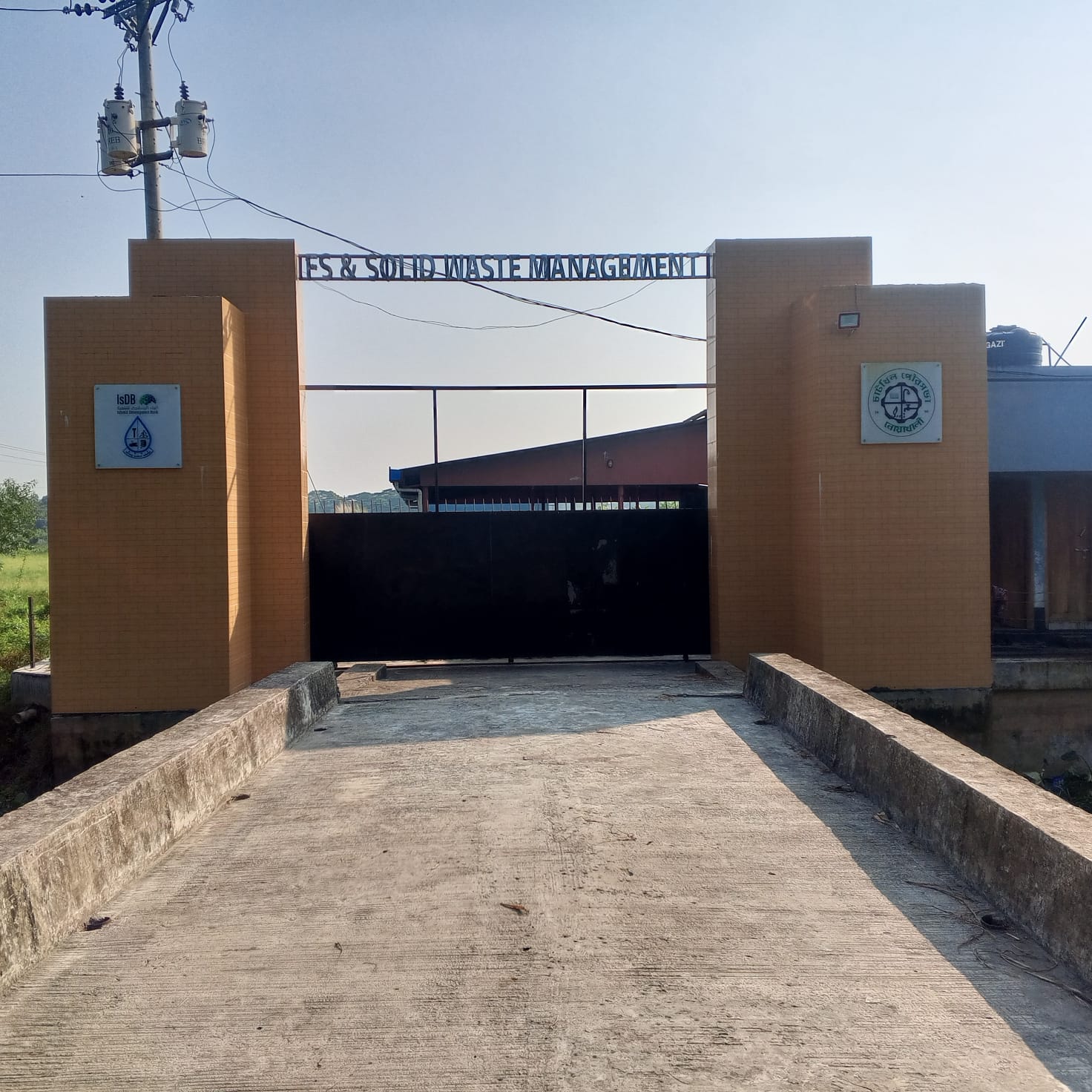
The IWTP at Shibganj and the FSTP at Kalihati were found to be only partially operational. Facilities at Sreepur, Dhanbari, Basurhat, Chatkhil and Boalmari were under lock and key, despite being structurally complete.
In municipalities such as Shaistaganj, Ramgati, Sonaimuri, Betgai, Muladi and Tarabo, construction work remains stalled somewhere between foundation and mid-stage completion.
Ironically, in several cases, municipal cleaners are dumping waste directly beside the very plants meant to process it.
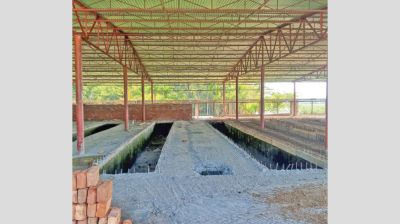
In Basurhat, an IWTP was built near agricultural land in the Mohiser Dgoi area, several kilometres from the municipality area. When visited, the facility was deserted and locked. Outside its boundary wall, heaps of untreated waste lay exposed.
Conservancy Inspector Liton Chandra Majumder said the municipality collects around 30-35 tonnes of waste daily, all of which is dumped there.
Assistant Engineer (Civil) Mohammad Easin said the project authorities had yet to formally hand over the facility, vehicles or vacuum tankers.
“Many works inside the IWTP are still unfinished, and the contractor fled after August 5,” he said. “We cannot use the facility in this condition.”
DPHE Sub-Assistant Engineer at Companiganj upazila Main Uddin said officials of Masurhat municipality often exaggerate minor issues to justify inaction.
“They show apathy towards operating the IWTPs,” he said.
A similar scene was observed in Boalmari municipality on 25 October. An IWTP built in the Kalaran area of Ward-9 stood unused, with cows grazing inside the compound. Newly constructed quarters for cleaners and guards were locked, while a large volume of waste was dumped along the access road, producing a foul stench.
Boalmari Executive Engineer Molla Md Shafiqul Islam said the municipality lacked trained manpower to operate the plant.
“We have recently invited expressions of interest and received proposals from two bidders,” he said. “We plan to award the work to a contractor who will collect waste, collect bills and operate the IWTP. The project authority has assured us funding for one year’s operating costs.”
In Chatkhil, Conservancy Inspector Abdul Motaleb Bhuiyan said the municipality collects 15-16 tonnes of household waste daily from homes and 19 hospitals, dumping it into a water body near the Chatkhil-Ramganj highway.
Yet a well-built IWTP at Ghasipur Mouza, enclosed by a boundary wall, was found lying idle during a visit on 23 October.
Md Nazrul Islam, director of the DPHE’s Water Supply and Environmental Sanitation Project for 32 municipalities, said the IWTP at Kalihati was being run by a third party but struggled due to insufficient waste supply.
“If the municipality does not collect waste properly, what can I do?” he asked.
A DPHE executive engineer, speaking on condition of anonymity, said municipalities had failed to deploy promised technical staff.
“We invested huge sums in these plants, but they are not functioning due to non-cooperation from municipal authorities and the Local Government Division,” he said, adding, “Now UNOs are administering municipalities, but they are not taking responsibility for the facilities.”
He added that a third-party operator hired to manage faecal sludge treatment in Shibganj was recently removed by the municipality, reverting waste management to its old, unregulated form.
Deputy Director of the 30-pourashava project, Mahmudur Rashid Mazumder, said some plants remain idle due to infrastructure gaps.
“The IWTP at Goalando cannot operate because there is no approach road,” he said. “Operations at Bhuapur will begin after a third-party operator is appointed.”
In Sreepur municipality also, an IWTP was constructed inside the Gosinga forest area but has remained unused due to the absence of an access road. The forest office obstructed the construction of the approach road.
Forests under siege in Kaliakoir and Sreepur
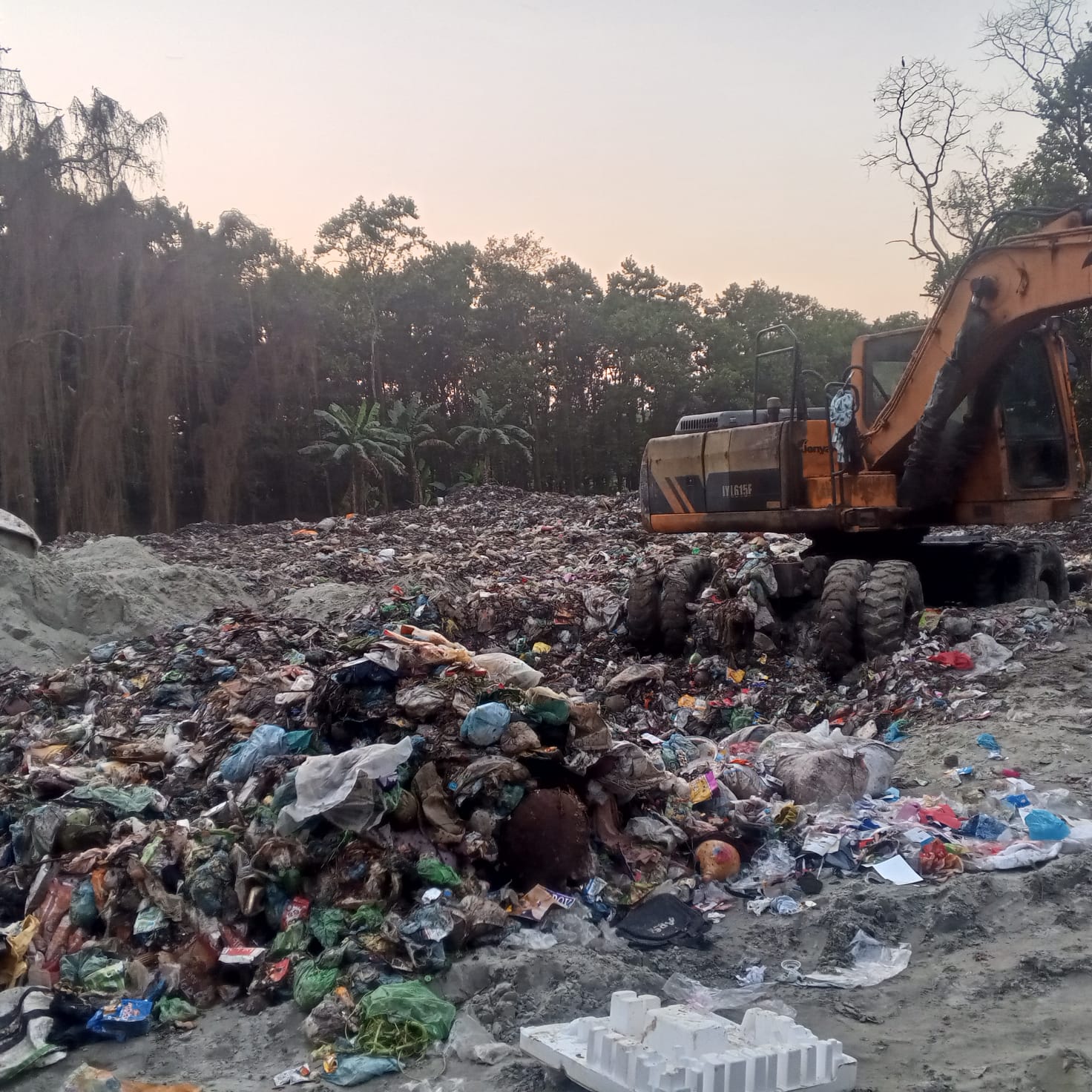
In Kaliakoir, a municipality included in the 32-pourashava project, failure to secure land has led to waste being dumped directly into the Kalampur reserve forest.
Municipality Secretary Jahidul Islam Talukder said around 50 tonnes of waste are collected daily from households, hospitals and industries across nine wards, handled by 14 contractors.
Conservancy Inspector Rawshan Akther Rubi confirmed that truckloads of waste were dumped in the forest.
“Previously we dumped waste near the University of Frontier Technology, Bangladesh,” she said. “But after the university objected, we moved here.”
During a visit on 19 November, large sections of the forest floor were found buried under several feet of waste mixed with sand. Leachate was seen flowing down the waste piles. Numerous sal trees had turned reddish and were dying.
Local resident Md Piarul Islam said tree loss had accelerated since dumping began.
“People using the forest road and nearby residents are suffering badly because of the waste,” he said.
Chandra Beat Officer Eakub Mia said the dumping initially occurred on private land before spreading into forest areas, prompting intervention. Former range officer Monirul Islam said repeated letters had been sent to authorities about the issue.
A similar situation exists in Sreepur, where an IWTP was constructed
inside the Gosinga forest area but has remained unused for two years due to the absence of an access road.
Visits to Gosinga and Bormi unions showed widespread dumping across forest and agricultural land. Garbage truck driver Main Uddin said the municipality dumps six truckloads of waste daily near the Dhaka–Mymensingh highway, with additional dumping along Kapasia Road.
“Earlier we dumped at Vitipara under the Bormi forest beat,” he said. “After strong opposition from the forest office, we stopped – but dumping on agricultural land continues.”
Forest Range Officer Moklesur Rahman said enforcement remains difficult.
“We conduct drives to catch those dumping waste, including municipal workers and private companies,” he said, adding, “They often dump at night.”
He added that permission from higher authorities would be required to allow road construction through forest land to access the IWTP.
Canals turned into sewers
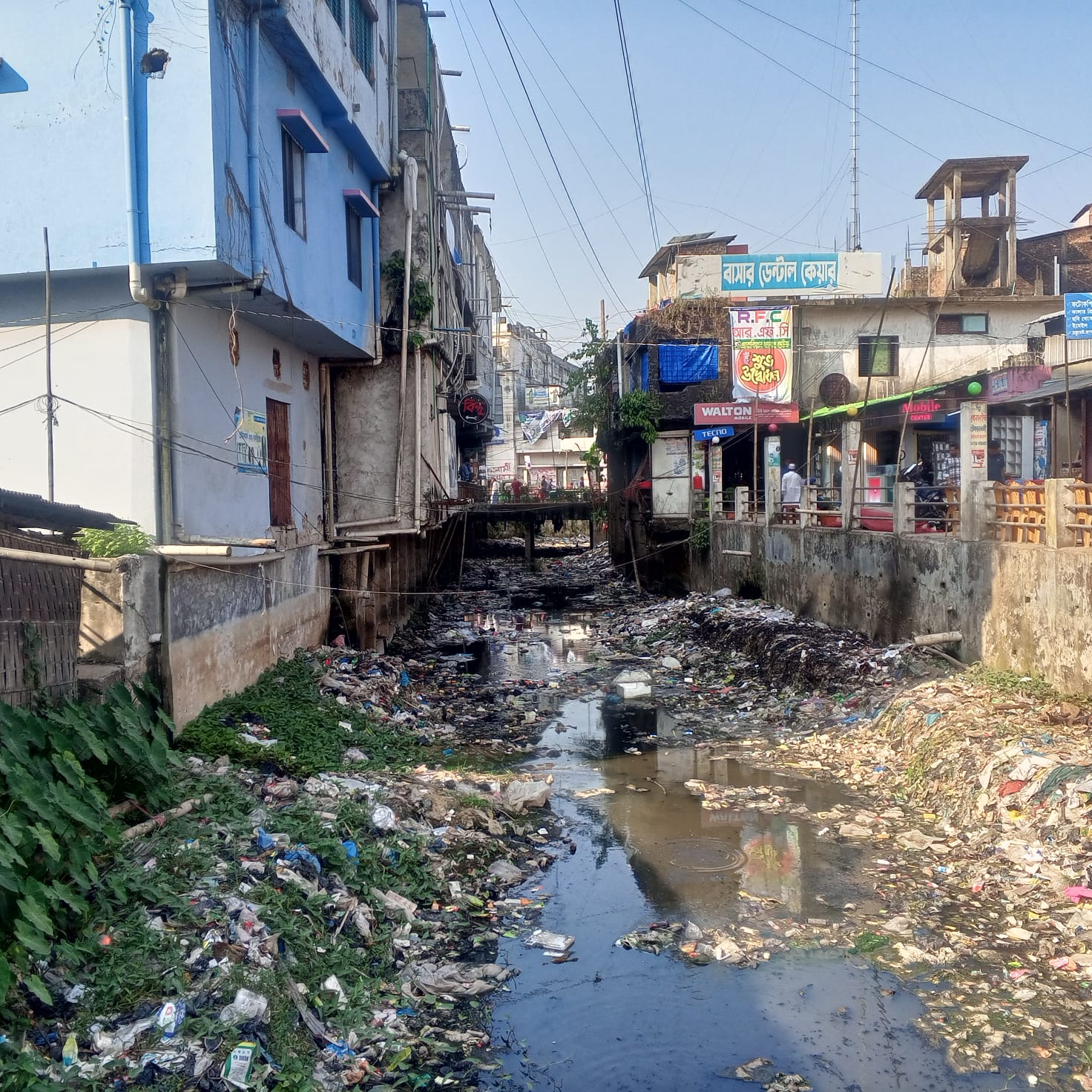
In municipalities including Chatkhil, Basurhat, Sonaimuri, Dhanbari, Madhupur and Shibganj, both municipal and private waste is being dumped into canals.
In Basurhat, the Shankhar Banshi canal – eventually draining into the River Meghna – has become heavily polluted. The clogged canal now causes waterlogging during the monsoon, breeding mosquitoes and flies.
Residents said the water is unusable even for washing.
During a visit on 10 November, this correspondent found the canal appearing pitch black, with household and market sewage discharged being directly through pipes.
Assistant Sub-Assistant Md Rasel said the municipality cleans the canal almost every year.
“Toilet waste from the market flows into the canal,” he said. “As a result, Ward 3 floods during heavy rainfall.”
In Chatkhil, a canal in front of the upazila parishad has filled with solid and human waste. In Shibganj, most toilets are connected to drainage lines that empty into the Zia canal, which also serves irrigation needs.
A visit on 27 November showed the canal resembling a sewage pond, its water dark and foul-smelling.
What studies show
Environmental experts warn that such dumping renders water sources unusable, reduces soil fertility and increases toxic gases in the air.
According to the Department of Environment’s “Surface and Ground Water Quality Report 2023”, municipal waste dumping reduces dissolved oxygen (DO) levels and raises biochemical oxygen demand (BOD) and chemical oxygen demand (COD), making water unfit for aquatic life.
The report cites Hatirjheel in Dhaka as an example, where DO levels ranged from 1.3 to 10.98 mg/l, BOD from 9 to 34 mg/l, and COD from 24 to 108 mg/l—far beyond safe thresholds.
DO below 1-2 mg/l can cause fish kills, while healthy water should maintain levels above 6.5–8 mg/l. Natural waters should have BOD levels of 5 mg/l or less, and unpolluted surface water typically has COD below 20 mg/l.
The report warns that rivers in rural areas, including the Surma, are also showing signs of contamination, while major rivers such as the Padma, Meghna, Jamuna and Brahmaputra remain within limits but face growing threats.
Lessons ignored
Former Dhaka WASA deputy managing director AKM Shohid Uddin said the rest of the country must learn from Dhaka’s mistakes.
“Dhaka lost the chance to use nearby surface water sources like the Buriganga and Rampura canal due to pollution,” he said. “Now water must be brought from the Padma and Shitalakshya at great cost.”
He noted that high pollution levels force expensive pre-treatment, sharply increasing chemical costs.
“When municipalities dump waste openly, they lose the moral authority to stop citizens from doing the same,” he said. “This practice must stop.”
The report was prepared as part of the Transparency International Bangladesh Investigative Journalism Fellowship Programme.
Read More