 For all latest news, follow the Daily Sun's Google News channel.



Photo : SM MOSTAFIJUR RAHMAN
He was buried in the shadow of a poet who once taught the country how to defy injustice with words.
On Saturday afternoon, Sharif Osman Bin Hadi was laid to rest beside the grave of Kazi Nazrul Islam on the Dhaka University campus, as hundreds of thousands gathered to mourn a life cut short and a voice they fear has been silenced too soon.
The symbolism was unmistakable. Known for his fiery speeches and organising on the streets, Hadi had come to embody, for many young Bangladeshis, the rebellious spirit of Nazrul himself.
“Orman Hadi”, as he was widely known, was a co-founder and spokesperson of the Inqilab Moncho and a prominent face of the July uprising.
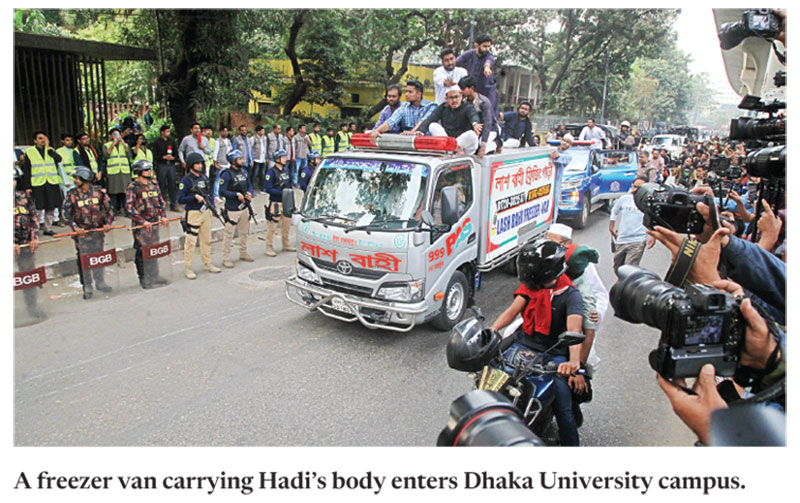
As the ambulance carrying his coffin reached the university shortly after 3pm, grief rippled through the crowd.
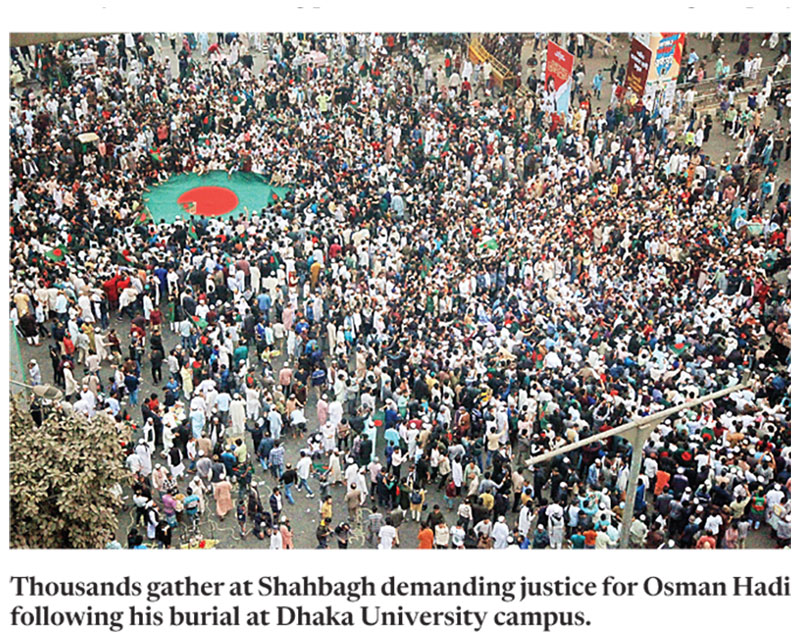
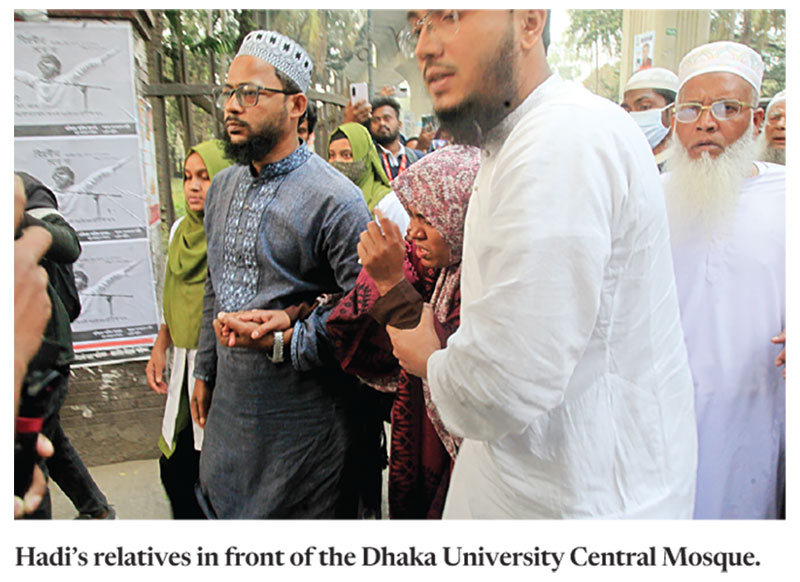
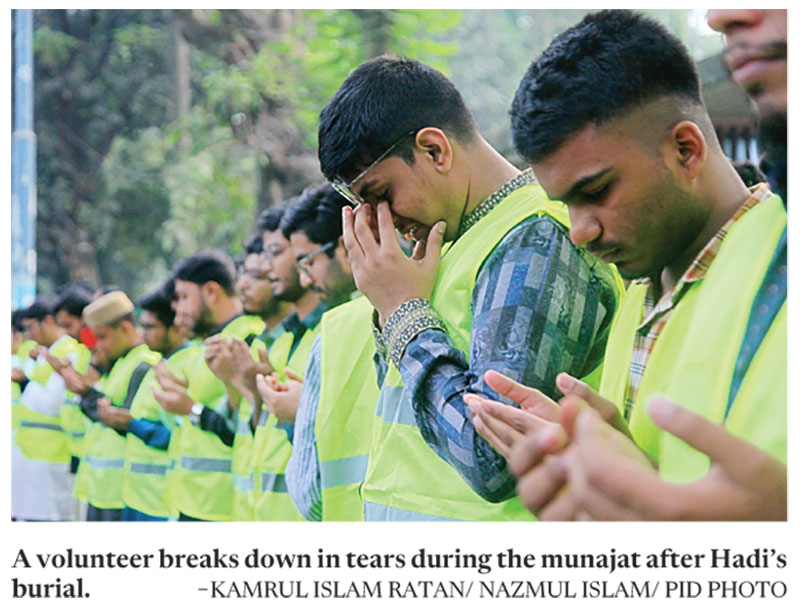
Within an hour, he was buried next to the national poet, close to the university’s central mosque, amid tears, prayers and raised fists.
Mourners stood shoulder to shoulder, some sobbing openly, others silent, stunned by the suddenness of his death.
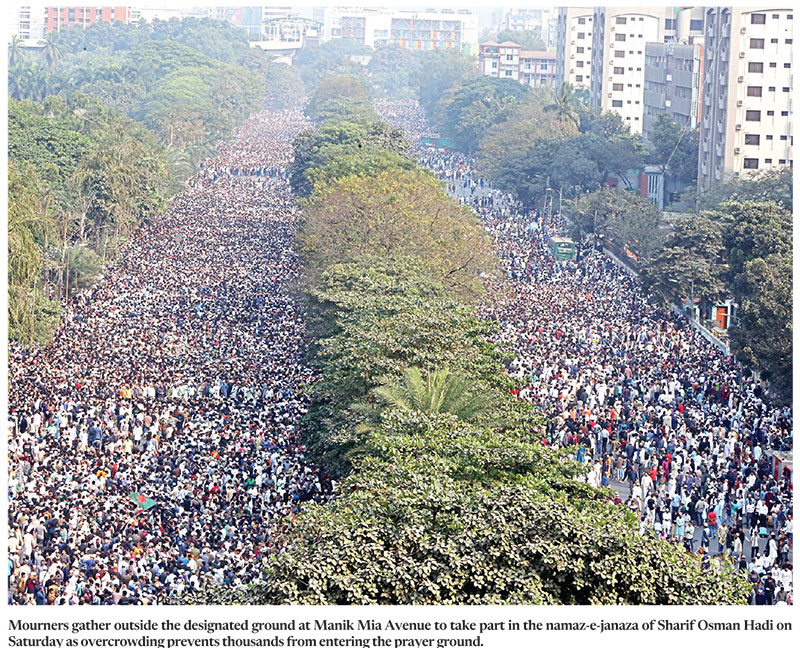
His burial followed a namaz-e-janaza at the South Plaza of the national parliament complex that drew a crowd so vast it spilled across Manik Mia Avenue and into surrounding neighbourhoods. From Farmgate to Asadgate, from Khamarbari to Bijoysaroni, the roads became a sea of people.

Most were young. Many arrived in processions, chanting slogans that blended mourning with resistance.
Cries against authoritarianism rang out alongside demands for justice for Hadi’s killing. The atmosphere oscillated between sorrow and defiance, grief and resolve.
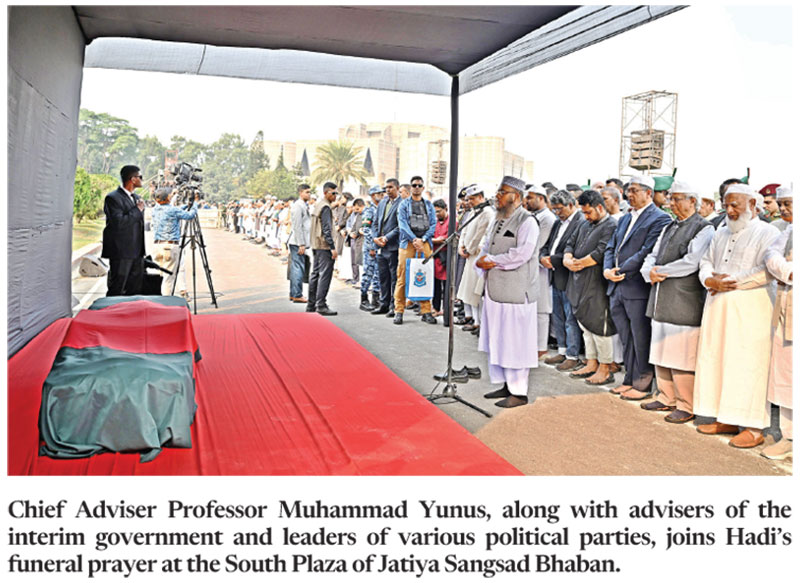
The funeral prayers were led by Hadi’s elder brother, Abu Bakar Siddik, at around 2.30pm, following brief remarks by Abdullah Al Jaber, member secretary of the Inqilab Moncho. The adviser for religious affairs, A F M Khalid Hossain, offered prayers for Hadi’s soul after reading a short account of his life.
Among those present were Chief Adviser Prof Mohammad Yunus, members of the advisory council, senior figures from the BNP and Jamaat-e-Islami, leaders of the National Citizen Party, and prominent activists from across the political spectrum.
Their presence underscored Hadi’s growing influence and the breadth of the shock caused by his death. A potential candidate for the Dhaka-8 constituency in the upcoming 13th general election, Hadi was shot in the head on 12 December near the Box Culvert area of Bijoynagar, a day after the election schedule was announced.
He was initially taken to Dhaka Medical College Hospital and later transferred to Evercare Hospital.
As his condition worsened, he was flown to Singapore on 15 December, where he died three days later while undergoing treatment.
News of his death triggered protests in Dhaka and elsewhere, with demonstrators accusing the interim government of failing to ensure public safety.
Analysts believe Hadi’s killing was not an isolated crime but part of a broader crisis of accountability.
The crowds at Saturday’s namaz-e-janaza were so dense that many were unable to reach the designated prayer area.
Some offered prayers from nearby roads; others attempted to scale boundary walls.
A few sustained minor injuries in the crush before order was restored. Even so, thousands remained in the vicinity long after the prayers ended, unwilling to leave.
Security was tight. Army patrols guarded the entrances to Manik Mia Avenue, backed by police, Rapid Action Battalion and Ansar personnel. Yet the mood was less volatile than heavy with collective grief.
Observers noted that Dhaka had not seen a funeral of comparable scale since the namaz-e-janaza of Shaheed President Ziaur Rahman at the same site in June 1981. For many in attendance, the comparison spoke volumes.
Hadi, you are in our hearts forever: CA
In an emotionally charged address moments before the namaz-e-janaza, Chief Adviser Prof Muhammad Yunus told the crowd that Osman Hadi had not left them – but taken permanent residence in the nation’s conscience.
“We have not come to bid you farewell,” Yunus said, adding, “You are in our hearts. As long as Bangladesh exists, you will remain in the hearts of all Bangladeshis.”
He described the vast gathering not as a final goodbye, but as a collective vow. “Millions are here, and millions more across the country and abroad are waiting to hear about Hadi. This is not a farewell – it is a promise,” he said. “What you asked of us, we will fulfil.”
That promise, Yunus said, would be carried forward across generations. “Not just us, but generation after generation of Bangladeshis will carry it.”
Recalling Hadi’s values, the chief adviser spoke of his love for humanity, his dignity in public life and his political ethics, saying these had been embraced by the nation.
He invoked Kazi Nazrul Islam’s poem “Bidrohi” – “Bolo Bir, Chiro Unnata Momo Shir” – calling it the mantra Hadi had revived for a new generation.
“Our heads will never bow,” Yunus said. “With this mantra, we will walk before the world with our heads held high.”
Referring to Hadi’s wish to contest elections, Yunus said he had shown how politics could be practised with respect – how to reach people without intimidation, how to speak without creating nuisance, and how to engage with dignity.
“You taught us how politics should be done,” he said. “And we have accepted that teaching.”
Concluding his address, Yunus pledged that Hadi would remain “vividly alive” in the nation’s public life. “You will not be forgotten,” he said.
“Today, we leave you to Almighty Allah – and we move forward carrying your mantra.”