


 For all latest news, follow the Daily Sun's Google News channel.


Victory Day observed with pledge to realise martyrs’ dreams
Daily Sun Report, Dhaka
Published: 17 Dec 2025, 12:00 AM
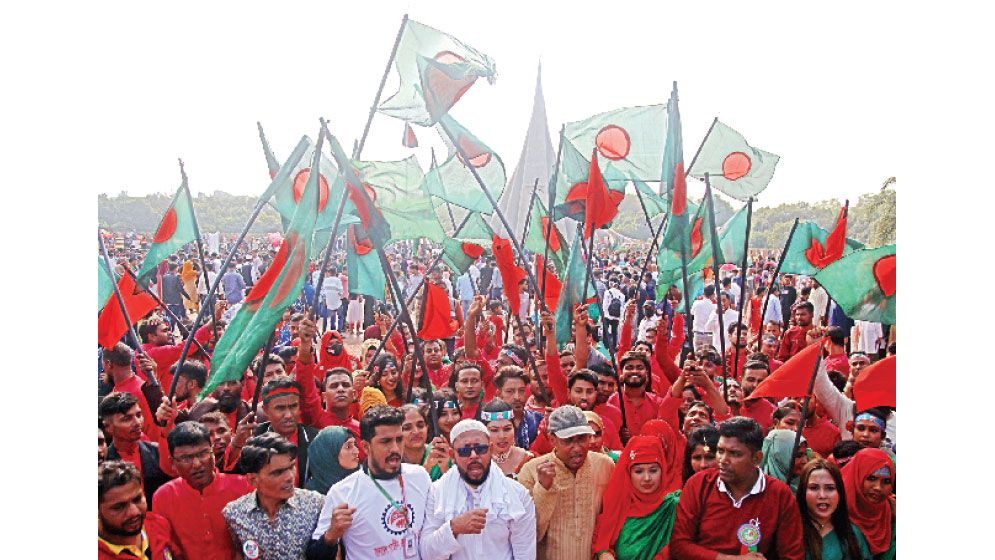
People from all walks of life throng the National Martyrs’ Memorial in Savar on Victory Day to pay tribute to the martyrs of the Liberation War. NAZMUL ISLAMa
Bangladesh on Tuesday marked the 54th anniversary of victory in the 1971 War of Independ-ence with a renewed pledge to build a nation founded on equality, human dignity and social jus-tice – the ideals for which millions of martyrs and freedom fighters laid down their lives.
On 16 December 1971, after a nine-month war, Bangladesh emerged on the world map as an in-dependent state, ending more than two decades of oppressive and discriminatory rule by Pakistan.
From early morning, people from all walks of life gathered at the National Memorial in Savar and at memorials across the country to pay tribute to the martyrs, placing wreaths and flowers and carrying the national flag.
Cities, towns and villages were decked out in red and green, while colourful programmes were organised nationwide to mark the historic day.
The official observances included a 31-gun salute, hoisting of the national flag atop government, semi-government, autonomous and private institutions, and the illumination of key buildings, roads and street islands.
Bijoy Melas (victory fairs) and cultural events were held across the country.
President Mohammed Shahbuddin, Chief Adviser Prof Muhammad Yunus and Chief Justice Syed Refaat Ahmed paid their respects separately at the National Memorial around 7am.
A smartly turned-out contingent from the Bangladesh Army, Navy and Air Force presented the state salute.
After laying wreaths, the dignitaries observed a moment of silence in honour of the martyrs as the bugle sounded the Last Post. They later signed the visitors’ book.
Families of Bir Shreshthas, wounded freedom fighters, members of the diplomatic corps, and representatives of social, cultural and professional organisations, along with students and chil-dren, thronged the memorial throughout the day.
Leaders of several political parties, including the BNP, Jatiya Party, Communist Party of Bang-ladesh, Jatiya Samajtantrik Dal (JSD), Krishak Sramik Janata League, Nagarik Oikya, Biplabi Workers’ Party, Gono Adhikar Parishad and Rashtra Sangskar Andolan, also paid homage by placing wreaths.
In a separate highlight, Bangladesh set a world record by staging a mass parachuting display to mark 54 years of victory.
Fifty-four paratroopers carried out a coordinated skydive while carrying national flags at the pa-rade ground beside the Tejgaon Old Airport in the capital. The event, organised by the Armed Forces, was witnessed by Chief Adviser Prof Muhammad Yunus.
Political parties marked the day with their own programmes. BNP leaders paid tribute and of-fered prayers at the mausoleum of party founder and Z Force commander, former president Ziaur Rahman.
Jamaat-e-Islami organised a youth marathon from Suhrawardy Udyan to Manik Mia Avenue, while the NCP held an anti-aggression procession from Bangla Motor to the Central Shaheed Minar. Jatiyatabadi Chhatra Dal brought out a victory flag procession.
At Dhaka University, a group of students staged a protest against individuals who opposed the Liberation War, throwing shoes at a photograph of Ghulam Azam in front of the DUCSU build-ing in the afternoon.
National newspapers published special supplements, while Bangladesh Betar, Bangladesh Televi-sion and private radio and TV channels aired special programmes highlighting the significance of Victory Day.
Cultural institutions including the Bangladesh Shilpakala Academy, Bangla Academy, National Museum, Liberation War Museum and Bangladesh Shishu Academy organised discussions, per-formances and sports events.
Liberation War-based films and documentaries were screened at cinemas across the country.
Receptions were held in honour of freedom fighters and families of martyred fighters at city, dis-trict and upazila levels.
The Bangladesh Post Office issued commemorative stamps, while special prayers were offered at mosques, temples, churches and other places of worship, seeking eternal peace for the souls of the martyrs.
Improved meals were served at hospitals, jails, old-age homes and orphanages, and children’s parks and museums remained open to all. Bangladesh missions abroad also observed the day with similar programmes.
Pakistan, created in 1947 with two wings in the east and west, was widely predicted by analysts to be unsustainable.
Years of political repression and economic discrimination fuelled the demand for autonomy and independence in East Pakistan.
In 1971, the Pakistan army launched a brutal military crackdown, known as Operation Search-light, on the night of 25 March, targeting unarmed civilians.
The resistance soon grew into a full-scale war of liberation.
The struggle culminated on 16 December 1971, when Pakistani forces surrendered to the joint command of the Mukti Bahini and the Indian army at the then Race Course Maidan, now Suhrawardy Udyan, in Dhaka – allowing the red and green flag of an independent Bangladesh to fly freely at last.