
 For all latest news, follow the Daily Sun's Google News channel.


Polls schedule due this week
Daily Sun Report, Dhaka
Published: 08 Dec 2025, 12:00 AM
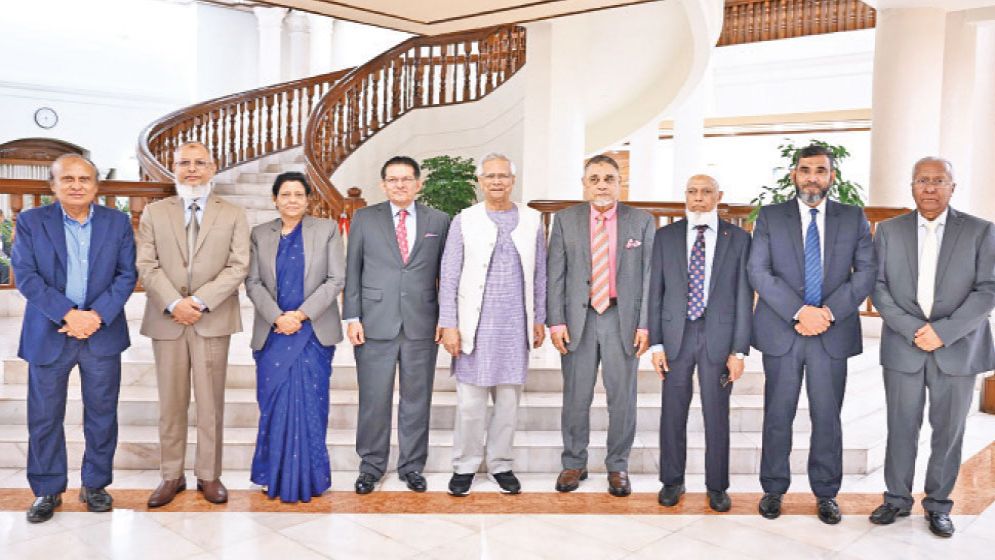
Chief Election Commissioner AMM Nasir Uddin and other election commissioners pose with Chief Adviser Prof Muhammad Yunus at the State Guest House Jamuna on Sunday. - CA PHOTO
The Election Commission is set to announce the schedule for the 13th parliamentary election “on any day this week”, following a series of decisions adopted at its 10th meeting and a subsequent briefing to Chief Adviser Prof Muhammad Yunus on Sunday.
Election Commissioner Brig Gen (Retd) Abul Fazal Md Sanaullah told reporters after the commission’s meeting that the Chief Election Commissioner (CEC) AMM Nasir Uddin had confirmed the timeframe.
“The CEC had earlier said that the schedule will be announced in the second week of December. The week is the 8th to the 15th. The schedule will be announced on any day during this period,” he said.
The tightly timed preparatory sequence has begun, he noted, adding that the EC will send formal letters to Bangladesh Betar and BTV today to record the CEC’s address to the nation, and a courtesy meeting with the President is set for 10 December.
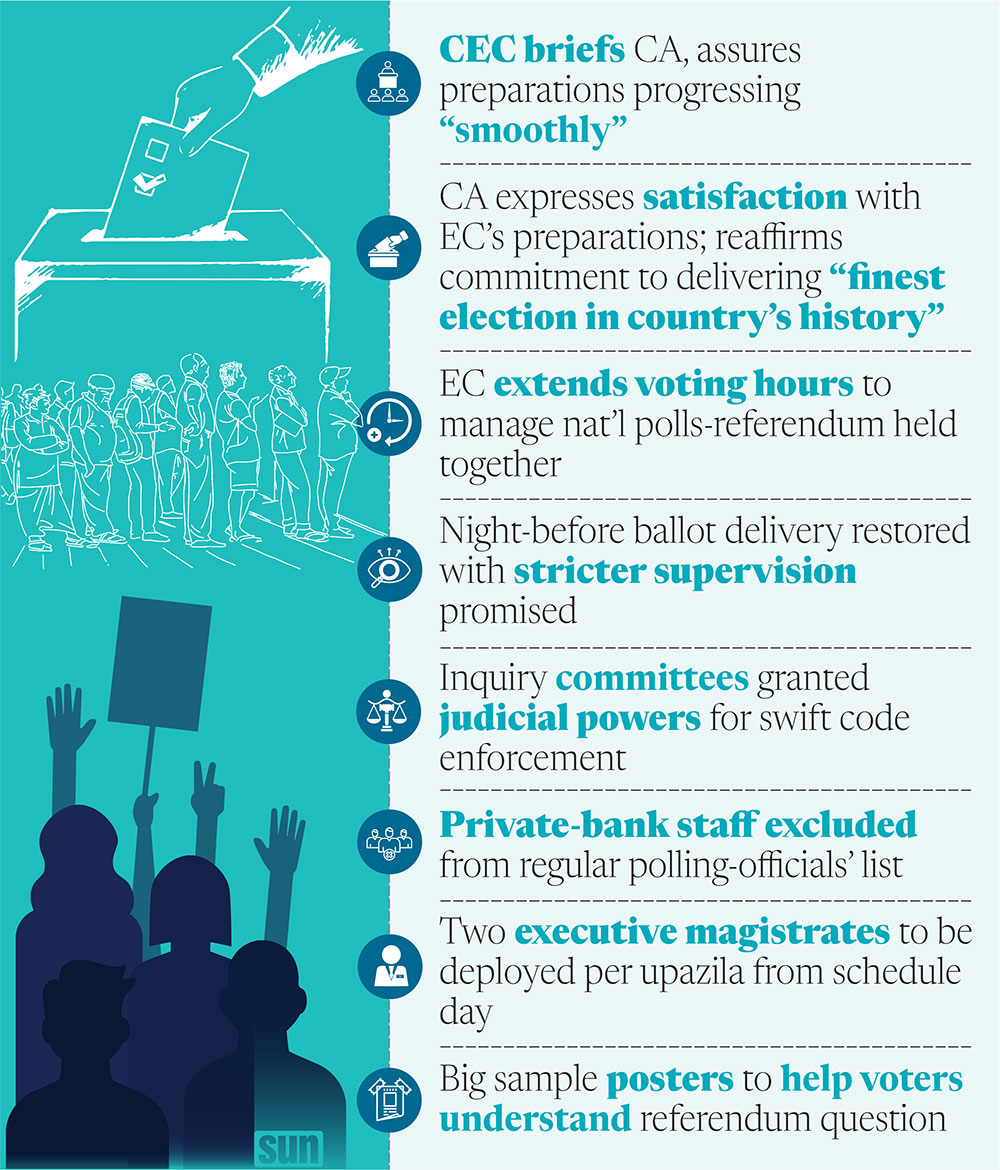
On Sunday evening, the CEC and all four commissioners briefed the chief adviser on the preparations at the State Guesthouse Jamuna, assuring him that arrangements for the February polls were “advancing smoothly”.
Prof Yunus expressed satisfaction with the EC’s preparations, saying the government would “continue to provide all forms of support for a fair and impartial election”.
He told the commission, “In this election, which the nation has long awaited, you are in the driver’s seat. We must reach our desired destination.”
The chief adviser reaffirmed the government’s commitment to delivering “the finest election in the country’s history”, pledging that preparations would continue with that aspiration in mind.
Longer voting hours and return to night-before delivery of ballots
The commission approved several operational changes for the upcoming election. Chief among them is an extension of polling hours by one hour. Voting will now run from 7:30am to 4:30pm.
Sanaullah said the extension was necessary because the parliamentary election and a referendum would be held simultaneously, requiring “proper time management”.
The EC has also decided to revert to the older practice of delivering ballot papers to polling centres the night before the vote.
The system, introduced under the Election Commission led by Nurul Huda but later abandoned by the commission led by Kazi Habibul Awal to counter allegations of “night-time voting”, will now be restored.
“We are confident. We do not expect a recurrence of those incidents,” Sanaullah said, adding, “We want to return to a position of confidence. There will be proper supervision, and we will maintain strict oversight to prevent any irregularities.”
He noted that ballot papers would be dispatched with enhanced security arrangements and that polling officials had been strictly forbidden from seeking help from local residents on arrival, a practice that had previously exposed officials to political influence. “Sufficient budgetary allocation has been provided, and officials may request additional funds if needed,” he said.
More secret booths, greater accessibility and clear referendum instructions
Responding to feedback from mock voting exercises and field reports, the EC will increase the number of secret voting booths in polling rooms and install temporary booths where necessary.
“To help voters easily understand the referendum question, large sample posters displaying the question will be hung at every polling centre,” Sanaullah said.
The EC will support the government’s public information campaign regarding the referendum and issue special instructions to ensure accessibility for voters with disabilities, elderly voters and pregnant women.
Polling officials: private-bank staff excluded
The Commission has decided that officials from private banks will not be included in the regular list of polling personnel. They may be used only if absolutely required. Polling officials will instead be drawn from government, semi-government, autonomous institutions and state-owned banks.
The decision follows concerns that temporary staff from private banks may be more vulnerable to local pressures or unable to maintain full neutrality.
Judicial powers for Electoral Inquiry Committees
In one of the most significant decisions in Bangladesh’s electoral history, the EC has granted judicial authority to all 300 Electoral Inquiry Committees – one for each constituency.
Previously limited to investigations, these committees will now also be able to adjudicate breaches of the electoral code of conduct and certain election-related offences through summary trials.
Under the Representation of the People Order (RPO), judicial officers will head these inquiry committees. If any candidate or supporter is found to have violated the code or admits wrongdoing, the committees will be empowered to impose penalties, including fines or, in some cases, imprisonment.
EC officials said the committees’ operational scope had been widened to ensure “swift and effective” enforcement.
From the day after the schedule announcement, two executive magistrates will be deployed to every upazila or thana, with numbers increasing during the final five days before polling. They will regularly patrol electoral areas to monitor compliance with the code of conduct.
Political campaign materials must be removed within 48 hours of the schedule announcement, after which punitive measures will be applied.
Security deployment and central monitoring cell
A circular regarding the deployment of law-enforcement agencies will be issued this week. The Home Ministry will prepare its operational plan based on the circular.
Sanaullah said the Commission would establish a central monitoring cell with representation from all security services and relevant institutions. This unit will also have the capacity to counter misinformation and disinformation during the election period.
Movement of taxis, microbuses, pickup vans and trucks will be restricted for 24 hours around polling day, while motorcycles will face a 72-hour restriction. Polling day will be a public holiday.
Overseas and domestic postal ballots
Printing of overseas postal ballots will begin on today, with dispatch starting tomorrow. Applications for domestic postal ballots will remain open for 15 days after the schedule is announced.
A circular will be issued to ensure journalists and election observers can perform their duties “without hindrance”, Sanaullah added.
He said discussions on returning officers – traditionally district commissioners – were still underway. “We also have some alternative proposals, which we are reviewing. You will know in due time.”
Asked whether the illness of a senior BNP leader or the overall political climate might influence the timing of the schedule, he said: “Political parties have differing views. These statements are essentially political in nature. The Election Commission is proceeding according to its own judgment, prior commitments and the government’s announced timeline.”
CEC briefs the CA
On Sunday evening, CEC Nasir Uddin, accompanied by the four commissioners and EC Secretary Akhter Ahmed, met Chief Adviser Prof Yunus at Jamuna.
Election Commissioner Abdur Rahmanel Masud described the meeting as a “courtesy call”, saying wider electoral preparations were discussed ahead of the EC’s meeting with the President on Wednesday.
According to officials present at the meeting, the CEC briefed the chief adviser on progress made across all preparatory stages.
He said the commission was “fully prepared” to organise both the parliamentary election and the referendum in the first half of February.
The commissioners thanked the chief adviser for the interim government’s full cooperation and also conveyed their appreciation to the security forces and the military through him.
Budget meetings with security forces and NID reforms
Separately, the EC held discussions with military, police, RAB, BGB and Ansar officials regarding budget allocations for election duties.
Forces have been instructed to submit justified budget proposals.
Payments to Ansar members will be processed through mobile banking, for which a dedicated mobile application is being developed.
The commission has also taken a major decision regarding the National Identity Registration Wing.
Due to an “unnatural increase” in requests for age changes, all such corrections – except those involving clear errors – will now be handled centrally by the director general of NID.
A proposal to increase NID correction fees by Tk5,000 was not approved.