


 For all latest news, follow the Daily Sun's Google News channel.


Sri Lanka’s Disaster Preparedness: A System Still Far behind Regional Standards
Sulochana Ramiah Mohan
Published: 03 Dec 2025, 12:00 AM

Sri Lanka has a formal disaster management structure in place, but its performance has consistently lagged behind countries like Bangladesh, India, the Philippines or Japan, where disaster preparedness has become a national priority. Sri Lanka has once again found itself devastated, this time by a cyclonic system that battered the island beyond anything imaginable. For a nation that has already endured a 30-year civil war, the 2004 Indian Ocean tsunami, the Easter Sunday attacks, the economic collapse triggered by COVID-19, and the political turmoil that reshaped its leadership, bringing in the Marxist-Leninist revolutionary brigade, this new disaster has struck at a moment of extreme vulnerability.
After the war ended, Sri Lanka “rediscovered” that it sits in a strategic position along the East-West maritime shipping route – a very prominent maritime route that could mint money if a strategy is executed. Successive governments attempted to leverage this advantage to stimulate growth rather than approach the world with a begging bowl. Yet the country never reached that goal. Instead, it slid deeper into financial crisis as foreign investments – largely from China, along with Japan and India – expanded. Heavy dependence on international development loans locked Sri Lanka into a cycle of debt that it has struggled to escape.
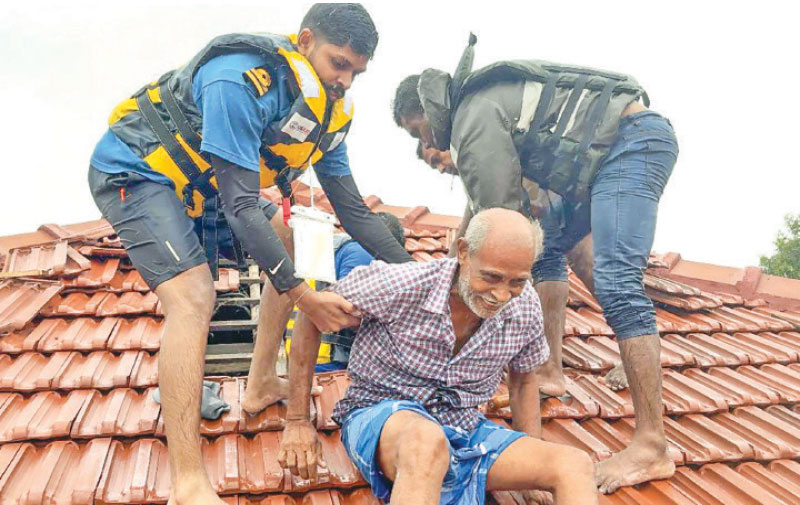
Many may see the latest destruction of Cyclone Ditwah as just another disaster. Unlike in the past, it was predicted as early as 5 November 2025, and ‘ignored’ for reasons that Sri Lanka has been “that way” for decades. But the scale of casualties and damage has shaken civilians more than even the war years or the 2004 tsunami that ravaged the coastal belt.
As an island nation, Sri Lanka should have been acutely aware of climate risks. However, national priorities were consumed by power struggles, widening inequality and chronic mismanagement. Climate change has hit the world at large, but its unpredictability is felt most painfully in smaller, vulnerable countries like Sri Lanka. Despite this, mitigation and preparedness were never treated as urgent national necessities.
Cyclonic conditions had been developing across Southeast Asia in early November. A country that lived through one of the world’s deadliest tsunamis seemed to have forgotten its lessons. The tragedy in Kadugannawa was the first major warning. Six lives were lost when a rock on the slope collapsed along the scenic Kandy road, burying a restaurant. For years, mountain slopes covered with long mana grass had been cleared to build restaurants and viewing points, weakening the landscape in the hill country of Sri Lanka. As the public focused on the horrifying footage of the Kadugannawa collapse, the wider cyclonic system began unleashing torrential rains, flash floods and landslides across the country. The Disaster Management Centre (DMC) and Public Service of the Defence Ministry are responsible for disaster management in Sri Lanka under the current government, and we are witnessing their poor preparedness, response and strategic direction. They have come under the hammer, calling for accountability at the moment.
Across the region, several countries transformed themselves into global models after experiencing catastrophic events. Bangladesh is widely recognised as one of the most disaster-prepared countries in South Asia, especially given how frequently it faces cyclones, riverine floods and storm surges. Over the past two decades, the country has transformed its disaster-management system with strong early-warning mechanisms, a nationwide cyclone-shelter network, and community-based preparedness programmes. The Philippines, struck by more than 20 typhoons annually, has also built a highly structured monitoring system. Japan leads globally in disaster technology, with earthquake-resistant buildings, automated warning systems, advanced rescue teams and world-class flood management. India, reshaped by the 1999 Odisha Super Cyclone, reformed its institutions, built thousands of shelters, established the NDRF, and carried out million-person evacuations during storms like Phailin and Fani. Thailand too strengthened its water and flood management systems after the 2011 floods.
In contrast, Sri Lanka’s disaster management framework remains strong on paper but weak in practice. The Disaster Management Act of 2005 created the National Council for Disaster Management (NCDM) and the Disaster Management Centre (DMC), which were expected to improve preparedness and coordination. However, years of political instability, shifting priorities and inconsistent funding prevented these bodies from becoming fully effective. Although Sri Lanka does issue weather alerts through the Meteorology Department and landslide warnings via the NBRO, information often does not reach communities quickly or clearly. Alerts lack localised detail, are not ready in local languages, and many rural areas depend on television or radio rather than direct warnings. Public awareness is similarly lacking. Few schools conduct evacuation drills, communities rarely participate in disaster training and risk maps are not widely shared.
Local-level preparedness is also weak. District and Divisional Secretariats are legally responsible for disaster coordination, yet many lack trained officers, proper drills, evacuation routes or active village committees. Past disasters – such as the Aranayake landslide, the Meethotamulla collapse and repeated river basin floods – have repeatedly revealed these institutional gaps.
Land mismanagement continues to amplify the risk. Illegal construction on unstable slopes, deforestation in hills, encroachment along riverbanks and poor drainage planning have worsened the impacts of heavy rain and extreme weather. The Kadugannawa slope collapse became a tragic example, where years of excavation and unregulated development weakened the landscape before disaster struck. For decades, national priorities were focused elsewhere, and disaster preparedness was treated as secondary, receiving inconsistent budgets and limited political attention.
Sri Lanka does have strengths, particularly in post-disaster response. The military, police, and emergency services mobilise rapidly, and the media plays a crucial role in disseminating information. NGOs, too, respond effectively during relief phases. Yet the country remains far stronger at responding to disasters than preparing for them.
The recent cyclone should serve as a critical wake-up call. As climate change accelerates extreme weather across South Asia, countries that invested early in preparedness have saved countless lives. Sri Lanka now faces a decisive moment: commit together to long-term disaster resilience or risk repeating the same tragedies with even greater human and economic cost.
The new regime under Anura Kumara Dissanayake may be inexperienced, but repeating past mistakes is unacceptable. The government’s handling of Cyclone Ditwah has already drawn criticism, and new developments have raised further concerns. The president has formed a management committee for the ‘Rebuild Sri Lanka’ Fund, which includes government officials and prominent private-sector leaders. Notably, the committee includes no women or subject-matter experts, raising questions about inclusivity and technical expertise. Critics argue that the focus appears to be on economic recovery rather than on restoring normal lives and providing permanent, sustainable solutions for communities affected by disasters, including proper relocation, rehabilitation and long-term resilience planning. In contrast, public engagement – locals caring for each other and for stray animals – has been exemplary during the crisis. Kudos to them!
_____________________________________
The writer is an award-winning journalist and the Deputy Editor of the Ceylon Today, Sri Lanka. She can be reached