
 For all latest news, follow the Daily Sun's Google News channel.


KING COMES, KING GOES, BUT CORRUPTION REMAINS – PART III
Why bureaucrats still seem untouchable
Special Correspondent, Dhaka
Published: 02 Dec 2025, 12:00 AM
Eighteen senior officials have been arrested and cases filed against more than a hundred others since the fall of the fascist Awami League government, yet the interim government’s crackdown has not stemmed misconduct within the civil service.
From allegations of selling “deputy commissioner” postings to claims of bribery, extortion and abuse of power by senior bureaucrats, a steady stream of cases over the past year and a half suggests that entrenched practices within the state machinery remain largely unchanged.
During the Awami League’s over-15-year rule, corruption became deeply embedded within the bureaucracy. Competing with political leaders, several officials engaged in large-scale graft, aided by a system that allegedly allowed senior bureaucrats to enrich themselves while staying aligned with the ruling party.
After 5 August, 18 top officials were arrested and cases filed against more than 100 bureaucrats. Even so, bureaucratic corruption has persisted. One of the most high-profile cases of the past 18 months involved the alleged exchange of crores of taka for appointments to Deputy Commissioner (DC) posts.
A leaked audio recording suggested that a former secretary of the public administration ministry – serving on a contractual basis – arranged DC postings in return for money. Copies of cheques linked to these allegations circulated in the media. A high-level probe committee was formed, but its findings were never released.
Later, accusations emerged surrounding the appointment of the Chattogram Deputy Commissioner.
The chief adviser personally investigated the matter, after which the public administration secretary was transferred. Transparency International Bangladesh (TIB) publicly argued that a transfer cannot be considered a sufficient response when corruption allegations are involved.
A separate committee, headed by the secretary of the Ministry of Social Welfare, was tasked with investigating allegations of unethical financial demands and harassment against Additional Secretary Zia Uddin Ahmed.
Earlier this year, while serving in the Ministry of Food, a complaint against him led to the formation of a three-member inquiry panel comprising Mohammad Abu Yusuf, secretary of the social welfare ministry; Rokeya Begum, joint secretary; and SM Noman Hasan Khan, deputy secretary. Zia Uddin is now posted as Additional Secretary at the Ministry of Liberation War Affairs.
The committee was instructed to carry out a full investigation and submit a clear report.
The complaint was filed by Md Mohidul Haque, owner of Ruposhi Flour, Rice & Nutrition Mill in Shibganj, Bogura – a milling-capacity flour mill listed by the Food Directorate. Mohidul wrote, “My Ruposhi Flour, Rice & Nutrition Mill is a milling-capacity flour mill enlisted by the Directorate of Food. To save government expenditure, I submitted an application to the Secretary of the Ministry of Food, requesting that my mill be designated as the single milling point for OMS flour in Shibganj and Kahalu municipalities of Bogura.”
He stated that following instructions from the Ministry of Food, the Bogura deputy commissioner submitted an investigation report with recommendations on 9 January.
But when the file reached Additional Secretary Zia Uddin, he allegedly refused to approve it. Instead, he summoned Mohidul’s close relative – former Shibganj upazila chairman Mir Shah Alam – to the secretariat and demanded Tk20 lakh in exchange for approval.
When the money was not paid, Zia Uddin rejected the file and returned it for further inquiry despite the recommendation. Mohidul alleges that harassment continued.
Following the complaint, the public administration ministry directed the Social Welfare Ministry to conduct an inquiry. Yet the accused official remains in his post.
In Mymensingh’s Phulpur, eight development projects worth Tk24 lakh were allocated from the Zila Parishad to develop the family graveyard of the local government secretary. The Zila Parishad’s executive officer, Kabir Hossain, was accused of undertaking the projects to please the secretary.
He also faced allegations of fraud and irregularities in blanket distribution. After the complaints surfaced, he was transferred and the Anti-Corruption Commission (ACC) launched an investigation.
The ACC has also opened an inquiry into allegations of abuse of power, irregularities, corruption and bribery against Mohammad Ejaz, administrator of Dhaka North City Corporation (DNCC).
The investigation began on 27 November, according to a letter signed by ACC Director Ishita Rani.
Ejaz was appointed by the interim government for one year on 12 February. The ACC has reported receiving allegations of widespread irregularities and bribery involving misuse of authority.
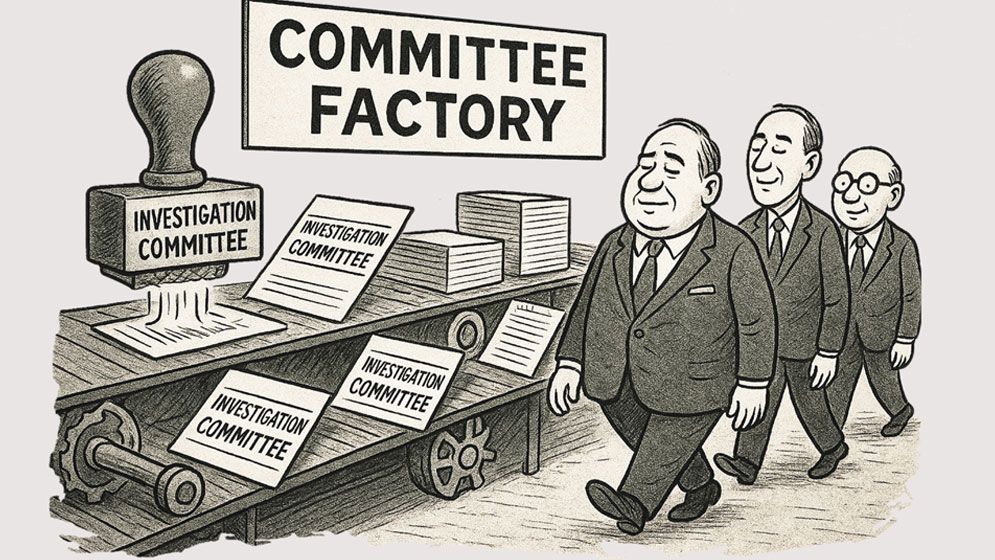
Confronted with a growing list of allegations against senior bureaucrats, the interim government appears to be following an all-too-familiar pattern: forming inquiry committees but making little visible progress, according to analysts.