


 For all latest news, follow the Daily Sun's Google News channel.


Experts urge stronger birth, death registration law to ensure universal coverage by 2030
Daily Sun Report, Dhaka
Published: 06 Nov 2025, 04:11 PM
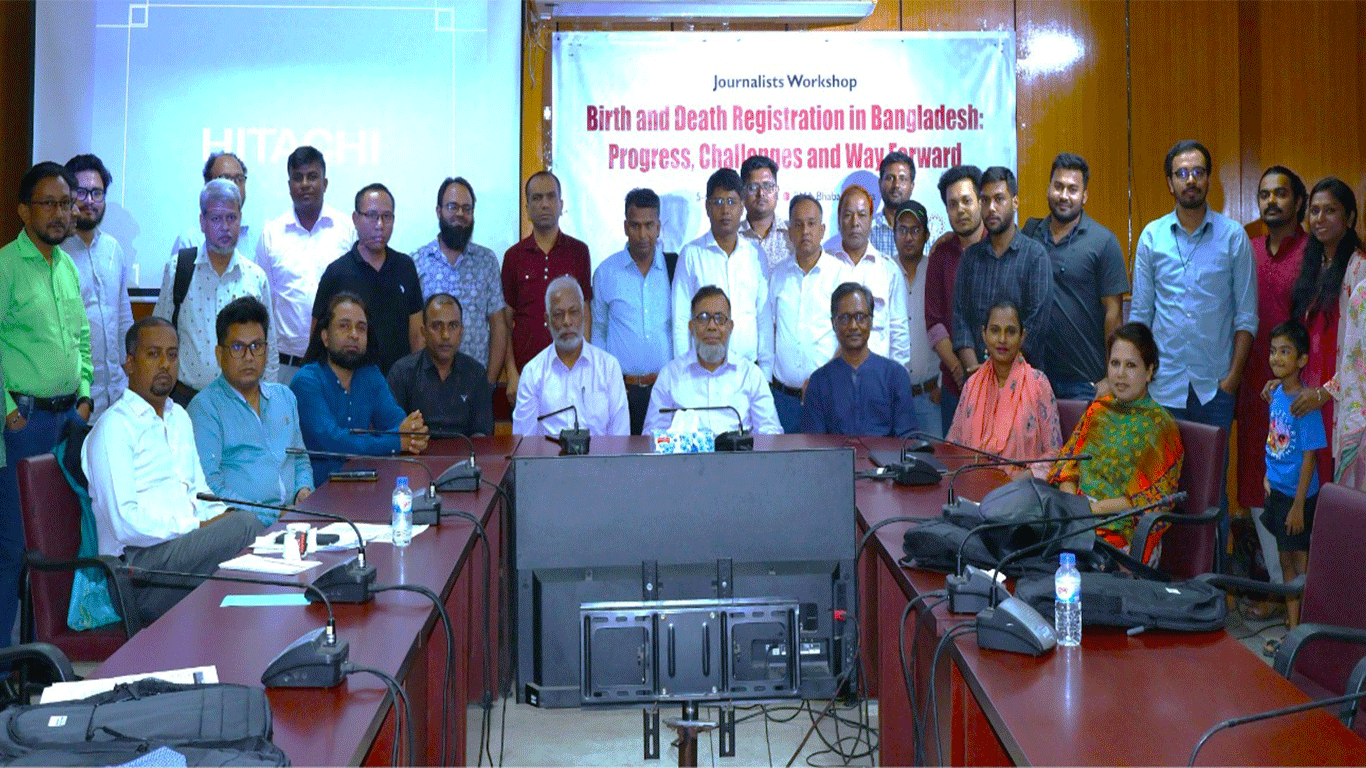
Photo: Courtesy
Experts and journalists have called for urgent reforms to strengthen Bangladesh’s Birth and Death Registration Act to ensure universal coverage by 2030.
They said gaps in the existing law and its weak implementation remain key obstacles to achieving this national target.
The observations came at a two-day journalists’ workshop titled “Birth and Death Registration in Bangladesh: Progress, Challenges, and Way Forward,” held on 5-6 November at the Bangladesh Medical Association (BMA) Bhaban in Dhaka.
The event was organised by PROGGA (Knowledge for Progress) with support from the Global Health Advocacy Incubator (GHAI), and attended by 30 journalists from print, television, and online media outlets, said a press release.
During the workshop, participants noted that Bangladesh’s birth registration rate currently stands at 50%, while death registration is 47%0—both well below the global averages of 77 and 74%, respectively.
Speakers emphasised that proper registration is essential to ensuring citizens’ access to education, healthcare, inheritance, voting rights, and social protection programmes.
They warned that inadequate registration increases the risks of child marriage, child labour, and statelessness.
“Birth and death registration is more than just statistics—it’s the foundation of national development and good governance,” said one of the speakers.
Participants highlighted that, under the current law, families are solely responsible for reporting births and deaths, while the health sector’s role is optional.
However, with around 67% of births taking place in healthcare facilities, many countries in the Asia-Pacific region have achieved near-universal registration by making hospitals legally responsible for registering births and deaths.
Speakers urged the government to revise the Birth and Death Registration Act 2004, to mandate that all hospitals and healthcare facilities record births and deaths directly.
They said such an amendment would significantly accelerate progress toward the universal registration goal under the Civil Registration and Vital Statistics (CRVS) Decade and Sustainable Development Goal (SDG) 16.9 — ensuring legal identity for all by 2030.
“We are committed to achieving universal birth and death registration by 2030. To do so, we must reform the law and ensure its proper implementation,” said Muhammad Ruhul Quddus, Bangladesh country lead of GHAI.
Md Nazrul Islam, country coordinator of Vital Strategies, stressed the importance of raising public awareness and enhancing institutional capacity.
“We need to improve public understanding of registration, strengthen the capacity of registrars, upgrade technology, and promote inter-sectoral coordination,” he said.
Other speakers included Md Moyeen Uddin, country coordinator of Vital Strategies; Kawsar Rahman, chief reporter of Janakantha; and ABM Zubair, executive director of PROGGA.
Presentations were delivered by PROGGA’s Head of Programs Md Hasan Shahriar and Coordinator Mashiat Abedin.