


 For all latest news, follow the Daily Sun's Google News channel.


Ctg Port risks collapse without urgent off-dock expansion
The port handled a record 3.3 million Twenty-foot Equivalent Units (TEUs) in the 2024-25 fiscal year
Nur Uddin Alamgir, Chattogram
Published: 26 Oct 2025, 02:39 AM
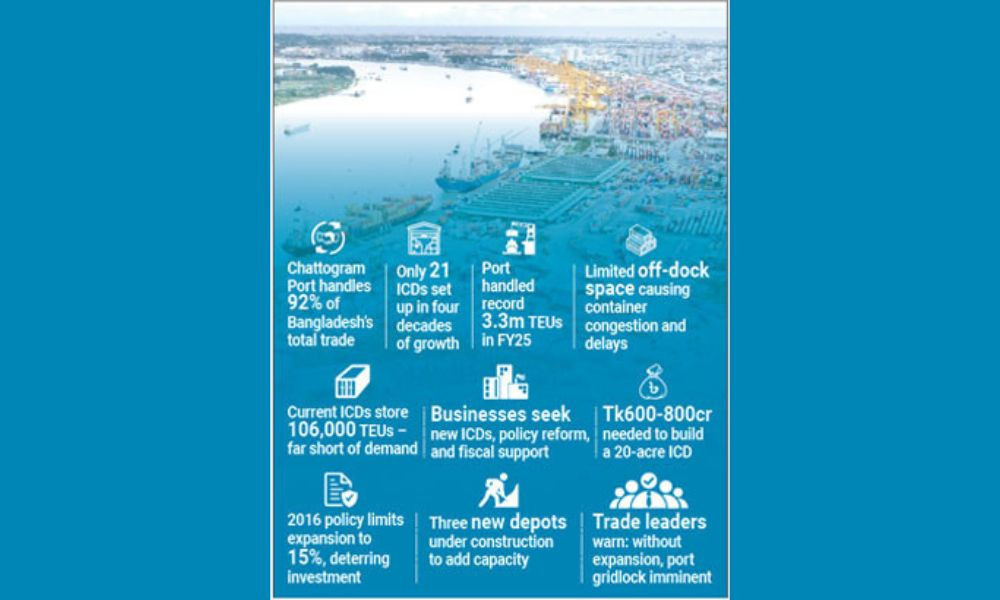
With containerised trade expanding rapidly, business leaders and stakeholders are warning that the country’s premier seaport, Chattogram Port, will struggle to operate smoothly unless off-dock facilities are urgently expanded.
They say limited Inland Container Depots (ICDs) – only 21 set up in four decades – are now inadequate to handle Bangladesh’s growing trade volume, calling for government policy reform and fiscal incentives to attract new investment.
Despite the spectacular rise in foreign trade, the number of ICDs has barely grown since the first one was established in 1985. The port handled a record 3.3 million Twenty-foot Equivalent Units (TEUs) in the 2024-25 fiscal year (FY25), underscoring the strain on existing off-dock capacity.
During any disruption, containers quickly pile up at port yards, causing congestion, delaying vessel turnaround times, and increasing shipping costs. These disruptions not only hurt exporters and importers but also impact domestic manufacturers and consumers by slowing production and pushing up the prices of essential goods.
Businesspeople argue that more ICDs are vital to meet future challenges, ensure uninterrupted international trade, and prevent the current operators from dominating the market.
At the same time, the Bangladesh Inland Container Depot Association (BICDA) is urging the government to revise policies and offer fiscal support to keep pace with trade growth.
Four decades of slow ICD development
Chattogram Port handles around 92% of Bangladesh’s import-export trade and 98% of containerised cargo.
When containerisation began in 1981, the Chattogram Port Authority (CPA) encouraged private entrepreneurs to set up ICDs as part of a modernised supply chain system. Sea Farers Limited established the first ICD in 1985, followed by Ocean Containers Limited in 1988, Shafi Motors Limited in 1996, Iqbal Enterprise Limited in 1998, and QNS in 1999.
Initially, the facilities handled only empty containers. Shafi Motors first obtained permission to store and containerise export goods, but Iqbal Enterprise was the first to actually containerise and dispatch export-laden containers to Chattogram Port.
The number of ICDs increased after 1999. By 2006, several off-docks were authorised to deliver nine items of containerised bulk cargo–rice, wheat, chickpeas, lentils, mustard, animal feed, raw cotton, waste paper, and scrap–directly from their premises. Later, all ICDs were permitted to handle these goods.
In 2010, the scope was widened again, allowing ICDs to process eight more items including fertiliser, onion, garlic, ginger, hard coke, carbon black, marble chips, and ball clay.
Today, ICDs handle 65 types of import items and 100% of Bangladesh’s export cargo.
Limited capacity, mounting pressure
The 21 operational ICDs collectively provide storage for 106,000 TEUs, handling around 750,000 export containers, 300,000 import containers, and 1.2 million empties each year.
As of Thursday, the off-docks held 7,500 export containers, 7,000 import containers, and 64,000 empties, according to official figures.
Three more depots are under construction–AK Khan Container Depot (9,000-container capacity), Shah Mazidia Depot (3,500), and Eastern Logistic-2 (8,000), according to sources.
By comparison, Chattogram Port’s total container storage capacity is just 59,000 TEUs. On Thursday, 39,954 TEUs were lying in the port yards, and in August, the figure exceeded 49,000 TEUs due to slow delivery, disrupting operations.
The port recorded steady growth in FY2024–25, handling 3,296,067 TEUs of containers and 130,724,783 tonnes of cargo, reflecting 4.02% and 6.07% increases respectively.
In the first three months of the current fiscal year, it processed 927,713 TEUs, 32,919,966 tonnes of cargo, and 1,031 vessels–up 12.24%, 13.88%, and 9.22% from the same period last year.
Policy barriers stifling expansion
BICDA Secretary General Mohammad Ruhul Amin Sikder said expanding ICD facilities in Chattogram requires government support in the form of policy amendments, incentives, and easier access to finance.
He said the Private ICD/CFS Policy-2016 restricts ICDs to locations at least 20 kilometres from the port area and limits expansion to 15% of their existing capacity.
“These restrictions are discouraging entrepreneurs from taking new initiatives,” Sikder told the Daily Sun on Thursday.
“Developing an ICD requires an investment of Tk600-Tk800 crore and takes around 15 years to recover capital for a 20-acre facility. So, if entrepreneurs are charged 12–13% interest rates like other businesses, it will not be viable for them to survive,” he noted.
He added that the government should also offer incentives for export processing in ICDs to further encourage investment.
Port users, traders voice concerns
Bangladesh Shipping Agents Association (BSAA) President Syed Mohammad Arif said that globally, containers are not delivered directly from ports; dry docks or ICDs usually handle them.
He alleged that the delivery of full container load (FCL) and less-than-container load (LCL) cargo from Chattogram Port often causes suffering and financial losses to importers.
Arif emphasised easing conditions for setting up new ICDs to prevent future crises as trade continues to expand.
Former director of the Bangladesh Freight Forwarders Association Khairul Alam Suzan said port congestion hampers operational efficiency, prolongs vessel turnaround times, and delays cargo delivery.
“The ICDs also struggle to handle export surges during the peak seasons,” he said. “So, it is high time to increase both the number of ICDs and the range of items they can handle to meet future challenges.”
International Business Forum Chattogram President SM Abu Tayyab said the limited number of ICDs allows existing ones to monopolise the business.
“Increasing the number will bring competition, ensure fair pricing, and strengthen accountability,” he remarked.
The reporter can be reached at [email protected]