


 For all latest news, follow the Daily Sun's Google News channel.


4 major highways in Khulna division crippled by decay
Vehicles are frequently damaged, and traffic congestion severely disrupts trade and commerce
Amanur Aman, Kushtia
Published: 12 Oct 2025, 01:54 AM
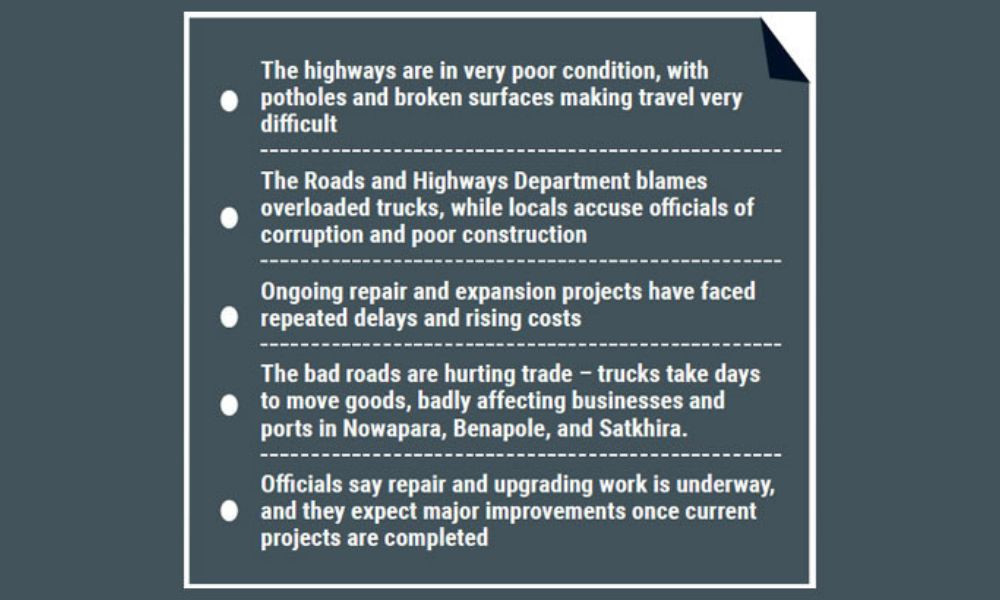
Four major highways in the Khulna division have been in a dire state for a long time, making travel extremely difficult.
Asphalt has worn away along most sections, leaving large potholes and uneven surfaces. Even light rainfall makes navigation treacherous, and once the water dries, mud, dust, and loose soil further obstruct travel.
Vehicles are frequently damaged, and traffic congestion severely disrupts trade and commerce in Jashore’s industrial town of Nowapara, the port town of Benapole, and Satkhira’s land port, Bhomra.
The Roads and Highways Department (RHD), which owns these highways, has blamed continuous overloading, particularly by trucks, for the deterioration.
However, residents of the affected areas have accused the authorities of carrying out substandard construction work and misappropriating funds over the past fifteen years.
Jashore-Khulna highway: A key southwestern route
The Jashore–Khulna highway stretches 60.3 kilometres, including 33.5 kilometres running from Jashore to Rajghat in Abhaynagar upazila. It is one of the busiest and most important routes in southwestern Bangladesh, directly connecting the country’s largest land port at Benapole, river ports, the industrial town of Nowapara, Mongla port in Bagerhat, and Satkhira’s land port, Bhomra.
The government launched a project to expand and reconstruct the road in 2017, with construction beginning in May 2018. The 19-kilometre Padmabila–Chengutia section was awarded to Toma Construction, while the remaining stretch went to Mahbub Brothers. The combined cost of the two contracts was Tk321 crore, with completion initially scheduled for June 2020.
Delays caused by the COVID-19 pandemic and adverse weather pushed the deadline to December 2020. When that deadline was also missed, it was extended again to June 2022, raising the total cost to Tk348 crore.
Although the road was officially handed over to the Roads and Highways Department in that year, sections began to deteriorate within a month. Within a year, around 15 kilometres from Rupdia to Nowapara had become almost impassable. The government urgently initiated renovation work worth Tk172 crore, which is still ongoing. The same contractors – Mahbub Brothers and Toma Construction – are carrying out the repairs.
Jashore-Jhinaidah highway: The only route to Rajshahi and northern Bangladesh
The distance from Chanchra in Jashore to the Jhinaidah bus terminal is 47.48 kilometres. The Jashore section up to Kaliganj in Jhinaidah has become a heavily damaged, pothole-ridden stretch, while most of the 27-kilometre Jhinaidah section has lost its asphalt entirely, creating large craters along the road.
Sources said that a six-lane upgrade project on this highway, launched in 2021, was originally slated for completion by December 2023.
However, delays forced an extension to June 2026. In June this year, the Roads and Highways Department sought another six-month extension from the Planning Commission.
Land acquisition costs have tripled to Tk265 crore, further slowing construction progress.
Poor conditions on the Jashore-Narail and Jashore-Satkhira highways
Of its 34 kilometres, sections from Hamidpur to Baulia, Rostompur to Charabhita, and Dholga to Tularampur of the Jashore-Narail highway are nearly impassable. Small vehicles frequently overturn due to the uneven surface.
The seven-kilometre stretch from Navaran to Bogaachra of the Jashore-Satkhira highway is in a fragile condition. Potholes are being temporarily filled with bricks, and some portions are under makeshift brick paving.
People who rely on these roads are suffering immensely. Business owners, in particular, have been hit hardest.
Ahmed Raju, manager of Nowapara Group, said that Nowapara, being an industrial town and river port, handles about 70 per cent of the country’s imported fertilisers.
“Due to the poor condition of the roads, a single truck can take two to three days to get through, which severely affects fertiliser distribution and other port-based businesses,” he said.
Truck driver Hafizur Rahman Bachchu described the situation as dire.
“Travelling has become extremely difficult. Many vehicles’ axles break and get stuck. A journey that should take a few hours can now take two to three days because of traffic jams,” he said.
Alamgir Hossain Bhuiya, a driver for Ghorai Transport on the Khulna–Kushtia route, added, “It should take about three to three and a half hours to travel from Khulna to Kushtia via Jashore, but now it takes six to seven hours, and the cost is no longer covered.”
Executive Engineer Golam Kibria of the Roads and Highways Department in Jashore said that 18-20 kilometres of reinforced concrete (RCC) paving work on the Jashore-Khulna highway is currently underway.
“About five kilometres have been completed, 2.3 kilometres are in progress, and four more kilometres have been submitted to the ministry. We expect the first four kilometres to be completed by October,” he said.
Work is also in progress on the eight-lane Jashore-Jhinaidah highway and the six-lane Jashore-Narail highway.
Once these projects are completed, the long-standing problems on Jashore’s four main highways are expected to improve significantly.