


 For all latest news, follow the Daily Sun's Google News channel.


DCCI stresses for a concerted ecosystem to grow Bangladesh’s halal industry
Daily Sun Report, Dhaka
Published: 11 Oct 2025, 05:28 PM
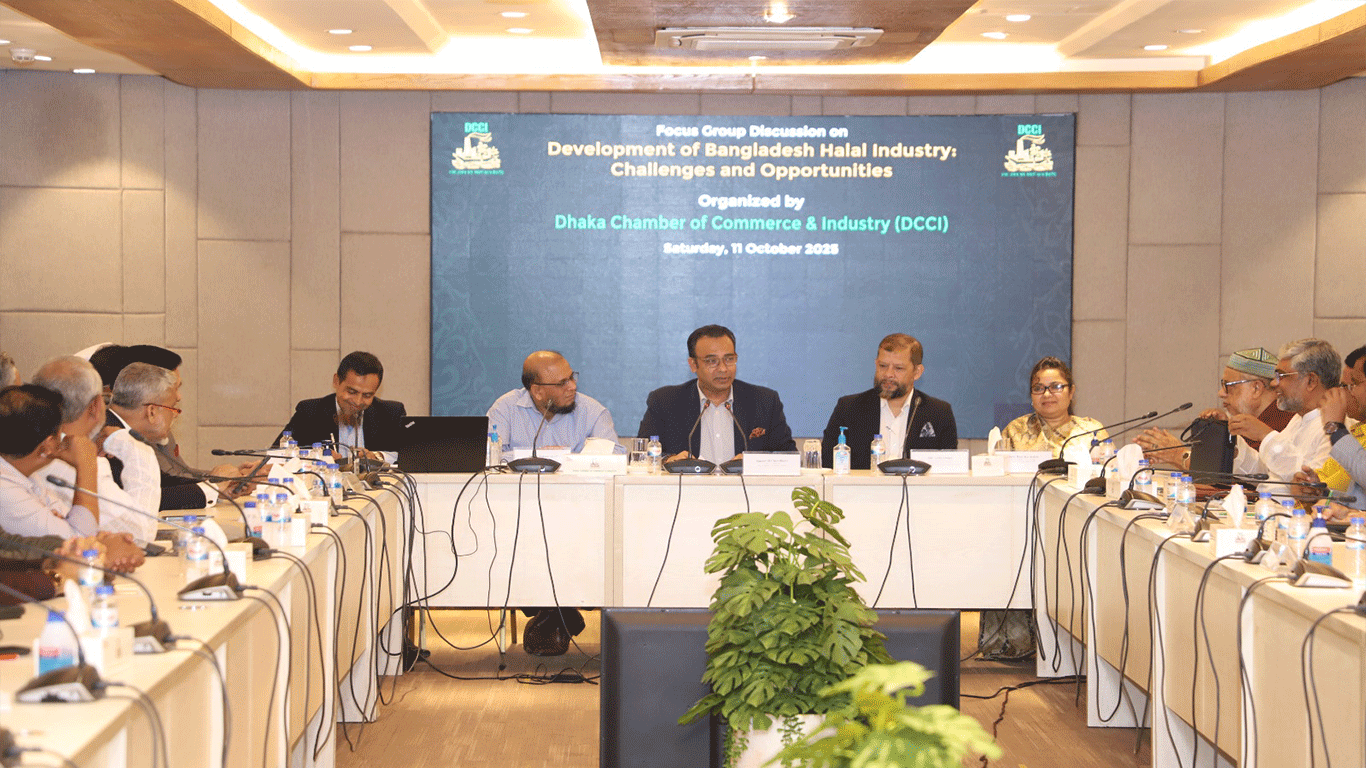
Photo: Daily Sun
Dhaka Chamber of Commerce and Industry (DCCI) has stressed on the urgent need to establish an independent board to ensure global recognition of Bangladesh’s halal certification system.
The chamber also called for a joint public–private collaboration to set up internationally accredited testing laboratories.
DCCI Senior Vice President Razeev H Chowdhury made these remarks at a focus group discussion titled “Development of Bangladesh Halal Industry: Challenges and Prospects” organized by DCCI at its auditorium in the capital.
Razeev Chowdhury stated that the rapidly growing global halal industry is currently valued at about $3 trillion and is projected to reach $9.45 trillion by 2034.
However, Bangladesh’s halal exports are limited to around $850 million, mostly in agro-based products.
“Despite the immense potential, the country’s halal sector faces multiple structural and institutional challenges that hinder its desired growth. These include non-compliance with international halal standards, inadequate logistics infrastructure, tariff and certification constraints, lack of modern laboratories, shortage of skilled manpower, and the absence of an integrated halal ecosystem,” he highlighted.
Presenting keynote paper, Mominul Islam, assistant professor at IUBAT, pointed out that both Islamic Foundation and Bangladesh Standards and Testing Institution (BSTI) currently issue halal certificates in Bangladesh, often resulting in procedural complexities.
He added that the lack of modern equipment, weak country branding, limited SME participation, absence of a unified halal policy, shortage of skilled human resources and inadequate supply chain systems are among the key barriers hindering the sector’s development.
Md Abul Kalam Azad, assistant manager-export at Paragon Group, emphasised the need for a digital, technology-based halal certification system and compliance audits to ensure product quality.
AGM Sayadul Haq Bhuiyan, head of supply chain and export at Bengal Meat, underscored the importance of value addition and the use of blockchain technology to trace animal life-cycle data.
He also stressed that halal certification authorities in Bangladesh must achieve international accreditation standards.
Md Abu Saleh Patwary, deputy director at Islamic Foundation, mentioned that any single government entity currently has not capable enough to issue halal certificates independently, hence several institutions coordinate this process.
He also emphasised on enhanced government monitoring for quality assurance of the halal products.
Baby Rani Karmakar, director general-1 (Joint Secretary) at Export Promotion Bureau (EPB), highlighted that the global halal market is growing by approximately 12% annually, but Bangladesh is still lagging behind.
She called for concerted efforts to increase Bangladesh’s market share in the global halal industry.
Md Ariful Hoque, director general (Joint Secretary) of international investment promotion at Bangladesh Investment Development Authority (BIDA), said that the Bangladesh’s halal sector could play a vital role in export diversification in the post-LDC era and he also informed that the government is seriously considering to establish a special economic zone dedicated to halal industries.
Md Aminul Islam, director general at Bangladesh Accreditation Board under Ministry of Industries, noted that Bangladesh is lagging in global halal market participation but he is hopeful that coordinated efforts could help unlock the sector’s full potential.
During the open floor discussion, M Abu Hurairah, former vice president of DCCI, mentioned that Bangladesh’s rural economy has become significantly more prosperous in recent times, with women in rural areas actively contributing to various economic activities.
He noted that providing small-scale incentives at minimal interest rates to encourage rural women’s participation in animal husbandry could greatly enhance Bangladesh’s progress in halal food exports.