


 For all latest news, follow the Daily Sun's Google News channel.


icddr,b organises Bangladesh Oxygen Summit 2025
Daily Sun Report, Dhaka
Published: 09 Oct 2025, 11:22 PM
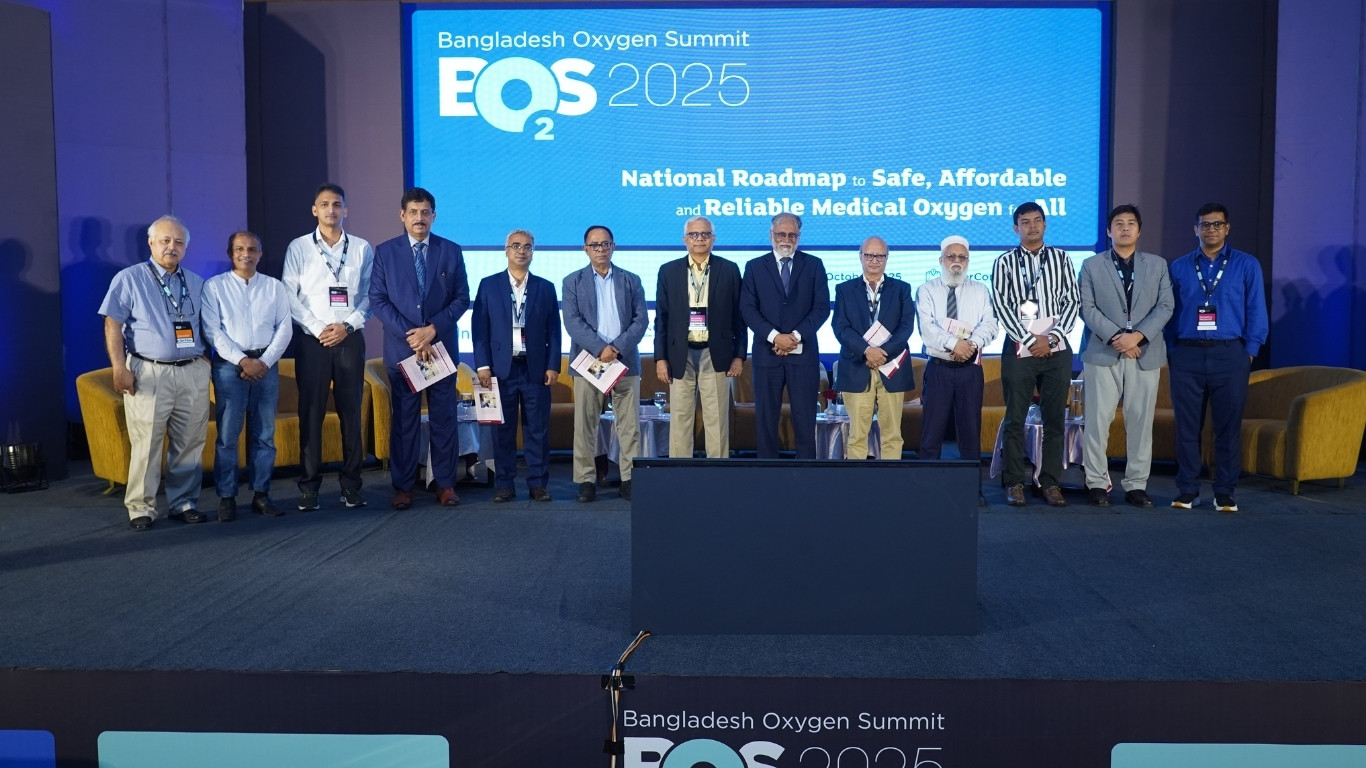
Photo: Courtesy
To advance equitable access to safe and affordable medical oxygen, icddr,b organised the Bangladesh Oxygen Summit 2025 at the InterContinental Dhaka.
The event, held under the theme “National Roadmap to Safe, Affordable and Reliable Medical Oxygen for All,” brought together policymakers, scientists, academicians, development partners, private sector and Government representatives to chart a collective plan for universal oxygen access.
The Honourable Special Assistant to the Minister (State Minister rank), Ministry of Health and Family Welfare, Prof Md Sayedur Rahman, attended the event as chief guest.
The inaugural address was delivered by Dr Shams El Arifeen, senior scientist (Emeritus) at icddr,b and one of the senior authors of The Lancet Global Health Commission on Medical Oxygen Security.
Established in 2022 following an icddr,b study led by Dr Ahmed Ehsanur Rahman, scientist, Maternal and Child Health Division at icddr,b, the Commission brings together 18 experts from academia, 40 advisors from diverse sectors, including researchers, practitioners and public health professionals.
Its mission is to ensure that no one dies due to lack of oxygen, even during global health emergencies such as the COVID-19 pandemic.
According to global analyses from the Commission, an estimated 373 million people worldwide require medical oxygen each year, including 105 million with acute medical conditions, 259 million undergoing surgery and 9 million dependent on long-term therapy.
More than four out of five people in need of oxygen live in low- and middle-income countries.
Hypoxaemia increases the risk of death nearly fivefold, yet only a fraction of patients in these settings receive oxygen when needed.
Medical oxygen is a World Health Organization-designated essential medicine that plays a vital role in healthcare at every level. Yet, access remains unequal across the world, particularly in low-resource settings.
In Bangladesh, shortages in primary healthcare facilities, particularly at district and upazila levels, continue to challenge patient care.
An icddr,b study assessing Bangladesh’s oxygen ecosystem found that despite major progress in establishing Pressure Swing Adsorption (PSA), Vacuum Swing Adsorption (VSA), and Vacuum Insulated Evaporator (VIE) plants, significant operational gaps persist.
A survey of 99 healthcare facilities revealed systemic weaknesses in technical maintenance, staffing and governance, threatening the reliability of oxygen services.
The study called for a national roadmap to strengthen plant capacity, develop a dedicated biomedical workforce, decentralise repair facilities, recognise oxygen as an essential public health service and promote a resilient mixed-supply model.
Speaking at the summit, Prof Dr Md Sayedur Rahman said, “There is still a gap in oxygen access, but the government is actively addressing it. We are working to establish a National Oxygen Network and to declare oxygen an essential medicine. Achieving self-sufficiency in medical oxygen is closely linked to national security.”
Dr Tahmeed Ahmed, executive director of icddr,b, who chaired the session, said, “Bangladesh has made remarkable progress in oxygen production, but much more remains to be done. Ensuring reliable supply requires strong governance, better coordination among sectors and sustained investment in system-wide monitoring.
“Good governance in oxygen systems can mean the difference between life and death. Continued investment in research and innovation will be essential to develop cost-effective solutions and evidence-based policies to sustain this progress.”
Director General of Health Services Prof Dr Abu Jafar added, “Oxygen is not just a commodity, it is a public service.”
He commended the contributions of icddr,b scientists in generating research evidence that has informed both national and global health policies.
The summit featured four scientific sessions exploring oxygen demand and supply, production and delivery mechanisms, policy and investment priorities, and innovations for sustainability.
Representatives from the Directorate General of Health Services, Bangladesh Bureau of Statistics, UNICEF, UNOPS, the World Bank, Asian Development Bank and private sector partners shared insights on strengthening national oxygen systems.
The final session showcased several locally developed technologies, including Bubble CPAP, OxyJet, the Nishshash ventilator and low-cost concentrators designed to improve respiratory care in low-resource settings.
Experts at the summit emphasised that oxygen access is central to achieving eight Sustainable Development Goals (SDGs), including SDG 3.1 on maternal mortality, 3.2 on newborn and child mortality, 3.3 on deaths from HIV/AIDS, tuberculosis and malaria, 3.4 on noncommunicable diseases and mental health, 3.5 on substance abuse, 3.6 on road traffic accident deaths, 3.8 on universal health coverage and 3.9 on mortality from environmental pollution.
The Bangladesh Oxygen Summit 2025 was supported by The Lancet Global Health, Every Breath Counts and Unitaid.
It concluded with a collective call to recognise medical oxygen as a human right and a national priority. Participants agreed that equitable access to oxygen is critical not only to health system resilience but also to the country’s preparedness for future emergencies.