


 For all latest news, follow the Daily Sun's Google News channel.


Bangladesh wastes a third of its food while millions go hungry: WB study
Moderating the event, CPD Executive Director Fahmida Khatun described food loss as a “critical barrier” to food security
Daily Sun Report, Dhaka
Published: 30 Sep 2025, 04:18 AM
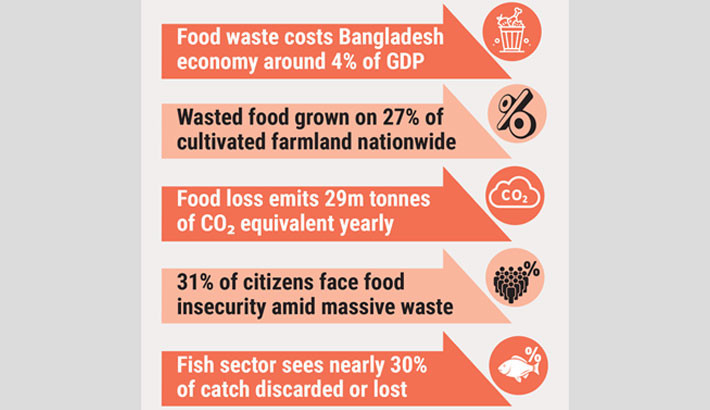
Bangladesh wastes nearly one-third of its available food each year, causing enormous economic losses and worsening hunger and environmental damage, a World Bank study revealed at a conference in Dhaka on Sunday.
The research estimates that around 34% of the country’s food supply – produced on more than 34,000 square kilometres of farmland, or roughly 27% of its cultivated area – is ultimately lost or discarded. The economic cost of this wastage is equivalent to 4% of Bangladesh’s GDP.
Son Than Vho, the World Bank’s senior agriculture specialist, told delegates that food loss and waste account for about 13% of the country’s total greenhouse gas emissions – some 29 million tonnes of CO₂ equivalent annually.
The findings underline a stark paradox: while 31% of Bangladeshis experience food insecurity and two-thirds cannot afford a healthy diet, vast amounts of food are spoiled or thrown away.
The report, presented at the conference “Towards Zero Food Waste and Loss: Building a Sustainable Food Value Chain in Bangladesh”, organised by the Centre for Policy Dialogue (CPD) with support from the Embassy of Denmark, FAO, the World Bank and the WFP, shows losses occurring at almost every stage of the food chain.
Most losses occur during production, transport, handling, storage and processing, while waste at the retail and consumer level remains significant. Loss rates are especially high for staples and perishables: rice (23%), lentils (27%), fish (36%) and mangoes (29%).
FAO deputy representative Dia Sanou said pre-harvest paddy losses stood at 23%-28%, with post-harvest wheat losses averaging 17.6%. Losses in horticulture ranged from 17% to 32%: mango (31.7%), banana (19.9%), potato (21.8%), carrot (26.8%), tomato (27.9%) and red amaranth (16.9%). Tomatoes also showed a 10% field loss.
Fisheries and Livestock Adviser Farida Akhter warned that nearly 30% of fish harvested in Bangladesh goes to waste, largely due to illegal nets and indiscriminate fishing.
“People use illegal nets that trap everything, keeping only the fish they want and discarding the rest,” she said, adding, “Nearly two-thirds of the catch from each vessel is thrown away, causing serious harm to biodiversity and natural resources.”
She added that while 16% of the population now suffers severe food insecurity, inequality and overconsumption persist.
“Our farmers are producing, but they don’t get fair prices or proper storage facilities. Finally, they are being forced to give up,” she warned.
Moderating the event, CPD Executive Director Fahmida Khatun described food loss as a “critical barrier” to food security.
“Despite remarkable growth over the last five decades, Bangladesh still suffers from malnutrition and undernutrition. Food distribution is unequal. That is why reducing food loss is crucial,” she said.
Speakers including WFP Bangladesh deputy country director Jesse Wood, Agriculture Ministry secretary Dr Mohammad Emdad Ullah Mian and Food Ministry additional secretary Mohammad Yasin echoed calls for immediate action to address the crisis.