


 For all latest news, follow the Daily Sun's Google News channel.


The artistic beauty and humanism of Lalon Fakir
Prodeepto Mobarook, Poet and Researcher.
Published: 17 Aug 2025, 07:28 PM
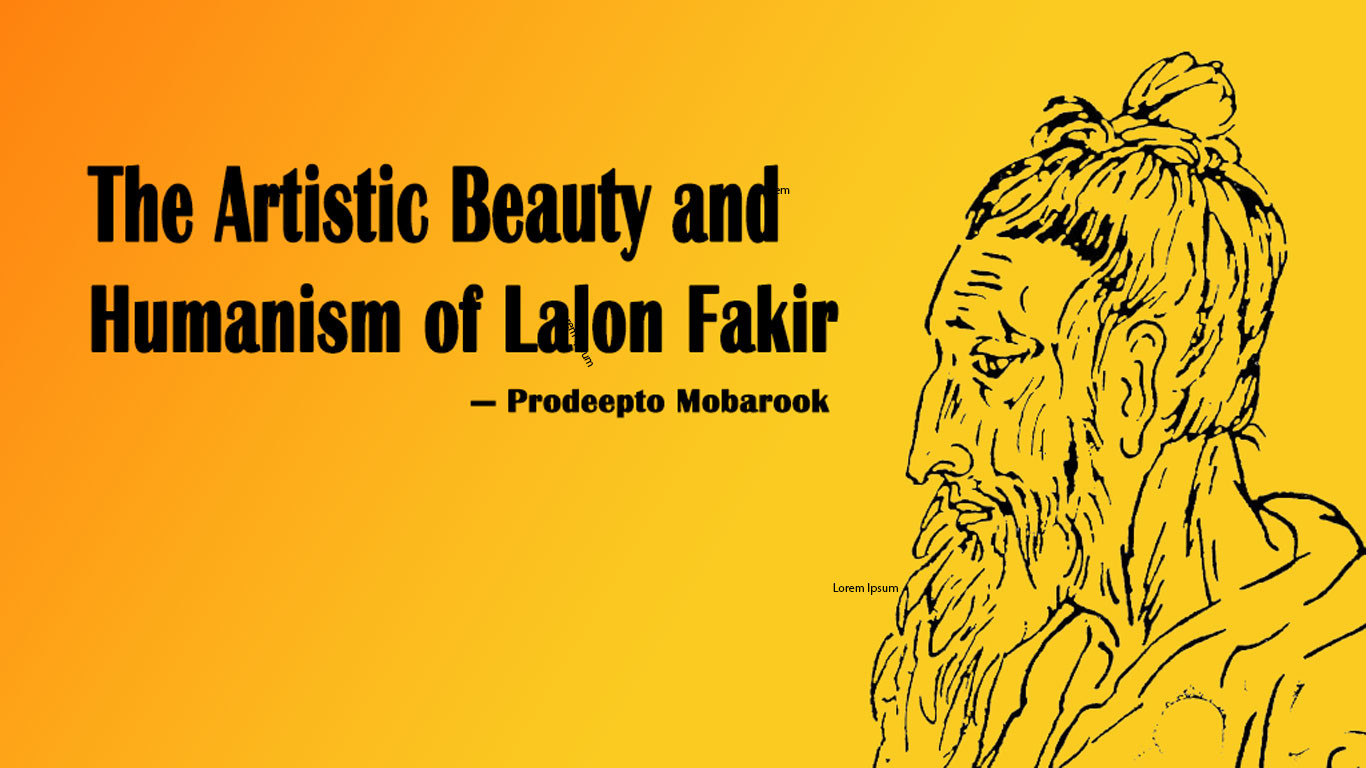
The origins of the word Baul lie in Persia. In the deserts, a group of wandering Sufi mystics, renouncing worldly life and living upon music, were known as Al or Baul. They were mystics whose practices were esoteric and often based on tantric and ascetic traditions. The Baul community we speak of today in Bengal is considered a continuation of these Persian Al or Baul groups.
I also hold a slightly different view regarding the first use of the word Baul in Bengali. It appears for the first time in the 14th century in Shah Muhammad Sagir’s epic Yusuf-Zulekha, where these mystics were referred to as Baul or Baur. Whatever its origin, there is no disagreement about the meaning of the term: it denotes those perceived by society as lowly, destitute, and mad. They had no social status, wealth, or permanent residence wandering from place to place, sustaining themselves by others’ generosity. Regardless of time or society, their lifestyle and position remained the same.
As a people, Bengalis have made no small contribution to philosophy and the arts. Among such milestones, the life and thought of Fakir Lalon Shah stand as a towering pillar. Lalon Fakir’s real name was Lalit Narayan Kar, affectionately called Lalu. His father was Madhab Kar and his mother Padmabati. Despite having no formal education, Lalon raised profound philosophical questions: How was the universe created ? Who is God ? Who am I ? What is the relationship between Creator and creation? His quest for answers to such existential mysteries remains unparalleled in our cultural and historical heritage. With a depth of thought, artistic beauty, and spiritual subtlety, Lalon was one of the greatest humanist figures of his age.
Known as the “Baul Emperor,” Fakir Lalon Shah remains one of the greatest representatives of Bengali culture. Rooted in folk tradition, the very mainstream of Bengali culture, Lalon nourished it through his philosophy and song. His fakirism and Baul doctrine stood against communal fanaticism and religious orthodoxy, upholding human values and social consciousness. At once both mystical and rebellious, Lalon’s songs deal with themes of Baul practice while simultaneously protesting against injustice, social inequality, and superstition.
His songs encompass discourses on the body, soul, the master, devotion, divinity, and contain reflections on Muhammad, Krishna, Jesus, the Vedas, the Qur’an, and the Bible. This spiritual philosophy, expressed through music, transformed Lalit Narayan Kar into the Mahatma known as Lalon Fakir. His message was simple yet eternal: above all identities of race, caste, or creed, there is humanity; and the Creator of the universe resides within the human heart. Thus, he demonstrated that the path to the divine lies in love between human beings.
Lalon believed that peace would never prevail if humans judged one another as Hindu, Muslim, Buddhist, Christian, or Jain instead of recognising each other simply as human beings. This belief, which modern civilisation also holds true, inspired countless poets, thinkers, and scholars across the world. More than a century and a half later, his vision of a society free of hatred and division continues to guide us as a beacon of humanity.
Lalon composed more than ten thousand songs between 1774 and 1890. Songs that soothe, awaken, and elevate the human spirit. Far from being the destitute fakir some imagine, research shows that Lalon led a settled life. He owned betel-leaf gardens, a mango orchard, livestock, and even horses, besides his home, wife, and adopted daughter, Perenneza. At his death, he left behind property and nearly two thousand rupees in cash. He inherited land from his foster father, Maulana Malam Shah, on which he established his akhra, the site of his shrine today and he purchased additional land during his lifetime. Contemporary records describe him as a respected and honourable man of middle-class standing, who maintained friendships with eminent thinkers, including Maharshi Debendranath Tagore, father of Rabindranath Tagore, who often invited Lalon for spiritual discussions at Shilaidaha.
Lalon’s life was guided by truth and integrity. He despised lies, cheating, greed, and lust, themes that resonate in his songs. Rabindranath himself compared Lalon’s verses with those of Shelley and likened his spiritual insight to the rishis of the Upanishads. In his view, Lalon’s songs embodied a fearless exploration of the infinite, an adventure in search of the ultimate truth.
Though many ascetics abandoned home and family in search of spirituality, Lalon challenged such views. He questioned why true spirituality could not be practised within the household, insisting that renunciation of family or women was not the essence of spiritual pursuit. Rather, he believed in living amidst society, working for its betterment, and uplifting humanity. His songs speak only of humanity, for to him, God resided within humankind itself: “This very human being holds the jewel of divinity.”
He was at once a loving father, a devoted husband, a reformer, and a social activist. His disciple Kangal Harinath first introduced Lalon’s philosophy to the public through the newspaper Gram Barta Prokashika in 1872. Later, after his passing in 1890, the periodical Hitakari, edited by Mir Mosharraf Hossain, published the first full-length article on his life and teachings, affirming his widespread influence across Bengal.
Lalon fought relentlessly against the rigid caste system, declaring in song: “They cry, caste is lost! What an absurd deception! / None stand for truth, all weave endless falsehoods.” His songs, rejecting distinctions of caste, creed, or religion, remain timeless calls for unity.
In today’s troubled world, his vision is strikingly relevant. Lalon’s philosophy of non-division and universal love offers a path to peace and harmony, transcending hatred and conflict. Truly, in artistic beauty and humanism, Lalon Fakir shines as a radiant flame of humanity.