


 For all latest news, follow the Daily Sun's Google News channel.


SADA PATHOR LOOTING IN SYLHET
Land-focused drive faces effectiveness test as most stones smuggled thru’ river routes
Looting of white stones from Bholaganj quarry has been going on since 5 August 2024
Ehsanul Haque Jasim, Dhaka
Published: 15 Aug 2025, 01:04 AM
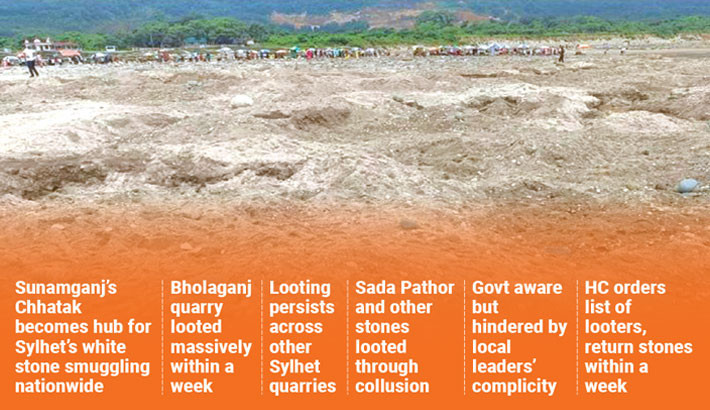
In the wake of massive looting over the past weeks, Sylhet authorities have launched a large-scale operation to recover the stones stolen from Bholaganj’s popular Sada Pathor tourist site and prevent further illegal extraction, but its effectiveness is under question as most stones are smuggled via rivers while the drive focuses on land routes.
“Without identifying the main route of white stone smuggling, the efforts will not be fruitful. It is not possible to recover the looted stones through the operation of the local administration of Sylhet alone,” said Abdul Hye Al-Hadi, chief coordinator of Save the Heritage and Environment.
Locals told the Daily Sun that looting of white stones, locally known as “Sada Pathor” from Bholaganj stone quarry has been going on since 5 August 2024 – following the fall of the previous Awami League government, but massive looting took place jus in a week this month.
The white stones extracted from the River Dholai are transported to Chhatak in Sunamganj via river networks, and from there supplied to different parts of the country through the Surma and other rivers.
River smuggling vs. land-focused enforcement
“Stone smuggling using land vehicles is generally less common in Bholaganj. The river route is predominantly used,” said Advocate Abdul Ahad, convener of the Greater Jaintia Unnoyon Parishad. Companiganj upazila is part of Greater Jaintia.
Looting is not confined to Bholaganj.
Stones are also being illegally extracted from quarries in Utmachhra, Jaflong, Bichhanakandi, and Lovachhorha, often with the backing of certain local political leaders.
Abdul Hye Al-Hadi, whose village lies near Jaflong quarry in Gowainghat upazila, told the Daily Sun that looting there has intensified recently, aided by influential locals.
“Lovachharha quarry in Kanaighat upazila is in a remote border area, so stone looting occurs daily,” said Talukdar Ahmed Masum, a resident of Bhalukmara village.
Md Abdul Awal, officer-in-charge of Kanaighat police station, added that law enforcement is active in preventing looting and has arrested suspects in previous raids.
Environmental and administrative concerns
Rights and environmental activists argue that after 5 August, the absence of police allowed illegal extraction to proliferate across Sylhet’s quarries, many of which are now nearly depleted after a year of unregulated looting.
Prof Dr Mohammad Zahirul Haque, vice-chancellor of Sylhet Metropolitan University, said: “After the political changeover, various natural and mineral resources, including stones and sand, have been looted in multiple areas of Sylhet.”
Sharif Jamil, coordinator of Waterkeepers Bangladesh and member secretary of Dhoritri Rokhhay Amra (DHORA), warned that Sylhet’s stones are “the raw money of looting” with multiple vested interests.
He added that environmental damage is certain, and a humanitarian disaster is increasingly likely.
The environment ministry had previously ordered a halt to mechanised stone extraction until a scientific study determined sustainable limits, but the directive was poorly enforced.
“Without government goodwill, it is difficult to save the quarries,” Jamil said. He described the recent Bholaganj looting as an “irreparable loss” and urged immediate identification and punishment of those responsible.
Local residents blame the authorities for inaction over months. “The local administration can’t avert responsibility for stone looting,” said Advocate Abdul Ahad.
Government records confirmed knowledge of the looting, yet enforcement lagged due to collusion with local political figures.
Legal measures and recovery efforts
In response, the Ministry of Power, Energy and Mineral Resources convened an inter-ministerial meeting on 27 April 2025 to discuss quarry management.
Environment Adviser Syeda Rizwana Hasan highlighted concerns over Sylhet’s quarries, including Bholaganj, and stressed the need for an action plan to develop tourism around these sites.
The interim government temporarily suspended leases for 17 of the country’s 51 quarries, but looting persisted in protected areas and tourist sites. Hasan told the Daily Sun that the activity continues with political collusion and criticised local journalists for failing to report the massive Bholaganj looting.
The High Court has now ordered authorities to compile a list of white stone looters and ensure the stones are returned to the Dholai River within seven days. T
he bench of Justice Zinat Haque and Justice Ainun Nahar Siddiqua issued the directive following a writ petition seeking swift legal action against those responsible for nearly a year of looting. A further hearing is scheduled for Sunday.
On Wednesday night, Sylhet district authorities announced five measures to recover looted stones, including 24-hour deployment of joint forces. Law enforcement has already detained some suspects and returned stones to the river.
Environmentalists warn that if illegal extraction continues unchecked, Sadapathor – a once-thriving tourist destination – could vanish entirely.
The reporter can be reached at: [email protected]
Edited by M Munir Hossain