


 For all latest news, follow the Daily Sun's Google News channel.


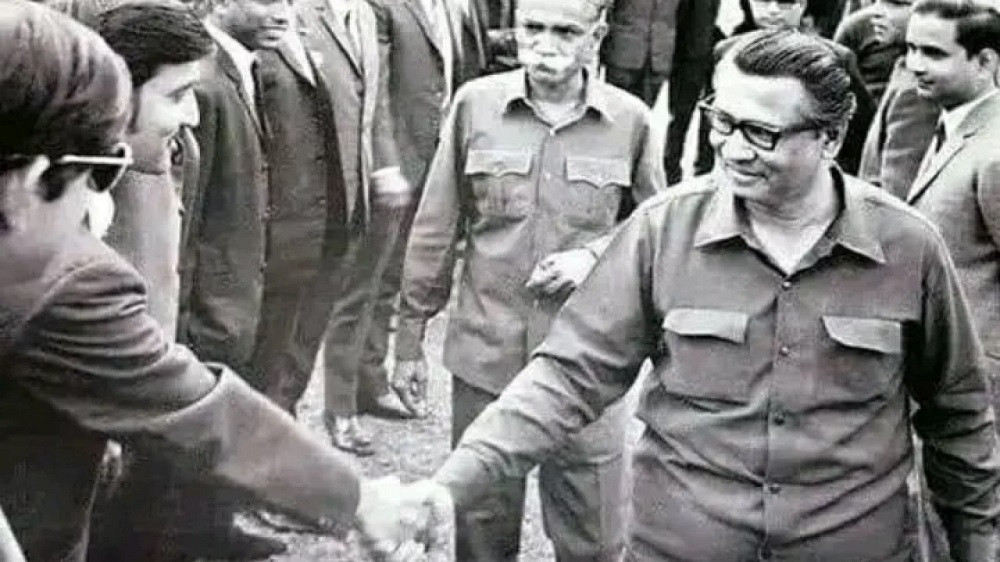
Bangladesh's wartime leader Tajuddin Ahmad | Photo: Collected
Among all the stalwarts who have led this country in the past, the name of Tajuddin Ahmad stands out due to his unique contributions. Being the architect and Prime Minister of the Mujibnagar government, he steered the ship of the newborn nation during the 1971 Liberation War when it had no map, no mast, and no captain. With his hard work and sacrifice, courage and sense of responsibility, and wisdom and farsightedness, he laid the administrative and ideological foundation of Bangladesh, leading the nine-month bloody war to achieve complete freedom amid intense opposition from different quarters from home and abroad.
His immense contributions and success made him an envy of others inside his party, Awami League, while his political opponents found no reason to recognise and appreciate a leader from a different stream to skip highlighting the history that glorifies the truth. The nation, too, showed a sign of suffering from amnesia in freeing national leaders from the tiny cage formed by political parties. And the result is that the birth centenary of Tajuddin Ahmad, one of the greatest sons of this nation, is being observed today without shedding light on his works and ideals through any national programme.
Tajuddin was born on 23 July 1925 as the second child of Maulavi Muhammad Yasin Khan and Meherunnesa Khanam at Dardaria village of Kapasia in Gazipur. He obtained 12th place in the matriculation examination and 4th position in the intermediate examination in the combined merit list of Pakistan, but didn't want to limit his brilliance in the academic sphere alone.
Instead of choosing a career aiming for mere personal benefits, he joined politics in his last years in school to prioritise people's wellbeing. A follower of Bengal Muslim League General Secretary Abul Hashim, Tajuddin was closely associated with Awami Muslim League, later Awami League, since its inception.
Be it the language movement of 1952, Jukta Front's victory in 1954's election, 1962's student movement against education commission report, 1966's drafting of Six Point, Mass Uprising of 1969 or Awami League's election win in 1970, he was one of the vital figures in all those glorious events of Bengalis' struggle for freedom.
In the process, he completed his BA honours in Economics and obtained LLB degree from the University of Dhaka, and became the youngest member of the legislative assembly, defeating Fakir Abdul Mannan, the then general secretary of the East Pakistan Muslim League, by a wide margin from his constituency in Gazipur.
Tajuddin Ahmad got married to Syeda Zohra Khatun in 1959, but politics gave him little chance to live a family life as he was arrested repeatedly. When Oli Ahad left the Awami League to join Mawlana Abdul Hamid Khan Bhasani's National Awami Party, he replaced him as the organising secretary of the party to popularise the nationalistic movement, and in 1966, he was elected the general secretary of the Awami League.
When a group of young economists explained the logic in favour of a proposed Six Point plan on regional autonomy to Sheikh Mujibur Rahman in a moonlit night of 1965 on a boat on the Sitalakhya River, skipping the prying eyes of Ayub Khan’s intelligence, Mujib was satisfied with their analysis, but it was Tajuddin who made the economists bound to clear everything in detail by throwing question after question.
In early 1966, when Zulfikar Ali Bhutto had offered Sheikh Mujibur Rahman a debate over the Six Points at the Paltan Maidan, a brilliant strategist Tajuddin accepted the challenge, though Bhutto did not turn up! But in March 1971, before the then-President Yahya Khan visited Dhaka for a discussion with Sheikh Mujib, Bhutto told him to watch out for Tajuddin.
From preparing different plans of programmes of the noncooperation movement to presenting crucial arguments during the discussion with the West Pakistani establishments, Tajuddin's role was instrumental.
When the Pakistan army attacked the unarmed civilians on 25 March 1971, it was Tajuddin who made his way across the border and contacted the then Indian Prime Minister Indira Gandhi.
With the help of the Indian government, he soon managed to gather all his party comrades and Bengali officers of the Pakistan government to form a wartime government on 10 April and take oath on 17 April 1971.
The following months were not smooth for him as he had to face at least two factions in the Awami League who felt uneasy about him. One group belonged to the rightist fraction led by Khandaker Mushtaq Ahmed, and another one of the young activists led by Sheikh Fazlul Haq Mani.
Both groups were unhappy about Tajuddin's leading role in the government as Prime Minister. Besides, Awami League leaders Abdur Rab Serniabat and Abdul Aziz also opposed him vehemently, inciting the young leaders of Mujib Bahini.
The socialist in Tajuddin was unwilling to cave in to fate. The intellectual in his being was prepared to withstand the onslaughts of the kind his fellow Awami Leaguers were throwing his way. Tajuddin remained calm, only thinking of the greater national interests.
A principled statesman, he dealt with the discontent in the Mujibnagar government, Muktibahini, and Awami League. Overcoming all these things, he managed everything from his limited resources and finally anchored the sheep of struggle to the shore of liberation.
In the post-Liberation War Bangladesh, Tajuddin Ahmad, as the Finance Minister, demonstrated a tremendous degree of courage in taking a development strategy for the country that did not have to include thoughts of aid from nations which had opposed its birth.
But the Mushtaq-Mani groups kept up their noisy complaints against him before Sheikh Mujib, and at one stage, his relations with Mujib was deteriorated and Tajuddin was asked to resign from the cabinet. When Mujib was assassinated along with most of his family members, Tajuddin was offered to join Khandaker Mushtaq's cabinet. But he refused the proposal despite knowing its outcome. And he was arrested and ultimately killed with three of his fellow Liberation War leaders while in prison on 3 November 1975.
Tajuddin Ahmad was a man of principles with qualities like self-effacement and extraordinary humility. Not many have been able to command the intellectual heights of political leadership that he so easily was symbolic of. Self-interest was never a part of his character. Self-denial mattered to him.
Tajuddin Ahmad and the birth of Bangladesh are interwoven. There is little argument with the thought that had he not been there, a very different kind of story could have been scripted for Bangladesh in 1971. But his immense contributions was not recognised or appreciated politically in the post-Liberation War years and he was systematically sidelined by his party and largely overlooked by the nation he helped birth.