


 For all latest news, follow the Daily Sun's Google News channel.


The thunder of missiles over Iran and Israel in June 2025 did more than signal another round of regional hostility—it exposed a deeper crisis of meaning in our global political order. The Israeli airstrikes that devastated over 100 sites in Iran, followed by Iran’s retaliatory missile attacks, were not sudden eruptions of irrational anger. They are the latest chapters in a history thick with asymmetries of power, uneven grief, and sanctioned impunity. In the name of “security,” Israel initiated a sweeping operation with devastating human consequences—over 200 Iranian lives lost, many more injured, and cities trembling under the weight of foreign firepower. Iran, a sanctioned and surveilled state with few diplomatic allies, responded with what it claimed was proportionate defence. In these deadly exchanges, the language of war once again overtook the language of justice, and the most crucial casualty became truth itself—not the operational truth of who struck first, but the deeper truth of whose suffering matters and whose does not.
Western discourse continues to moralise this crisis along predictable lines, painting Israel as a self-defending democracy and Iran as a rogue actor. Yet such narratives collapse under even modest scrutiny. Israel, an occupying power with nuclear capabilities and unwavering U.S. support, acts with an impunity no other regional power enjoys. It engages in assassinations, surveillance, preemptive bombings, and militarized policing across borders—often with the endorsement of the international community. Iran, despite its repressive governance and problematic policies, has also been the target of decades of external destabilization—from the 1953 Western-orchestrated coup to relentless economic sanctions. To suggest both nations are equally powerful actors in a symmetrical conflict is to erase the deep and deliberate architecture of global injustice. It is to ignore that power, like suffering, is unevenly distributed—and that silence from institutions like the UN or the EU often speaks louder than diplomacy itself.
This imbalance is not merely military or economic; it is epistemic. That is, the world decides whose fear is valid and whose resilience is suspect. When an Iranian hospital collapses under foreign attack, media coverage is sparse, fragmented, and sterilized. Yet when an Israeli city is struck—even in retaliation—the response is swift, emotionally charged, and morally conclusive. We have been conditioned to grieve selectively. The Israeli child crying in a bomb shelter is shown in slow-motion on television, while the Iranian mother weeping over rubble must find her voice in the margins. This disparity is not accidental—it is the product of decades of narrative domination, where colonial legacies shape not only borders but also headlines. And it is here that moral philosophy becomes indispensable, for it reminds us that no human life is worth more than another, and no suffering is made more sacred by geography or flag.
In light of this, we must resist the false binaries that dominate geopolitical discourse. To critique Israeli aggression is not to justify Iranian authoritarianism. To support the right of Iranians to live free from drone strikes is not to endorse their government’s repression. These are deliberately constructed traps, designed to paralyze moral clarity. True ethical responsibility demands nuance, but not neutrality. It requires us to listen to the silenced, to seek solidarity with civilians regardless of state, and to imagine a world where power does not determine visibility. In the words of Frantz Fanon, “Each generation must, out of relative obscurity, discover its mission, fulfil it, or betray it.” Ours is the mission of refusing to be numb, refusing to rank pain, refusing to let violence masquerade as inevitability. We must ask why so many have accepted the brutalization of Iranians, Palestinians, Syrians, and Yemenis as normal—but continue to treat certain borders, identities, and lives as inviolable.
What we are witnessing today is not only a crisis of diplomacy but a collapse of moral imagination. To normalize airstrikes as policy, and human death as strategic necessity, is to accept the dehumanization that sustains imperial power. As philosophers like Emmanuel Levinas and Judith Butler have argued, vulnerability is not weakness—it is what makes us human. The Iranian teenager whose internet has been cut off by the regime, the Israeli father terrified for his family’s safety, the Palestinian girl who has never known a day without fear—they are not footnotes to statecraft. They are the heart of it. Any political analysis that does not centre them is ethically bankrupt. This is the moment to reclaim conscience—not as a diplomatic tool, but as a revolutionary force. And perhaps, more radically, this is a moment to rethink the very structure of our global attention: what if we extended mourning to the unremarked, and extended policy not just from fear, but from care? What if states were measured not by how they retaliate, but by how they repair?
In truth, we live in a house already on fire. The smoke of past wars still lingers in our lungs, and yet we keep lighting new matches, forgetting that even stone will crack under relentless heat. If we do not find the courage to douse this cycle of vengeance with the water of empathy and justice, we will inherit not peace, but ash. The task before us is not just political; it is ethical and deeply human. Let us not speak of war as strategy but as tragedy—one that we can choose to rewrite. For now, the world stands like a tired orchard under a burning sky, each nation a tree scarred by fire, but still holding seeds of peace within. It is time we remembered how to plant.
_____________________________________
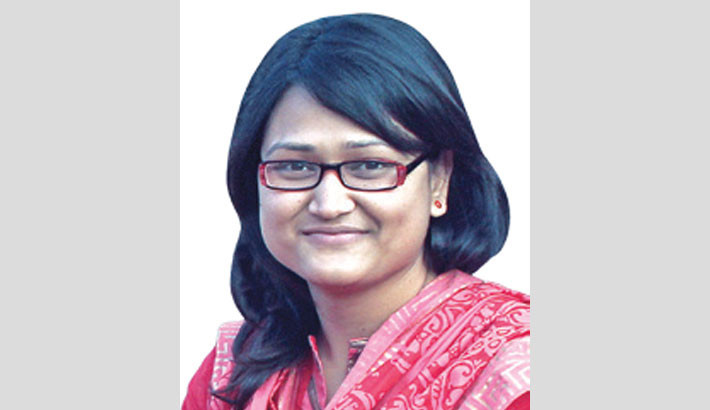
The writer is an Assistant Professor in the Department of Philosophy at IUBAT and pursuing a Master’s in Human Rights and Multiculturalism at University of South Eastern Norway