


 For all latest news, follow the Daily Sun's Google News channel.


There are moments in a nation’s history when time seems to hold its breath and when the past flickers in the rearview mirror and the future stands waiting at the edge of possibility. Bangladesh in 2025 finds itself in such a moment: suspended between unraveling and renewal, fragility and transformation. Bangladesh in 2025 stands not at a political junction but at a moral and structural crossroads, where the road ahead is fogged with uncertainty and the ground behind is cracked with history. The political tremor of August 2024, which shook the foundations of Sheikh Hasina’s long-standing regime, opened a moment of possibility— a rare clearing in the dense forest of partisan strife. In its place emerged an interim government led by Nobel Laureate Professor Muhammad Dr Yunus, whose globally admired legacy brought with it an aura of ethical restoration. Yet, almost a year on, that promise is tempered by the weight of inherited dysfunction. No ready blueprint awaited Dr Yunus—only a house with collapsed beams needing rescue and rebuilding. While civil society, youth leaders and segments of the diaspora continue to see him as a transitional healer; the slow, careful work of governance has proven more arduous than symbolic change.
At the heart of this transition lies a core dilemma: whether to rebuild institutions first or rush to elections and risk painting over cracks in the democratic architecture. Dr Yunus’ stance – prioritising reform over ballot – has found support among newer civic actors, including the National Citizen Party. But traditional players like the BNP have adopted the mantle of urgency, warning that extended transition could become a pretext for indefinite rule. Their rallies, especially those led by Amir Khasru Mahmud Chowdhury, have rekindled the old fire of street politics, demanding a swift return to electoral normalcy. The Army Chief’s call for elections by the end of 2025 reflects public fatigue, echoing impatience with a reform process that seems stalled in place. Critical areas such as judicial independence, decentralisation, and electoral framework remain entangled in political tug-of-war. These are not peripheral matters; they are the constitutional spine upon which democratic health depends. Yet, without resolving these, rushing to polls may simply resurrect the ghosts the uprising tried to bury.
Meanwhile, the social cost of political limbo is mounting. Law and order has become a brittle thread, fraying under pressure. Dhaka has witnessed a surge in public violence, from daylight robberies to targeted killings, circulated widely through viral CCTV footage that doubles as a visual index of institutional fatigue. In such moments, governance must be more than rhetoric—it must perform legitimacy. And this is where Dr Yunus’ approach stands apart. Unlike regimes that responded to unrest with repression, his strategy has been one of dialogue over crackdown and repair over retaliation. Drawing on philosophies like Axel Honneth’s theory of recognition, Dr Yunus has sought to humanise state-citizen relations, framing dignity not just as safety from harm but as mutual respect and social esteem. His emphasis on transparent policing and institutional accountability reflects a deeper belief that security cannot be restored by fear alone but by restoring trust in the idea of the state.
This ethos also extends to the economy, where the threads holding Bangladesh’s garment-driven growth are beginning to unravel. The ready-made garment (RMG) sector, the country’s primary export engine, is grappling with strikes, port delays, and discontented labour. A six-day customs officers’ strike at Chattogram port created supply chain chaos, signalling how fragile the system has become. As global buyers drift towards Vietnam and India, Bangladesh’s competitive edge is at risk of dulling beyond repair. Yet again, Dr Yunus offers not a populist quick fix but a structural rethinking: inclusive capitalism, ethical labour practices and social business as a pathway to resilient, fair growth. His economic vision echoes global justice thinkers like Thomas Pogge, who remind us that institutions must be measured not by what they promise but by how they prevent systemic harm. In a time when numbers dominate national discourse, Dr Yunus insists that metrics must be matched with meaning.
What Bangladesh needs now is more than a new election date or an industrial policy; it needs a recalibrated political imagination. The interim period is not just about filling the vacuum left by a toppled regime, but about constructing a new vocabulary for leadership and legitimacy. Dr Yunus’ leadership offers a rare moral reservoir in this context. Unbound by party loyalties and electoral compulsions, he can act as a moral bridge-builder, navigating between competing forces with deliberative patience. But his role must not be misread as that of a placeholder. If democracy is to be more than ritual, and governance more than reaction, his model of communicative politics rooted in recognition, responsibility and reform offers a compass for the journey ahead. As the country stands at this crossroads, the choice is no longer between past and future, but between expedience and ethical endurance. Dr Yunus cannot answer this alone. But under his guidance, Bangladesh may yet learn to walk forward not out of fear of the past, but out of faith in a shared future. It is this faith – quiet, unglamorous and patiently cultivated – that could become the seed of a new republic. And that seed, if nurtured wisely, may grow into a tree of democratic resilience, capable of withstanding the storms that history is certain to bring again.
_____________________________________
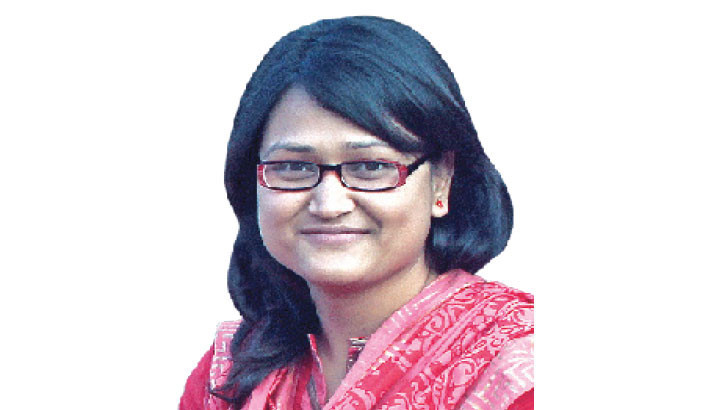
The writer is an Assistant Professor in the Department of Philosophy at IUBAT and pursuing a Masters in Human Rights and Multiculturalism at University of South Eastern Norway