


 For all latest news, follow the Daily Sun's Google News channel.


Dhaka does not sleep. It does not slow down. From the pre-dawn shuffle of rickshaw pullers to the midnight throb of traffic lights on dust-heavy roads, the capital of Bangladesh pulses forward. It is a city constantly trying to modernise, expand and rise. But in this breathless momentum, something vital is being overlooked: the ethics of dwelling. Philosopher Henri Lefebvre once wrote of “the right to the city”—not merely as access to infrastructure, but as the right to participate in shaping urban life. In Dhaka’s present form, however, this right feels unequally distributed. The everyday rhythms of the vulnerable—those who walk slowly, rest often or fall behind—are smothered by a model of development that privileges acceleration over attentiveness.
Here, time itself becomes a currency, and those without it are left behind. In a city where buses arrive overflowing and sidewalks disappear under construction debris, the daily act of getting from one place to another becomes a silent negotiation with exhaustion. These are not just inconveniences; they are structural denials of dignity. Take the example of Rehana, a 70-year-old woman in Mirpur, who has not visited her local market in months. Or Jhuma, a 19-year-old garment worker whose four-hour commute costs her sleep and safety. Their stories are not statistical footnotes—they are critiques of an urban fabric, that fails to recognise dependence, care and slowness as integral characteristics to public life. Scholars like Joan Tronto and Berenice Fisher remind us that just societies are built on recognising interdependence, not denying it. Yet, Dhaka continues to idolise autonomy and speed, forgetting that most of life, especially the most meaningful parts, is lived in the slow, the shared and the interdependent.
This denial extends to the air, the water and the disappearing green. Environmental degradation in Dhaka is not just an ecological issue but a sensory and emotional one. Philosopher Glenn Albrecht calls it “solastalgia,” the pain experienced when one’s home environment changes in ways that feel distressing. For many in Dhaka, this is no abstraction. It is the taste of lead in drinking water, the grey sky that thickens lungs, the vanishing rivers that once held the city’s cultural memory. In a world of climate precarity, Dhaka’s condition is a warning—an intimate, lived experience of what happens when the right to breathe and belong is compromised by unchecked urban expansion. When we lose the right to a breathable world, we lose more than comfort—we lose the relational threads that make places liveable, lovable and worth defending.
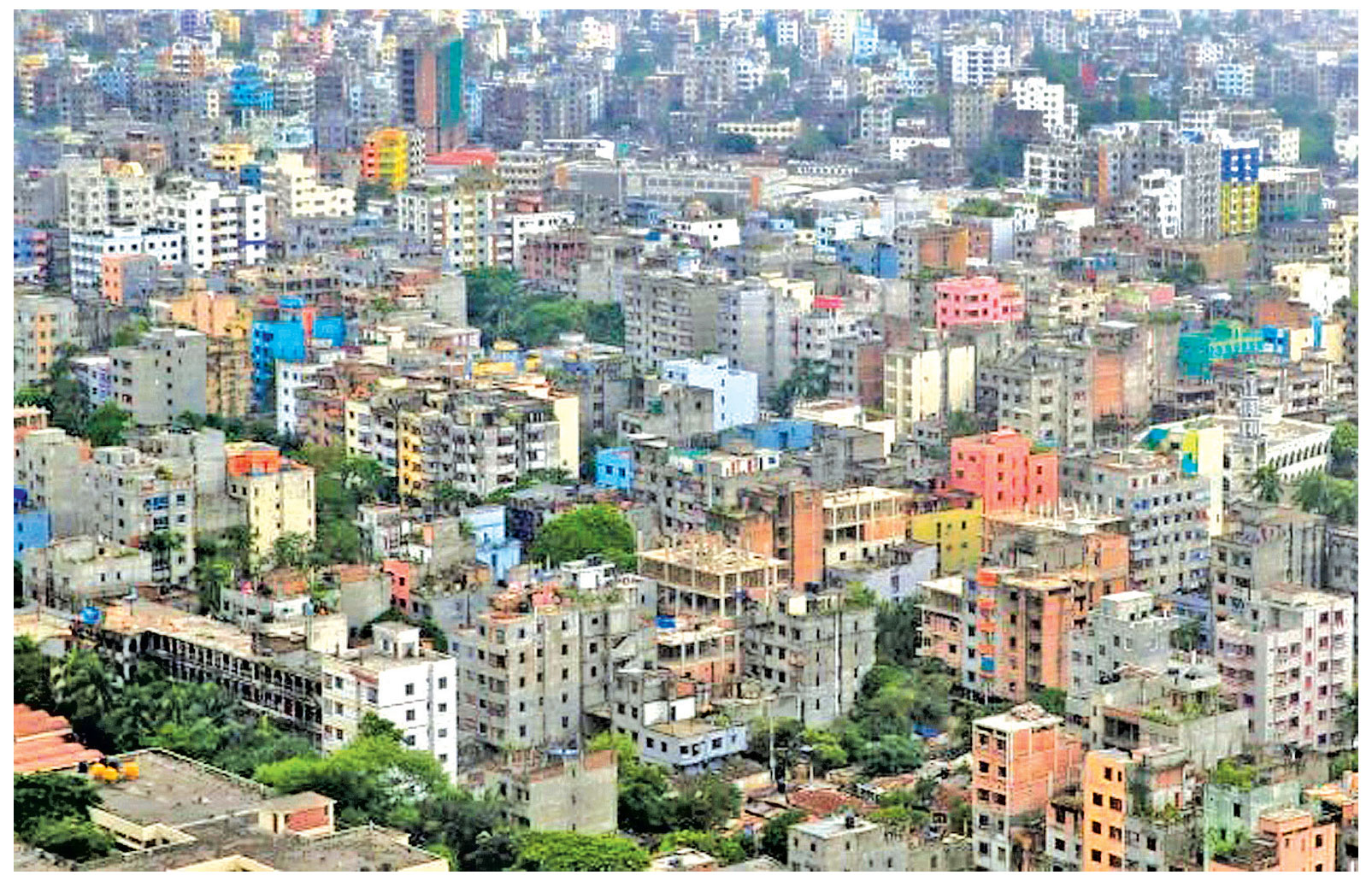
What’s most striking, however, is the normalisation of all this. Exhaustion is expected. Noise is absorbed. Danger is adapted to. Philosopher Byung-Chul Han warns us that in hyper-functionalist societies, individuals internalise systemic failure as personal fatigue. In Dhaka, you see this in the quiet resignation on the faces of those who wait in traffic, who tolerate injustice not out of apathy but necessity. The city trains its people to endure but seldom to demand. Yet resistance does not always need banners—it can begin with asking: why must dignity be so hard to come by in the everyday? Why should a child need to risk their breath to get to school? Why should an elder shrink their life because the city refuses to see them?
And yet, despite the weight of these questions, I believe there is hope. A future that can still be ours—if we rethink what we value. A city is more than roads and regulations; it is a moral landscape. To reimagine Dhaka, we must embrace the idea that slowness, softness and shared vulnerability are not hindrances to progress but the very conditions for ethical coexistence. What if public transport was built not just to move bodies, but to affirm their worth? What if urban planning was less about control and more about care? What if city lights were not just symbols of ambition, but beacons of belonging? A just Dhaka does not need to pause its dreams—but it must dream differently: not for speed, but for solidarity. Because the most enduring cities are not those that outpace time, but those that make space for everyone to arrive.
Perhaps this is the actual task before us, not merely to endure or escape but to imagine. To imagine a city that listens. One where roads remember the weight of tired feet, where street corners offer pause rather than peril, and where green spaces do not vanish under ambition but bloom as acts of care. A city where growth does not demand forgetting of history, of slowness, of one another. Dhaka, in all its noise and urgency, is not without love. But that love must learn to linger. In the hush beneath its chaos, the city seems to whisper—as if recalling something long buried: “Come to my city, into the purposeless crowd of untold stories.” This line, translated from a haunting Bengali song by the famous Bangladeshi musical band— Meghdol, feels less like an invitation and more like a plea. Because, perhaps this is what Dhaka has always been—a city of unfinished sentences, of everyday people pressed between pages never turned. And maybe, just maybe, to stop and listen is to begin again. If we choose to walk it differently together, a future that can still be ours.
_____________________________________
The writer is an Assistant Professor in the Department of Philosophy at IUBAT and pursuing a Masters in Human Rights and Multiculturalism at University of South Eastern Norway