


 For all latest news, follow the Daily Sun's Google News channel.


‘Tariff hike driven by false allegations’
Bangladeshi garments are largely made from American cotton, making them more deserving of tariff relief rather than punitive hikes.
Daily Sun Report, Dhaka
Published: 04 Apr 2025, 08:58 AM
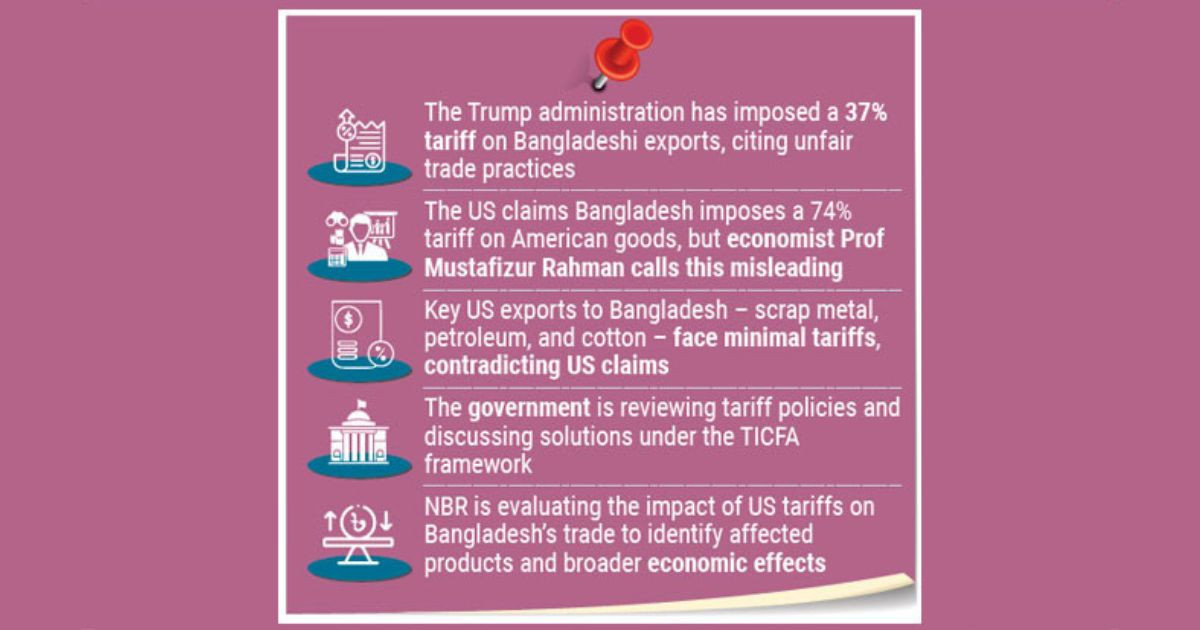
The Trump administration has imposed a steep 37% tariff on Bangladeshi exports to the United States, citing what it claims are unfair trade barriers. However, leading economist Prof Mustafizur Rahman has dismissed these allegations as misleading, arguing that Bangladesh imposes far lower tariffs on US goods than Washington suggests.
Mustafizur, a distinguished fellow at the Centre for Policy Dialogue (CPD), pointed out that Bangladesh’s major imports from the US include scrap metal, petroleum products, and cotton – none of which face excessive tariffs.
He emphasised that Bangladeshi garments, which dominate the country’s exports to the US, are largely made from American cotton, making them more deserving of tariff relief rather than punitive hikes.
“The claim that Bangladesh imposes a 74% tariff on US goods is highly misleading,” he said. “In reality, our tariffs on American imports are much lower. Moreover, Washington itself has policies to ease tariffs on foreign products made using US raw materials. By that logic, Bangladeshi apparel should qualify for reduced tariffs, not higher ones.”
Mustafizur also addressed US concerns over Bangladesh’s currency exchange policies, saying that while there were previous interventions, the country’s central bank has since aligned exchange rates with market forces. “The current taka-dollar exchange rate is now in line with market dynamics,” he noted.
He urged Bangladesh to engage in discussions under the Trade and Investment Cooperation Forum Agreement (TICFA) to address these trade disputes and clear up misconceptions.
Trump imposes ‘reciprocal’ 37% tariff on Bangladeshi products
The United States has imposed a 37% tariff on imports from Bangladesh as part of President Donald Trump’s new “Reciprocal Tariffs” policy. The move, announced on Wednesday night, primarily affects ready-made garments, which constitute the majority of Bangladesh’s exports to the US.
According to a chart published by the White House, the US government claims that Bangladesh imposes a 74% tariff on American goods. In response, Washington has introduced a “discounted reciprocal tariff” of 37% on Bangladeshi products entering the US market.
The policy is part of Trump’s “Liberation Day” initiative, which aims to counter what his administration describes as unfair trade practices by nations maintaining high barriers against US exports. A baseline 10% tariff will be applied to all imports, with significantly higher rates imposed on countries accused of currency manipulation, protectionism, or other non-tariff barriers.
The announcement has raised concerns in Bangladesh, whose economy heavily depends on exports to the US – its single largest export market. Industry leaders in Dhaka warn that such steep tariffs could undermine Bangladesh’s competitive advantage.
Bangladesh reviewing tariffs on us imports
The Bangladesh government is reviewing its tariff policies on US imports, according to Chief Adviser’s Press Secretary Shafiqul Alam.
Writing on Facebook on Thursday, Shafiqul stated that the National Board of Revenue (NBR) is considering options for tariff rationalisation to address the matter.
“The US is a key trade partner and Bangladesh’s largest export destination. We have been working with the Trump administration to enhance trade and investment ties, and we hope our ongoing discussions will help resolve the tariff issue,” he added.
NBR analysing impact of US tariffs on trade
The National Board of Revenue (NBR) has launched a study to assess the impact of the new US tariffs on Bangladesh’s trade, said NBR Chairman Abdur Rahman Khan on Thursday, adding that the research would identify the most affected products and evaluate the extent of duties imposed.
“We are in the research phase, examining which US imports to Bangladesh are subject to tariffs and how different products are affected,” he told a national English-language daily.
Abdur Rahman emphasised the need for thorough analysis before making any policy decisions. “We are considering multiple factors, including product categories, duty rates, and the impact of quota restrictions,” he said.
A high-level meeting has been scheduled for Sunday to review the findings and develop a strategic response. “This is a global issue, and we are also monitoring how neighbouring countries are reacting to similar tariff measures,” he noted.
Addressing the claim that Bangladesh imposes a 74% tariff on US products, the NBR chairman said, “We are verifying these figures. It is likely that only a few high-tariff items were highlighted to produce this figure.”
He explained that tariff calculations include various components, such as customs duty, supplementary duty, advance tax, advance income tax, and advance trade VAT, which collectively contribute to the total tax incidence.