


 For all latest news, follow the Daily Sun's Google News channel.


Bangladesh politics: Democratic or dynastic?
Md Yeasir Arafat
Published: 02 Mar 2025, 10:32 AM
Democracy, as described by Lord Bryce, is a system where the ruling power of a state is vested in the people as a whole rather than in a specific class or group. Abraham Lincoln echoed a similar sentiment, defining democracy as “government of the people, by the people, for the people.” However, in developing nations like Bangladesh, democracy faces significant challenges. John Stuart Mill highlighted three essential conditions for democracy to succeed including: a. willingness to accept democracy, b. commitment to performing democratic duties, and c. the ability to comprehend democratic principles. In Bangladesh, these conditions are not fully met due to a lack of proper democratic education, widespread political illiteracy and a culture of blind loyalty towards political families. These factors have allowed a handful of elite families to monopolise political power, making it difficult for competent and visionary leaders to emerge.
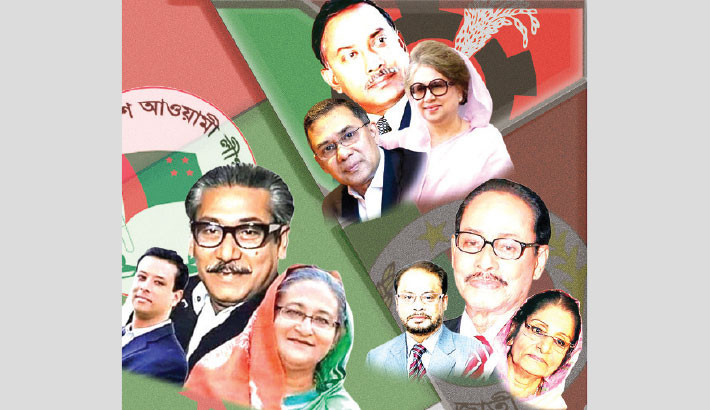
Bangladesh’s political landscape is dominated by three major parties, each controlled by influential political families. The Awami League, led by Sheikh Hasina, has remained under the control of the Mujib family since the country’s independence. Sheikh Hasina, the daughter of Sheikh Mujibur Rahman, has been at the helm of the party since 1981. Her leadership remains largely unchallenged within the party, making it difficult for alternative leaders to rise.
The Bangladesh Nationalist Party (BNP) follows a similar pattern, where leadership has remained within the Zia family. Founded by Ziaur Rahman, the party later came under the leadership of his wife, Khaleda Zia. Today, their son Tarique Rahman serves as the party’s acting chairman, despite being in exile. This dynastic control has restricted internal party democracy and blocked the rise of new leaders who might bring fresh ideas to the political landscape.
The Jatiya Party, founded by General Hussain Muhammad Ershad, is another example of family-based political dominance. After Ershad’s death, his brother GM Quader took over leadership, while his wife Raushon Ershad has also remained a significant political figure. Leadership disputes within the party have largely remained within the Ershad family, ensuring that control does not shift beyond their inner circle.
The dominance of political families in Bangladesh has led to a system where leadership is passed down as an inheritance rather than earned through merit. This lack of meritocracy prevents competent individuals from rising within political parties, as positions are often reserved for family members or those with close ties to ruling dynasties. As a result, many talented leaders with the potential to bring meaningful change are either sidelined or discouraged from entering politics altogether.
Another major issue is the suppression of dissent within political parties. Anyone who challenges family dominance is often removed from influential positions or forced out of the party. This lack of internal democracy weakens the political system, as it discourages open debate and innovation in governance. The cult of personality surrounding political families further exacerbates the problem. Many citizens continue to vote based on loyalty to a family name rather than evaluating a leader’s competence, policies or vision. This dynamic creates an electoral system that rewards legacy over leadership.
Additionally, the concentration of power within a few families fosters corruption and nepotism. When leadership is inherited rather than earned, governance becomes less about serving the public and more about maintaining control. Public resources, government contracts and key positions are often distributed based on political loyalty rather than capability, weakening democratic institutions in the process. Instead of strengthening independent bodies like the judiciary or the election commission, ruling families often seek to exert control over them to secure their dominance.
To break this cycle, internal democracy within political parties must be strengthened. Leadership positions should be determined through fair and transparent elections rather than being passed down through family ties. Political education is also crucial in ensuring that voters make informed decisions based on a leader’s competence rather than blind loyalty. Schools, universities and civil society organisations should actively promote democratic values and critical thinking.
A stronger and more independent election commission is essential in ensuring fair elections that allow new leaders to emerge without interference from dominant political families. Legal reforms, such as term limits or restrictions on direct family succession in political parties, could also help reduce dynastic control. Many democratic nations have implemented measures to prevent political monopolisation by a single family, and Bangladesh could benefit from similar reforms.
Encouraging young leaders to enter politics is another key step towards breaking this cycle. Political parties must create platforms that allow emerging leaders to rise based on merit, skill and vision rather than familial connections. Without fresh leadership, the country risks stagnation, as new ideas and perspectives are continually suppressed.
Bangladesh’s democracy is hindered by the deep-rooted dominance of political dynasties. As long as leadership remains concentrated within a few families, the country will struggle to achieve true democratic progress. Worthy, competent and visionary leaders are continuously overlooked, preventing meaningful reform and innovation in governance. To move towards a more democratic future, systemic changes must be made to ensure that leadership is determined by merit rather than inheritance. Only then can Bangladesh build a political system that truly serves its people, allowing democracy to function as it was originally intended.
The writer is a student at Department of Political Science, University of Rajshahi